Centre for Infectious Diseases, School of Biomedical Sciences, College of Medicine and Veterinary Medicine, The University of Edinburgh, Edinburgh, United Kingdom.
PLoS Negl Trop Dis. 2011 Jan 18;5(1):e941. doi: 10.1371/journal.pntd.0000941.
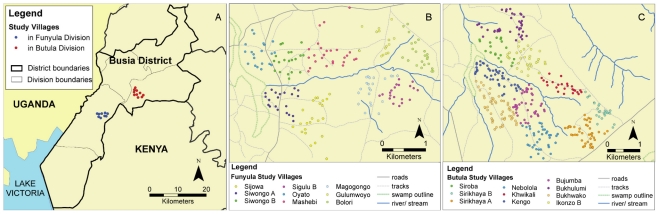
Trypanosomiasis is regarded as a constraint on livestock production in Western Kenya where the responsibility for tsetse and trypanosomiasis control has increasingly shifted from the state to the individual livestock owner. To assess the sustainability of these localised control efforts, this study investigates biological and management risk factors associated with trypanosome infections detected by polymerase chain reaction (PCR), in a range of domestic livestock at the local scale in Busia, Kenya. Busia District also remains endemic for human sleeping sickness with sporadic cases of sleeping sickness reported.
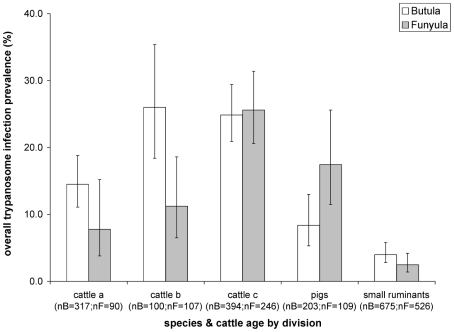
In total, trypanosome infections were detected in 11.9% (329) out of the 2773 livestock sampled in Busia District. Multivariable logistic regression revealed that host species and cattle age affected overall trypanosome infection, with significantly increased odds of infection for cattle older than 18 months, and significantly lower odds of infection in pigs and small ruminants. Different grazing and watering management practices did not affect the odds of trypanosome infection, adjusted by host species. Neither anaemia nor condition score significantly affected the odds of trypanosome infection in cattle. Human infective Trypanosoma brucei rhodesiense were detected in 21.5% of animals infected with T. brucei s.l. (29/135) amounting to 1% (29/2773) of all sampled livestock, with significantly higher odds of T. brucei rhodesiense infections in T. brucei s.l. infected pigs (OR = 4.3, 95%CI 1.5-12.0) than in T. brucei s.l. infected cattle or small ruminants.
Although cattle are the dominant reservoir of trypanosome infection it is unlikely that targeted treatment of only visibly diseased cattle will achieve sustainable interruption of transmission for either animal infective or zoonotic human infective trypanosomiasis, since most infections were detected in cattle that did not exhibit classical clinical signs of trypanosomiasis. Pigs were also found to be reservoirs of infection for T. b. rhodesiense and present a risk to local communities.
在肯尼亚西部,旋毛虫病被认为是畜牧业生产的一个制约因素,在那里,采采蝇和锥虫病的控制责任越来越多地从国家转移到个体牲畜所有者身上。为了评估这些本地化控制工作的可持续性,本研究在肯尼亚布西亚地区,从当地规模上调查了与聚合酶链反应(PCR)检测到的锥虫感染相关的生物学和管理风险因素,涉及一系列家养牲畜。布西亚区仍然是人感染昏睡病的地方病疫区,有散发病例报告。
在布西亚区采集的 2773 头牲畜中,共有 11.9%(329 头)检测到锥虫感染。多变量逻辑回归显示,宿主物种和牛龄影响总体锥虫感染,18 个月以上的牛感染的可能性显著增加,而猪和小反刍动物感染的可能性显著降低。不同的放牧和饮水管理措施,在调整宿主物种后,并不影响锥虫感染的几率。牛的贫血或状况评分均不显著影响锥虫感染的几率。在感染 T. brucei s.l.的动物中,检测到 21.5%(29/135)的动物感染了人类感染性的布氏锥虫布鲁斯亚种,占所有采样牲畜的 1%(29/2773),与感染 T. brucei s.l.的牛或小反刍动物相比,感染 T. brucei s.l.的猪感染 T. brucei rhodesiense的几率显著更高(OR=4.3,95%CI 1.5-12.0)。
尽管牛是锥虫感染的主要宿主,但仅对明显患病的牛进行靶向治疗不太可能实现动物感染性或人类感染性锥虫病传播的可持续中断,因为大多数感染是在没有明显锥虫病临床症状的牛中检测到的。还发现猪是 T. b. rhodesiense的感染源,对当地社区构成威胁。