Department of Bioscience, Faculty of Applied Bioscience, Tokyo University of Agriculture, Tokyo 156-8502, Japan.
Mol Brain. 2011 Feb 11;4:9. doi: 10.1186/1756-6606-4-9.
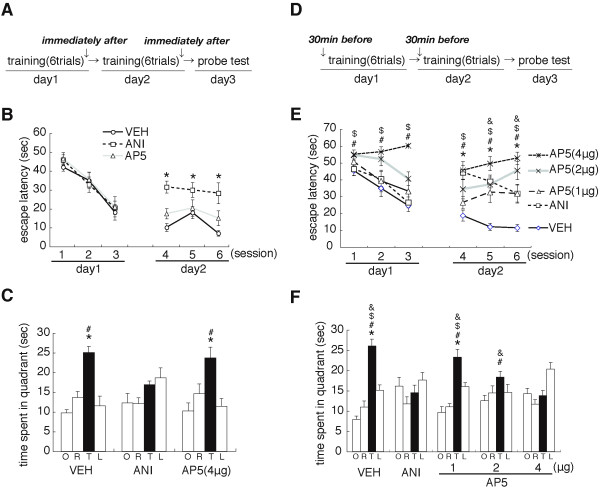
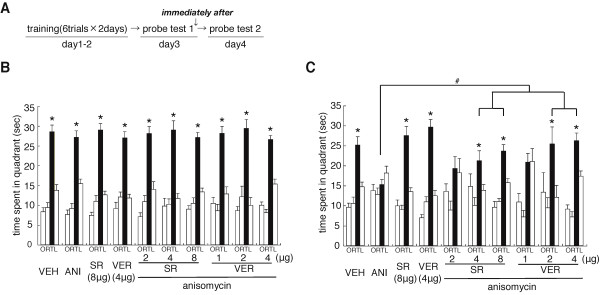
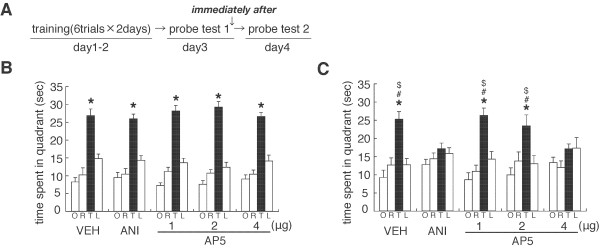
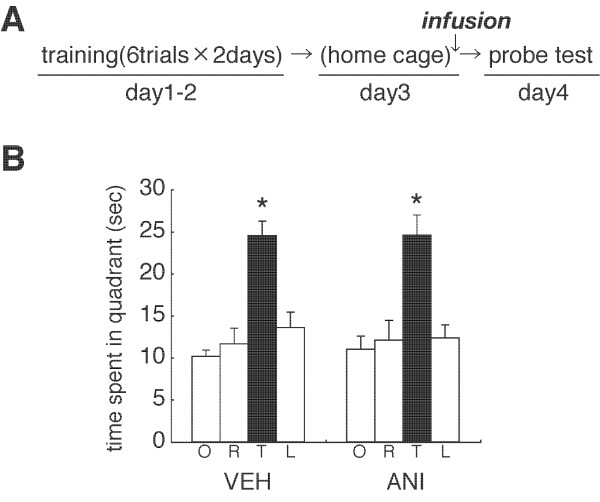
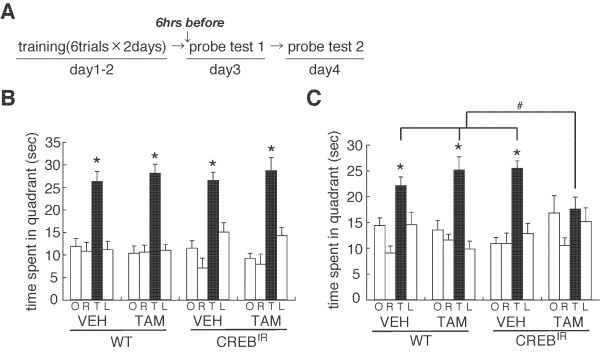
Memory retrieval is not a passive process. Recent studies have shown that reactivated memory is destabilized and then restabilized through gene expression-dependent reconsolidation. Molecular studies on the regulation of memory stability after retrieval have focused almost exclusively on fear memory, especially on the restabilization process of the reactivated fear memory. We previously showed that, similarly with fear memories, reactivated spatial memory undergoes reconsolidation in the Morris water maze. However, the underlying molecular mechanisms by which reactivated spatial memory is destabilized and restabilized remain poorly understood. In this study, we investigated the molecular mechanism that regulates the stability of the reactivated spatial memory.
We first showed that pharmacological inactivation of the N-methyl-D-aspartate glutamate receptor (NMDAR) in the hippocampus or genetic inhibition of cAMP-responsible element binding protein (CREB)-mediated transcription disrupted reactivated spatial memory. Finally, we showed that pharmacological inhibition of cannabinoid receptor 1 (CB1) and L-type voltage gated calcium channels (LVGCCs) in the hippocampus blocked the disruption of the reactivated spatial memory by the inhibition of protein synthesis.
Our findings indicated that the reactivated spatial memory is destabilized through the activation of CB1 and LVGCCs and then restabilized through the activation of NMDAR- and CREB-mediated transcription. We also suggest that the reactivated spatial memory undergoes destabilization and restabilization in the hippocampus, through similar molecular processes as those for reactivated contextual fear memories, which require CB1 and LVGCCs for destabilization and NMDAR and CREB for restabilization.
记忆提取不是一个被动的过程。最近的研究表明,被重新激活的记忆通过依赖基因表达的再巩固而变得不稳定,然后再稳定下来。关于提取后记忆稳定性的调控的分子研究几乎完全集中在恐惧记忆上,尤其是在重新激活的恐惧记忆的再稳定过程上。我们之前的研究表明,与恐惧记忆类似,被重新激活的空间记忆在 Morris 水迷宫中经历再巩固。然而,被重新激活的空间记忆被破坏和再稳定的潜在分子机制仍知之甚少。在这项研究中,我们研究了调节被重新激活的空间记忆稳定性的分子机制。
我们首先表明,在海马体中药理学失活 N-甲基-D-天冬氨酸谷氨酸受体(NMDAR)或遗传抑制 cAMP 反应元件结合蛋白(CREB)介导的转录会破坏被重新激活的空间记忆。最后,我们表明,在海马体中药理学抑制大麻素受体 1(CB1)和 L 型电压门控钙通道(LVGCCs)会阻断蛋白合成抑制对被重新激活的空间记忆的破坏。
我们的研究结果表明,被重新激活的空间记忆通过激活 CB1 和 LVGCCs 而变得不稳定,然后通过激活 NMDAR 和 CREB 介导的转录而重新稳定。我们还表明,被重新激活的空间记忆在海马体中经历了失稳和再稳定,通过与重新激活的上下文恐惧记忆相似的分子过程,需要 CB1 和 LVGCCs 进行失稳,而需要 NMDAR 和 CREB 进行再稳定。