Program on Prevention Outcomes and Practices, Stanford Prevention Research Center, Stanford School of Medicine, Stanford, CA, USA.
BMC Public Health. 2011 Feb 14;11:98. doi: 10.1186/1471-2458-11-98.
Obesity exerts an enormous health impact through its effect on coronary heart disease and its risk factors. Primary care-based and community-based intensive lifestyle counseling may effectively promote weight loss. There has been limited implementation and evaluation of these strategies, particularly the added benefit of community-based intervention, in low-income Latino populations.
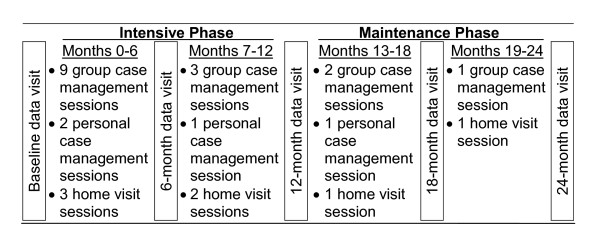
The Vivamos Activos Fair Oaks project is a randomized clinical trial designed to evaluate the clinical and cost-effectiveness of two obesity reduction lifestyle interventions: clinic-based intensive lifestyle counseling, either alone (n = 80) or combined with community health worker support (n = 80), in comparison to usual primary care (n = 40). Clinic-based counseling consists of 15 group and four individual lifestyle counseling sessions provided by health educators targeting behavior change in physical activity and dietary practices. Community health worker support includes seven home visits aimed at practical implementation of weight loss strategies within the person's home and neighborhood. The interventions use a framework based on Social Cognitive Theory, the Transtheoretical Model of behavior change, and techniques from previously tested lifestyle interventions. Application of the framework was culturally tailored based on past interventions in the same community and elsewhere, as well as a community needs and assets assessment. The interventions include a 12-month intensive phase followed by a 12-month maintenance phase. Participants are obese Spanish-speaking adults with at least one cardiovascular risk factor recruited from a community health center in a low-income neighborhood of San Mateo County, California. Follow-up assessments occur at 6, 12, and 24 months for the primary outcome of percent change in body mass index at 24 months. Secondary outcomes include specific cardiovascular risk factors, particularly blood pressure and fasting glucose levels.
If successful, this study will provide evidence for broad implementation of obesity interventions in minority populations and guidance about the selection of strategies involving clinic-based case management and community-based community health worker support.
ClinicalTrials.gov: NCT01242683.
肥胖通过其对冠心病及其危险因素的影响,对健康造成巨大影响。基于初级保健和社区的强化生活方式咨询可能会有效地促进体重减轻。在低收入拉丁裔人群中,这些策略的实施和评估有限,特别是社区干预的额外益处。
Vivamos Activos Fair Oaks 项目是一项随机临床试验,旨在评估两种减肥生活方式干预措施的临床和成本效益:诊所为基础的强化生活方式咨询,单独使用(n = 80)或与社区卫生工作者支持联合使用(n = 80),与常规初级保健相比(n = 40)。诊所咨询包括 15 个小组和四个个人生活方式咨询课程,由健康教育者提供,针对身体活动和饮食实践中的行为改变。社区卫生工作者的支持包括七次家访,旨在在个人家庭和社区内实际实施减肥策略。干预措施使用基于社会认知理论、行为改变的跨理论模型以及先前经过测试的生活方式干预措施的技术的框架。该框架的应用基于同一社区和其他地方的过去干预措施以及社区需求和资产评估进行了文化调整。干预措施包括为期 12 个月的强化阶段和为期 12 个月的维持阶段。参与者是从加利福尼亚州圣马特奥县一个低收入社区的社区卫生中心招募的肥胖、讲西班牙语且至少有一种心血管危险因素的成年人。在 24 个月时,主要结局是 24 个月时体重指数的百分比变化,进行 6、12 和 24 个月的随访评估。次要结局包括特定的心血管危险因素,特别是血压和空腹血糖水平。
如果成功,这项研究将为在少数民族人群中广泛实施肥胖干预措施提供证据,并为选择涉及诊所为基础的病例管理和社区为基础的社区卫生工作者支持的策略提供指导。
ClinicalTrials.gov:NCT01242683。