International Institute of Molecular and Cell Biology, Warsaw, Poland.
Exp Cell Res. 2011 May 1;317(8):1093-107. doi: 10.1016/j.yexcr.2011.02.002. Epub 2011 Feb 19.
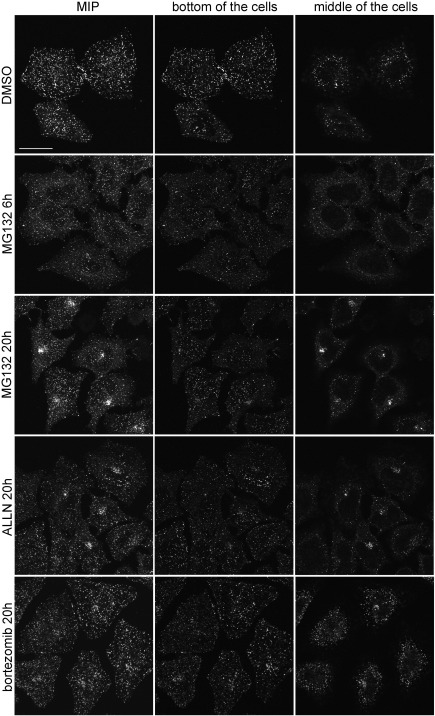
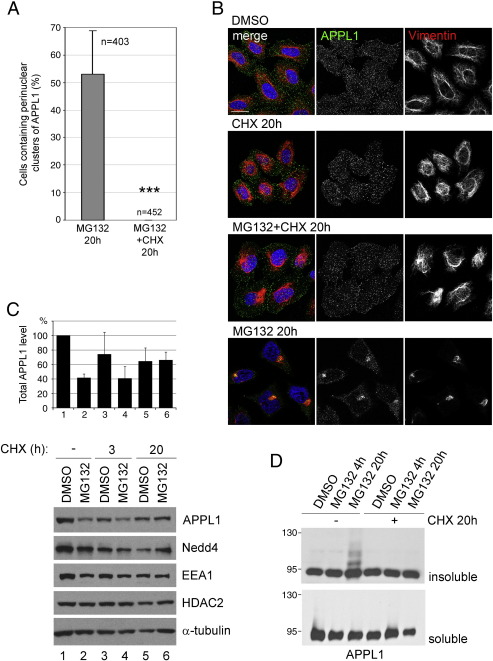
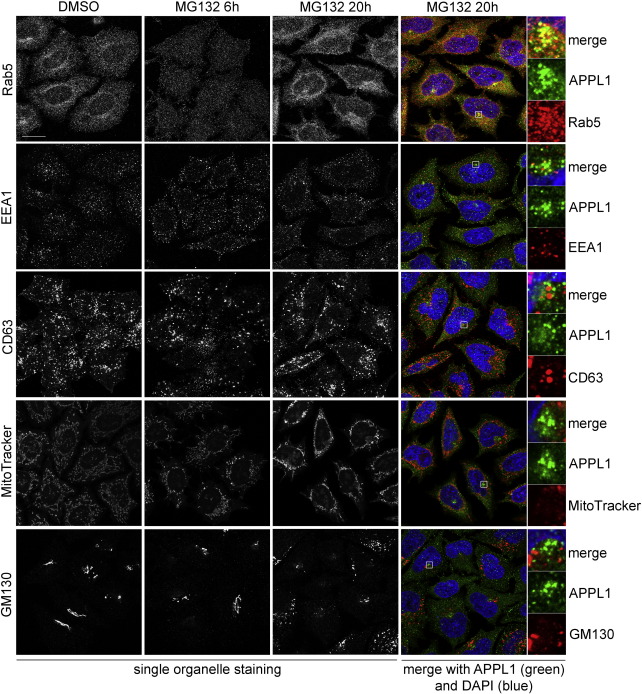
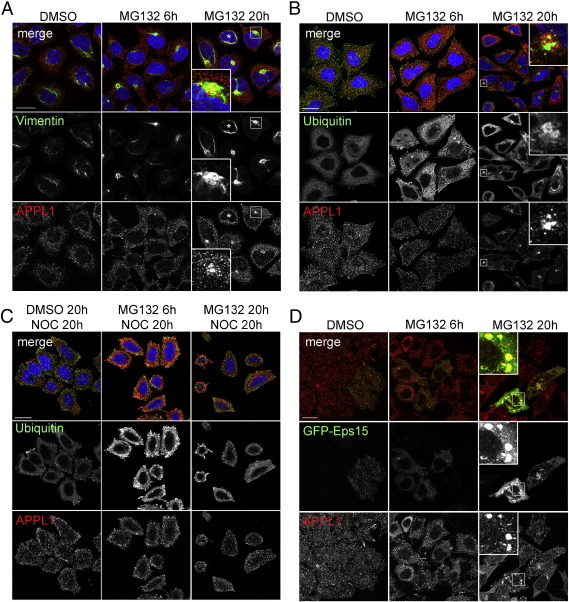
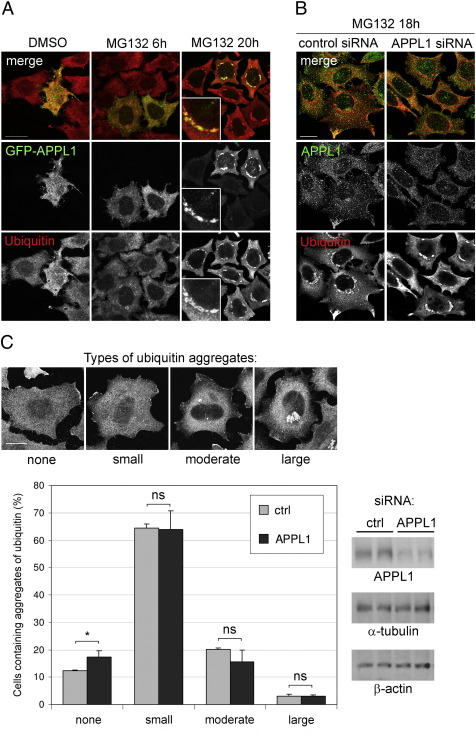
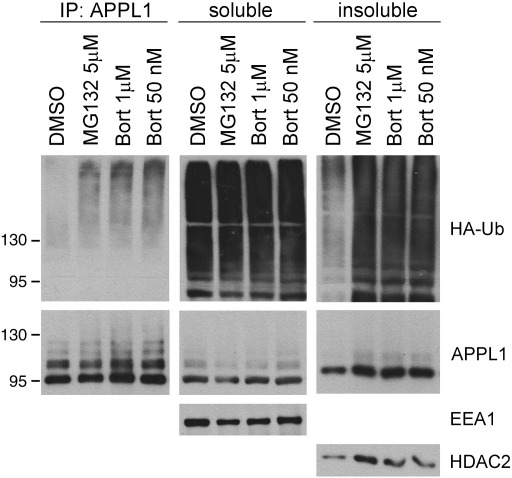
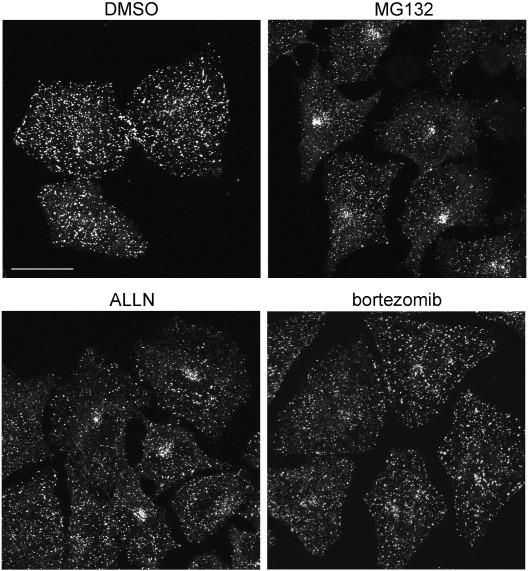
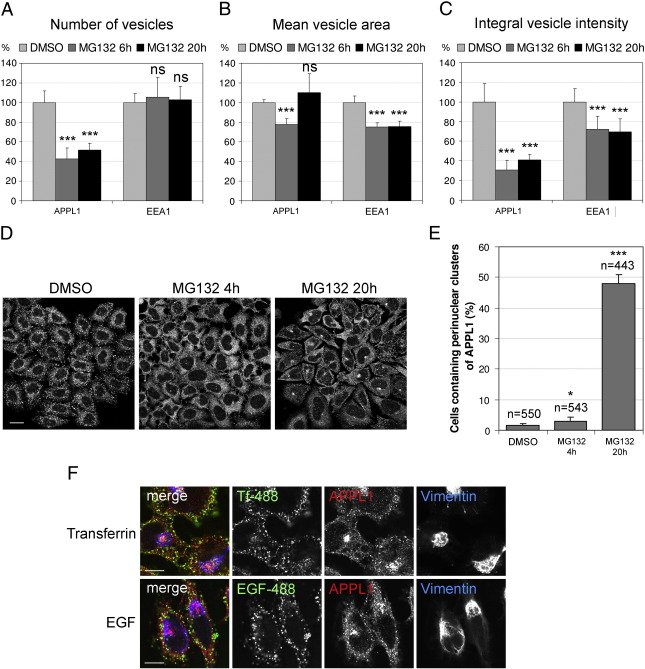
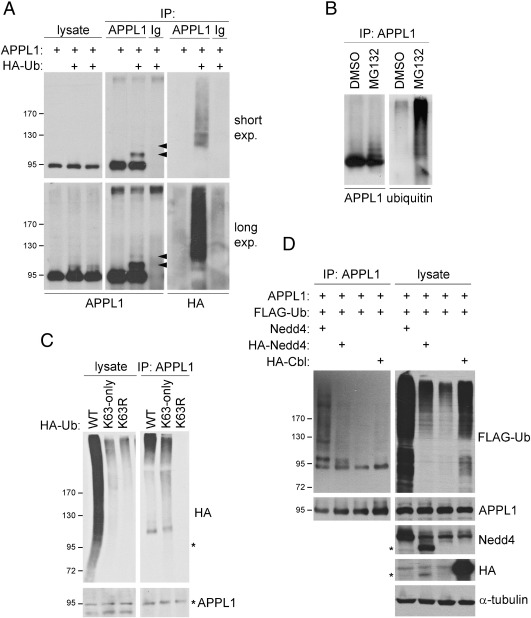
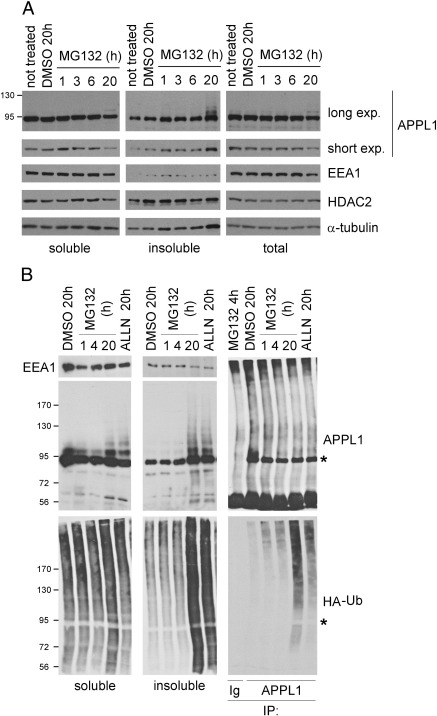
Inhibitors of proteasomes have been shown to affect endocytosis of multiple membrane receptors, in particular at the step of cargo sorting for lysosomal degradation. Here we demonstrate that the inhibition of proteasomes causes specific redistribution of an endosomal adaptor APPL1, which undergoes initial solubilization from APPL endosomes followed by clustering in the perinuclear region. MG132 treatment decreases APPL1 labeling of endosomes while the staining of the canonical early endosomes with EEA1 remains unaffected. Upon prolonged treatment with proteasome inhibitors, endogenous APPL1 localizes to the site of aggresome formation, with perinuclear APPL1 clusters encapsulated within a vimentin cage and co-localizing with aggregates positive for ubiquitin. The clustering of APPL1 is concomitant with increased ubiquitination and decreased solubility of this protein. We determined that the ubiquitin ligase Nedd4 enhances polyubiquitination of APPL1, and the ubiquitin molecules attached to APPL1 are linked through lysine-63. Taken together, these results add APPL1 to only a handful of endogenous cellular proteins known to be recruited to aggresomes induced by proteasomal stress. Moreover, our studies suggest that the proteasome inhibitors that are already in clinical use affect the localization, ubiquitination and solubility of APPL1.
蛋白酶体抑制剂已被证明会影响多种膜受体的内吞作用,特别是在溶酶体降解的货物分拣步骤。在这里,我们证明蛋白酶体的抑制会导致内体衔接蛋白 APPL1 的特异性再分布,APPL1 首先从 APPL 内体中溶解,然后在核周区域聚集。MG132 处理会减少 APPL1 对内体的标记,而用 EEA1 对经典早期内体的染色则不受影响。在用蛋白酶体抑制剂进行长时间处理后,内源性 APPL1 定位于聚集体形成部位,核周 APPL1 簇被包裹在中间丝蛋白 vimentin 笼中,并与泛素阳性的聚集物共定位。APPL1 的聚集伴随着该蛋白的泛素化增加和可溶性降低。我们确定泛素连接酶 Nedd4 增强了 APPL1 的多泛素化,并且连接到 APPL1 上的泛素分子通过赖氨酸 63 连接。总之,这些结果将 APPL1 添加到仅少数几种已知可被蛋白酶体应激诱导的聚集体募集的内源性细胞蛋白中。此外,我们的研究表明,已经在临床中使用的蛋白酶体抑制剂会影响 APPL1 的定位、泛素化和可溶性。