Liu Dan, Martin Vanesa, Fueyo Juan, Lee Ok-Hee, Xu Jing, Cortes-Santiago Nahir, Alonso Marta M, Aldape Kenneth, Colman Howard, Gomez-Manzano Candelaria
Department of Neuro-Oncology, The University of Texas M. D. Anderson Cancer Center, Houston, Texas, USA.
Severance Hospital Integrative Research Institute for Cerebral and Cardiovascular Disease, Yonsei University Health System, Seoul, Korea.
Oncotarget. 2010 Dec;1(8):700-709. doi: 10.18632/oncotarget.204.
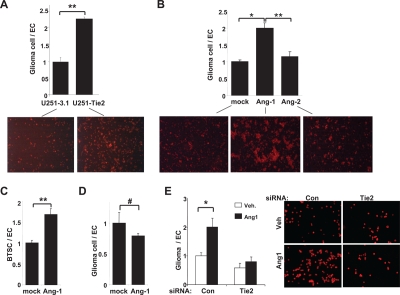
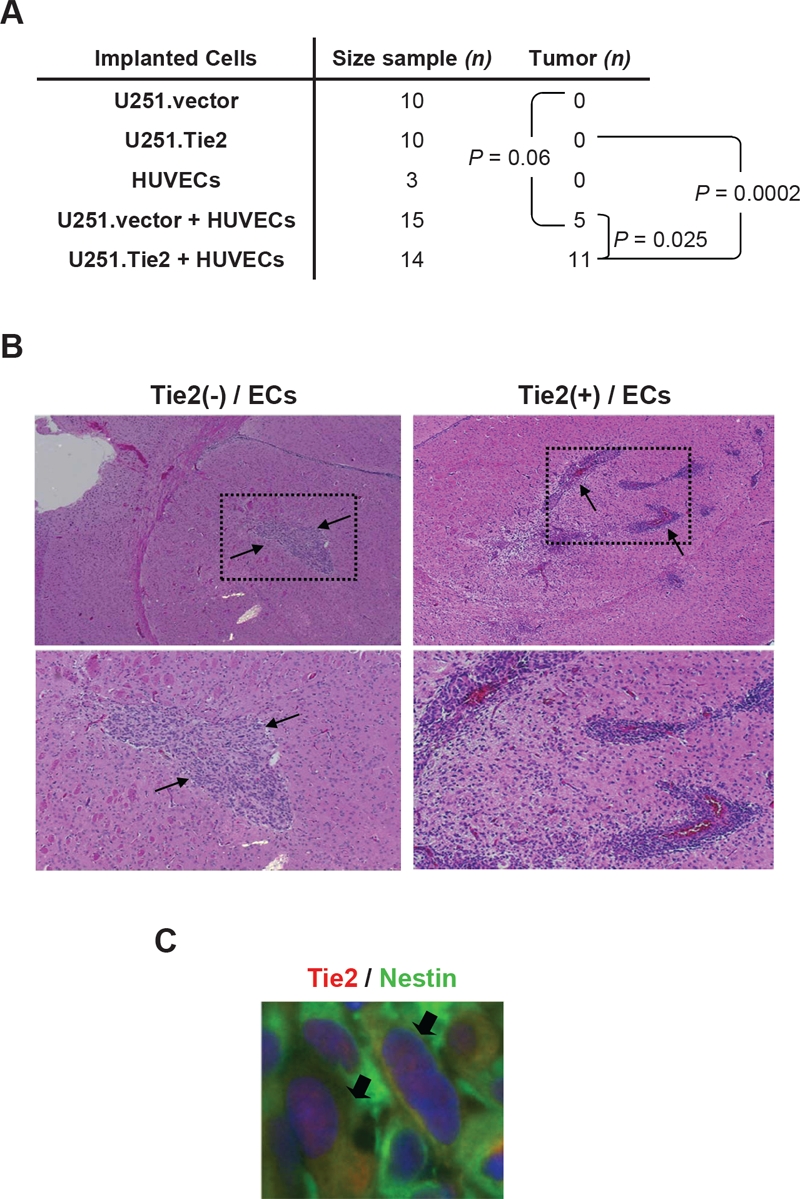
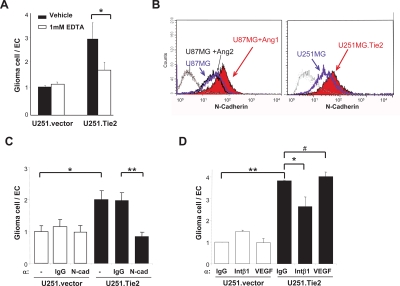
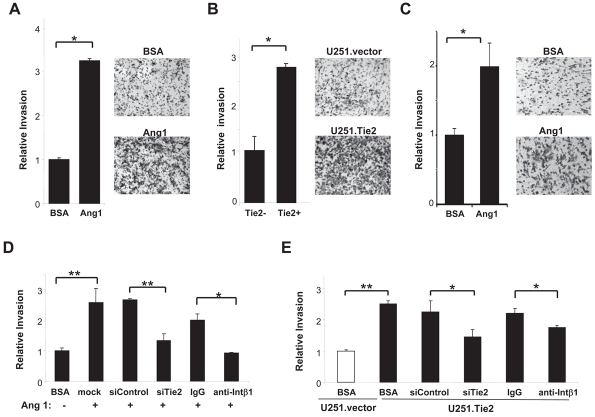
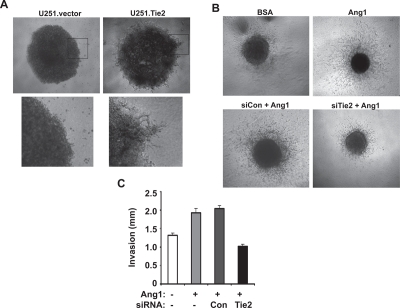
Malignant gliomas are the prototype of highly infiltrative tumors and this characteristic is the main factor for the inevitable tumor recurrence and short survival after most aggressive therapies. The aberrant communication between glioma cells and tumor microenvironment represents one of the major factors regulating brain tumor dispersal. Our group has previously reported that the tyrosine kinase receptor Tie2/TEK is expressed in glioma cells and brain tumor stem cells and is associated with the malignant progression of these tumors. In this study, we sought to determine whether the angiopoietin 1 (Ang1)/Tie2 axis regulates crosstalk between glioma cells and endothelial cells. We found that Ang1 enhanced the adhesion of Tie2-expressing glioma and brain tumor stem cells to endothelial cells. Conversely, specific small interfering RNA (siRNA) knockdown of Tie2 expression inhibited the adhesion capability of glioma cells. Tie2 activation induced integrin β1 and N-cadherin upregulation, and neutralizing antibodies against these molecules inhibited the adhesion of Tie2-positive glioma cells to endothelial cells. In 2D and 3D cultures, we observed that Ang1/Tie2 axis activation was related to increased glioma cell invasion, which was inhibited by using Tie2 siRNA. Importantly, intracranial co-implantation of Tie2-positive glioma cells and endothelial cells in a mouse model resulted in diffusely invasive tumors with cell clusters surrounding glomeruloid vessels mimicking a tumoral niche distribution. Collectively, our results provide new information about the Tie2 signaling in glioma cells that regulates the cross-talk between glioma cells and tumor microenvironment, envisioning Tie2 as a multi-compartmental target for glioma therapy.
恶性胶质瘤是高度浸润性肿瘤的典型代表,这一特征是大多数积极治疗后肿瘤不可避免复发和生存期短的主要因素。胶质瘤细胞与肿瘤微环境之间的异常通讯是调节脑肿瘤扩散的主要因素之一。我们团队之前报道过酪氨酸激酶受体Tie2/TEK在胶质瘤细胞和脑肿瘤干细胞中表达,并与这些肿瘤的恶性进展相关。在本研究中,我们试图确定血管生成素1(Ang1)/Tie2轴是否调节胶质瘤细胞与内皮细胞之间的相互作用。我们发现Ang1增强了表达Tie2的胶质瘤细胞和脑肿瘤干细胞与内皮细胞的黏附。相反,特异性小干扰RNA(siRNA)敲低Tie2表达可抑制胶质瘤细胞的黏附能力。Tie2激活诱导整合素β1和N-钙黏蛋白上调,针对这些分子的中和抗体可抑制Tie2阳性胶质瘤细胞与内皮细胞的黏附。在二维和三维培养中,我们观察到Ang1/Tie2轴激活与胶质瘤细胞侵袭增加有关,使用Tie2 siRNA可抑制这种侵袭。重要的是,在小鼠模型中颅内共植入Tie2阳性胶质瘤细胞和内皮细胞会导致弥漫性侵袭性肿瘤,细胞簇围绕类肾小球血管,模拟肿瘤微环境分布。总体而言,我们的结果提供了关于胶质瘤细胞中Tie2信号传导的新信息,该信号传导调节胶质瘤细胞与肿瘤微环境之间的相互作用,将Tie2设想为胶质瘤治疗的多靶点。