School of Psychological Sciences and Health, University of Strathclyde, Jordanhill Campus, 76 Southbrae Drive, Glasgow, G13 1PP, UK.
BMC Public Health. 2011 Feb 19;11:120. doi: 10.1186/1471-2458-11-120.
In Scotland, older adults are a key target group for physical activity intervention due to the large proportion who are inactive. The health benefits of an active lifestyle are well established but more research is required on the most effective interventions to increase activity in older adults. The 'West End Walkers 65+' randomised controlled trial aims to examine the feasibility of delivering a pedometer-based walking intervention to adults aged 65 years through a primary care setting and to determine the efficacy of this pilot. The study rationale, protocol and recruitment process are discussed in this paper.
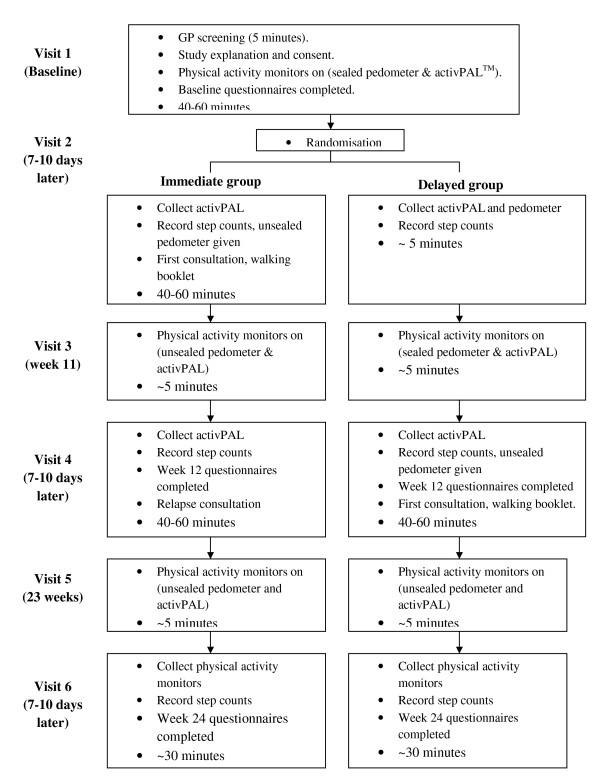
METHODS/DESIGN: The intervention consisted of a 12-week pedometer-based graduated walking programme and physical activity consultations. Participants were randomised into an immediate intervention group (immediate group) or a 12-week waiting list control group (delayed group) who then received the intervention. For the pilot element of this study, the primary outcome measure was pedometer step counts. Secondary outcome measures of sedentary time and physical activity (time spent lying/sitting, standing or walking; activPAL™ monitor), mood (Positive and Negative Affect Schedule), functional ability (Perceived Motor-Efficacy Scale for Older Adults), quality of life (Short-Form (36) Health Survey version 2) and loneliness (UCLA Loneliness Scale) were assessed. Focus groups with participants and semi-structured interviews with the research team captured their experiences of the intervention. The feasibility component of this trial examined recruitment via primary care and retention of participants, appropriateness of the intervention for older adults and the delivery of the intervention by a practice nurse.
West End Walkers 65+ will determine the feasibility and pilot the efficacy of delivering a pedometer-based walking intervention through primary care to Scottish adults aged 65 years. The study will also examine the effect of the intervention on the well-being of participants and gain an insight into both participant and research team member experiences of the intervention.
在苏格兰,由于很大比例的老年人不活跃,他们是身体活动干预的一个关键目标群体。积极生活方式的健康益处已得到充分证实,但需要更多研究来确定最有效的干预措施,以增加老年人的活动量。“西区步行者 65+”随机对照试验旨在检验通过初级保健环境向 65 岁以上成年人提供基于计步器的步行干预的可行性,并确定该试验的效果。本文讨论了研究的理由、方案和招募过程。
方法/设计:干预措施包括为期 12 周的基于计步器的分级步行计划和身体活动咨询。参与者被随机分为即时干预组(即时组)或 12 周候补名单对照组(延迟组),然后接受干预。对于本研究的试点部分,主要结果测量是计步器步数。次要结果测量包括久坐时间和身体活动(躺着/坐着、站立或行走的时间;activPAL™监测器)、情绪(积极和消极情绪量表)、功能能力(老年人感知运动效能量表)、生活质量(简短形式(36)健康调查版本 2)和孤独感(加州大学洛杉矶分校孤独感量表)。与参与者进行焦点小组讨论,并对研究团队进行半结构化访谈,以了解他们对干预的体验。该试验的可行性部分评估了通过初级保健的招募和参与者的保留情况、干预措施对老年人的适宜性以及由执业护士提供干预措施的情况。
西区步行者 65+将确定通过初级保健向苏格兰 65 岁以上成年人提供基于计步器的步行干预的可行性和试点效果。该研究还将检查干预对参与者幸福感的影响,并深入了解参与者和研究团队成员对干预的体验。