Department of Public and Occupational Health, EMGO Institute for Health and Care Research, VU University Medical Centre, P.O. Box 7057, 1007 MB Amsterdam, The Netherlands.
J Occup Rehabil. 2011 Sep;21(3):313-24. doi: 10.1007/s10926-011-9291-7.
Within the labour force workers without an employment contract represent a vulnerable group. In most cases, when sick-listed, these workers have no workplace/employer to return to. Therefore, the aim of this study was to evaluate the effectiveness on return-to-work of a participatory return-to-work program compared to usual care for unemployed workers and temporary agency workers, sick-listed due to musculoskeletal disorders.
The workers, sick-listed for 2-8 weeks due to musculoskeletal disorders, were randomly allocated to the participatory return-to-work program (n = 79) or to usual care (n = 84). The new program is a stepwise procedure aimed at making a consensus-based return-to-work plan, with the possibility of a temporary (therapeutic) workplace. Outcomes were measured at baseline, 3, 6, 9 and 12 months. The primary outcome measure was time to sustainable first return-to-work. Secondary outcome measures were duration of sickness benefit, functional status, pain intensity, and perceived health.
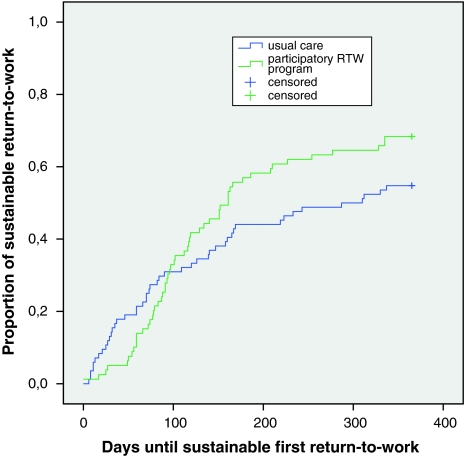
The median duration until sustainable first return-to-work was 161 days in the intervention group, compared to 299 days in the usual care group. The new return-to-work program resulted in a non-significant delay in RTW during the first 90 days, followed by a significant advantage in RTW rate after 90 days (hazard ratio of 2.24 [95% confidence interval 1.28-3.94] P = 0.005). No significant differences were found for the measured secondary outcomes.
The newly developed participatory return-to-work program seems to be a promising intervention to facilitate work resumption and reduce work disability among temporary agency workers and unemployed workers, sick-listed due to musculoskeletal disorders.
在劳动力中,没有劳动合同的工人是一个弱势群体。在大多数情况下,这些工人一旦请病假,就没有工作场所/雇主可返回。因此,本研究的目的是评估与常规护理相比,针对因肌肉骨骼疾病请病假的临时工和派遣工的参与式重返工作方案对重返工作岗位的效果。
因肌肉骨骼疾病请病假 2-8 周的工人被随机分配到参与式重返工作方案(n=79)或常规护理组(n=84)。新方案是一个逐步程序,旨在制定基于共识的重返工作方案,并有可能提供临时(治疗性)工作场所。在基线、3、6、9 和 12 个月时测量结果。主要结局指标是可持续首次重返工作的时间。次要结局指标包括病假时间、功能状态、疼痛强度和感知健康。
干预组可持续首次重返工作的中位数时间为 161 天,而常规护理组为 299 天。新的重返工作方案在最初 90 天内导致重返工作的时间没有明显延迟,之后在 90 天后重返工作的速度有显著优势(风险比为 2.24[95%置信区间 1.28-3.94]P=0.005)。对于测量的次要结局,没有发现显著差异。
新开发的参与式重返工作方案似乎是一种很有前途的干预措施,可以促进临时工和失业工人因肌肉骨骼疾病请病假后恢复工作并减少工作残疾。