Barnett Institute and Department of Chemistry and Chemical Biology, Northeastern University, Boston, Massachusetts 02115, United States.
Anal Chem. 2011 Mar 15;83(6):2029-37. doi: 10.1021/ac102825g. Epub 2011 Feb 21.
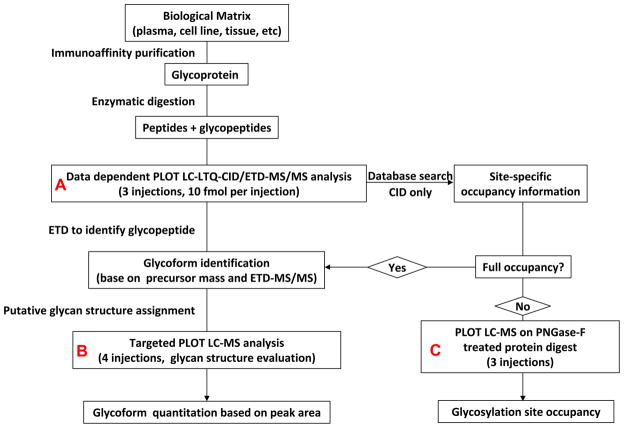
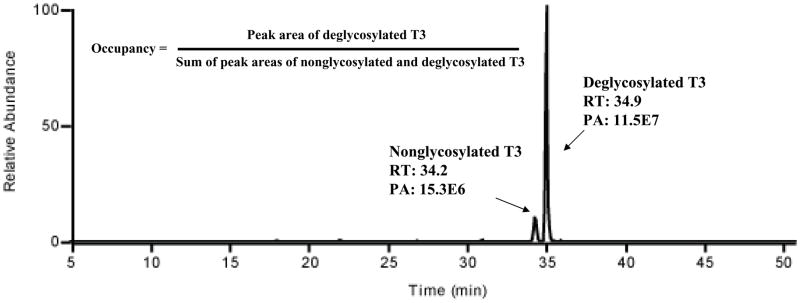
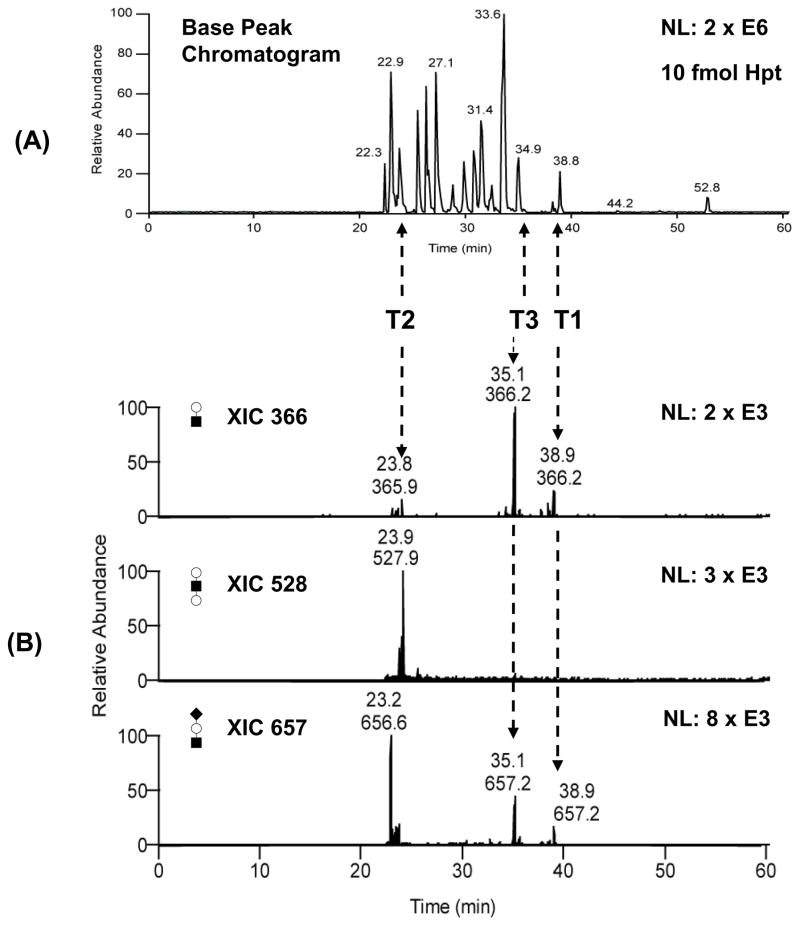
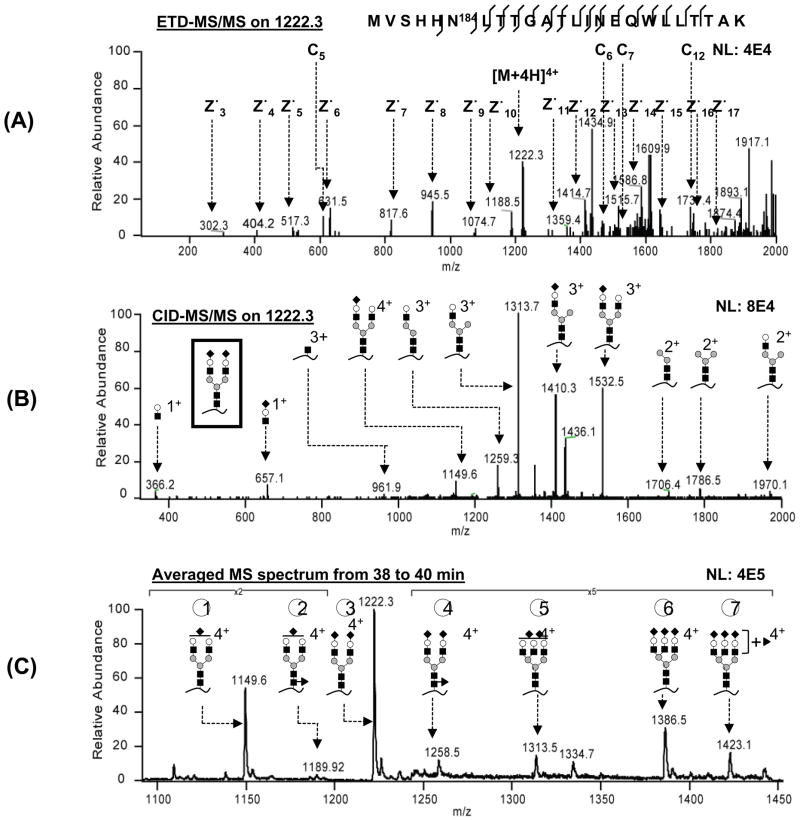
Site-specific analysis of protein glycosylation is important for biochemical and clinical research efforts. Glycopeptide analysis using liquid chromatography-collision-induced dissociation/electron transfer dissociation mass spectrometry (LC-CID/ETD-MS) allows simultaneous characterization of the glycan structure and attached peptide site. However, due to the low ionization efficiency of glycopeptides during electrospray ionization, 200-500 fmol of sample per injection is needed for a single LC-MS run, which makes it challenging for the analysis of limited amounts of glycoprotein purified from biological matrixes. To improve the sensitivity of LC-MS analysis for glycopeptides, an ultranarrow porous layer open tubular (PLOT) LC column (2.5 m × 10 μm i.d.) was coupled to a linear ion trap (LTQ) collision-induced dissociation/electron transfer dissociation mass spectrometer to provide sensitive analysis of N-linked protein glycosylation heterogeneity. The potential of the developed method is demonstrated by the characterization of site-specific glycosylation using haptoglobin (Hpt) as a model protein. To limit the amount of haptoglobin to low picomole amounts of protein, we affinity purified it from 1 μL of pooled lung cancer patient plasma. A total of 26 glycoforms/glycan compositions on three Hpt tryptic glycopeptides were identified and quantified from 10 LC-MS runs with a consumption of 100 fmol of Hpt digest (13 ng of protein, 10 fmol per injection). Included in this analysis was the determination of the glycan occupancy level. At this sample consumption level, the high sensitivity of the PLOT LC-LTQ-CID/ETD-MS system allowed glycopeptide identification and structure determination, along with relative quantitation of glycans presented on the same peptide backbone, even for low abundant glycopeptides at the ∼100 amol level. The PLOT LC-MS system is shown to have sufficient sensitivity to allow characterization of site-specific protein glycosylation from trace levels of glycosylated proteins.
糖肽分析采用液相色谱-碰撞诱导解离/电子转移解离质谱(LC-CID/ETD-MS),可同时对聚糖结构和连接的肽位点进行特征分析。然而,由于电喷雾电离过程中糖肽的离子化效率较低,每次 LC-MS 运行需要 200-500 飞摩尔的样品,这使得从生物基质中纯化的有限量糖蛋白的分析变得具有挑战性。为了提高糖肽 LC-MS 分析的灵敏度,将超窄多孔层开管(PLOT)LC 柱(2.5 m×10 μm i.d.)与线性离子阱(LTQ)碰撞诱导解离/电子转移解离质谱仪耦合,用于对 N-连接蛋白糖基化异质性进行灵敏分析。该方法的潜力通过以触珠蛋白(Hpt)作为模型蛋白进行的位点特异性糖基化特征分析得到了证明。为了将触珠蛋白的量限制在低皮摩尔量的蛋白质,我们从 1 μL 的肺癌患者血浆混合池中对其进行亲和纯化。通过 10 次 LC-MS 运行,从三个 Hpt 胰蛋白酶糖肽中鉴定和定量了 26 种糖型/聚糖组成,每次运行消耗 100 飞摩尔的 Hpt 消化物(13ng 蛋白质,每次注射 10 飞摩尔)。该分析包括糖基化程度的测定。在这种样品消耗水平下,PLOT LC-LTQ-CID/ETD-MS 系统的高灵敏度允许对糖肽进行鉴定和结构确定,以及对同一肽骨架上呈现的聚糖进行相对定量,即使对于丰度较低的糖肽(约 100 飞摩尔)也是如此。结果表明,PLOT LC-MS 系统具有足够的灵敏度,可以从痕量糖基化蛋白中对糖基化蛋白的位点特异性进行特征分析。