Health Services Research Unit, University of Aberdeen, Aberdeen, UK.
Trials. 2011 Feb 21;12:50. doi: 10.1186/1745-6215-12-50.
Surgical placebos are controversial. This in-depth study explored the design, acceptability, and feasibility issues relevant to designing a surgical placebo-controlled trial for the evaluation of the clinical and cost effectiveness of arthroscopic lavage for the management of people with osteoarthritis of the knee in the UK.
Two surgeon focus groups at a UK national meeting for orthopaedic surgeons and one regional surgeon focus group (41 surgeons); plenary discussion at a UK national meeting for orthopaedic anaesthetists (130 anaesthetists); three focus groups with anaesthetists (one national, two regional; 58 anaesthetists); two focus groups with members of the patient organisation Arthritis Care (7 participants); telephone interviews with people on consultant waiting lists from two UK regional centres (15 participants); interviews with Chairs of UK ethics committees (6 individuals); postal surveys of members of the British Association of Surgeons of the Knee (382 surgeons) and members of the British Society of Orthopaedic Anaesthetists (398 anaesthetists); two centre pilot (49 patients assessed).
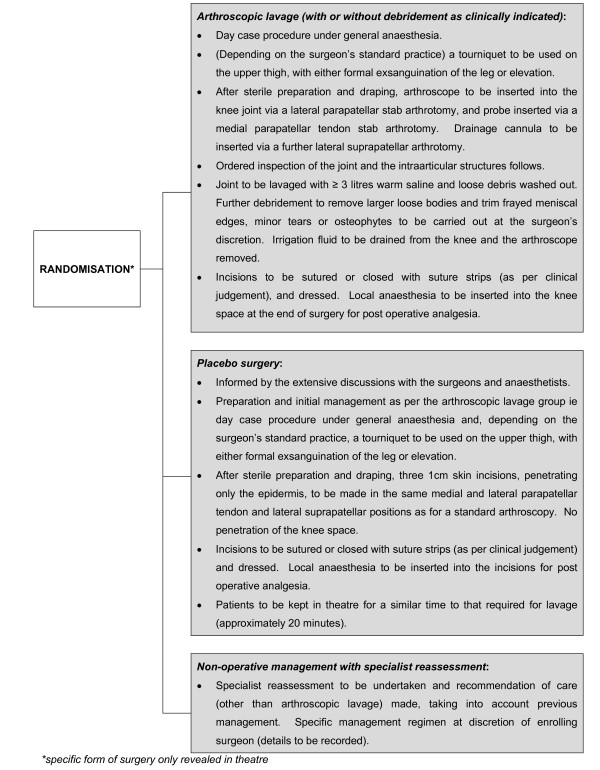
There was widespread acceptance that evaluation of arthroscopic lavage had to be conducted with a placebo control if scientific rigour was not to be compromised. The choice of placebo surgical procedure (three small incisions) proved easier than the method of anaesthesia (general anaesthesia). General anaesthesia, while an excellent mimic, was more intrusive and raised concerns among some stakeholders and caused extensive discussion with local decision-makers when seeking formal approval for the pilot.Patients were willing to participate in a pilot with a placebo arm; although some patients when allocated to surgery became apprehensive about the possibility of receiving placebo, and withdrew. Placebo surgery was undertaken successfully.
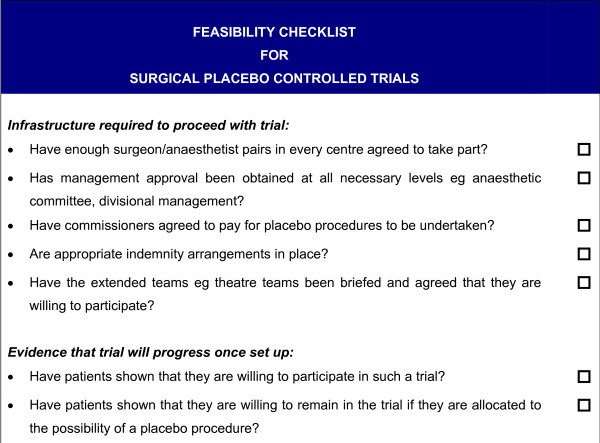
Our study illustrated the opposing and often strongly held opinions about surgical placebos, the ethical issues underpinning this controversy, and the challenges that exist even when ethics committee approval has been granted. It showed that a placebo-controlled trial could be conducted in principle, albeit with difficulty. It also highlighted that not only does a placebo-controlled trial in surgery have to be ethically and scientifically acceptable but that it also must be a feasible course of action. The place of placebo-controlled surgical trials more generally is likely to be limited and require specific circumstances to be met. Suggested criteria are presented.
The trial was assigned ISRCTN02328576 through http://controlled-trials.com/ in June 2006. The first patient was randomised to the pilot in July 2007.
手术安慰剂颇具争议。本深入研究旨在探讨设计、可接受性和可行性问题,这些问题与评估关节镜灌洗治疗膝关节骨关节炎的临床和成本效益的手术安慰剂对照试验的设计相关,该试验在英国开展。
英国全国骨科医师会议上的 2 个外科医生焦点小组(41 名外科医生);英国全国骨科麻醉师会议上的全体讨论(130 名麻醉师);3 个麻醉师焦点小组(1 个全国性的,2 个区域性的;58 名麻醉师);关节炎护理患者组织的 2 个焦点小组(7 名参与者);来自英国两个地区中心的顾问等候名单上的人的电话访谈(15 名参与者);英国伦理委员会主席的访谈(6 个人);英国膝关节外科医师协会成员的邮寄调查(382 名外科医生)和英国矫形麻醉师学会成员的邮寄调查(398 名麻醉师);2 个中心的试验(49 名患者接受评估)。
广泛认为,如果不严格科学,那么关节镜灌洗的评估必须采用安慰剂对照。选择安慰剂手术程序(三个小切口)比麻醉方法(全身麻醉)更容易。全身麻醉虽然是一种很好的模拟,但更具侵入性,并引起了一些利益相关者的关注,并在寻求对试验的正式批准时与当地决策者进行了广泛的讨论。患者愿意参与有安慰剂组的试验;尽管一些患者在接受手术时对接受安慰剂的可能性感到担忧,并退出了试验。安慰剂手术成功进行。
我们的研究说明了人们对手术安慰剂的看法存在分歧,且往往存在强烈的意见分歧,同时还说明了这种争议背后的伦理问题,以及即使获得伦理委员会的批准,仍然存在的挑战。它表明,原则上可以进行安慰剂对照试验,尽管存在困难。它还强调,手术中的安慰剂对照试验不仅必须在伦理和科学上是可接受的,而且还必须是可行的行动方案。一般来说,安慰剂对照手术试验的地位可能有限,需要满足特定情况。提出了一些建议的标准。
该试验于 2006 年 6 月通过 controlled-trials.com 分配给 ISRCTN02328576。第一个患者于 2007 年 7 月被随机分配到试验。