Department of Neurobiology and Anatomy, University of Texas Health Science Center Houston, TX, USA.
Front Comput Neurosci. 2011 Feb 1;4:159. doi: 10.3389/fncom.2010.00159. eCollection 2011.
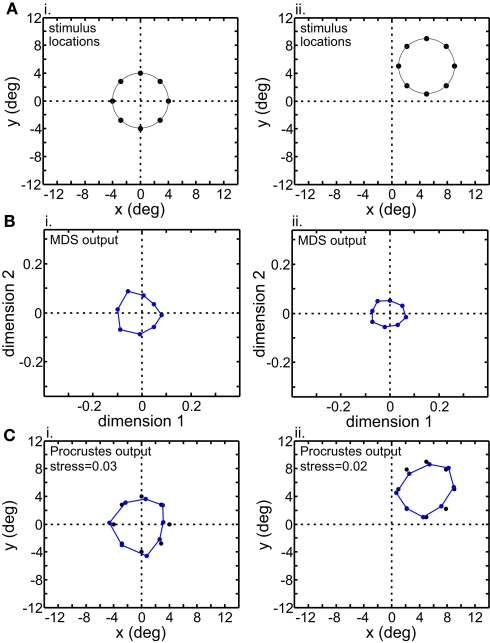
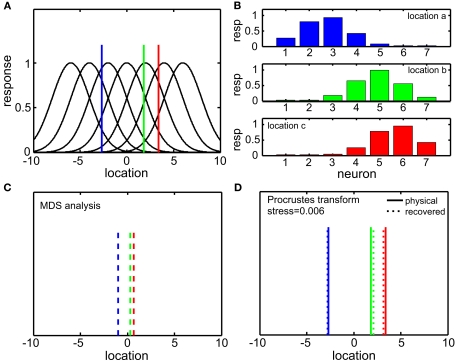
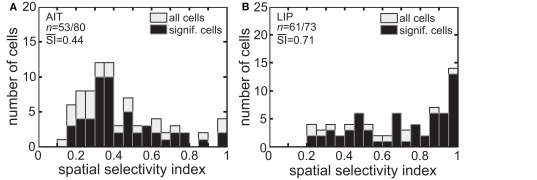
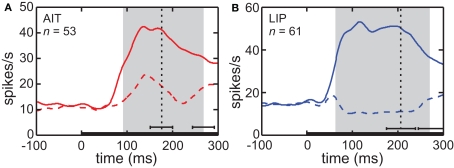
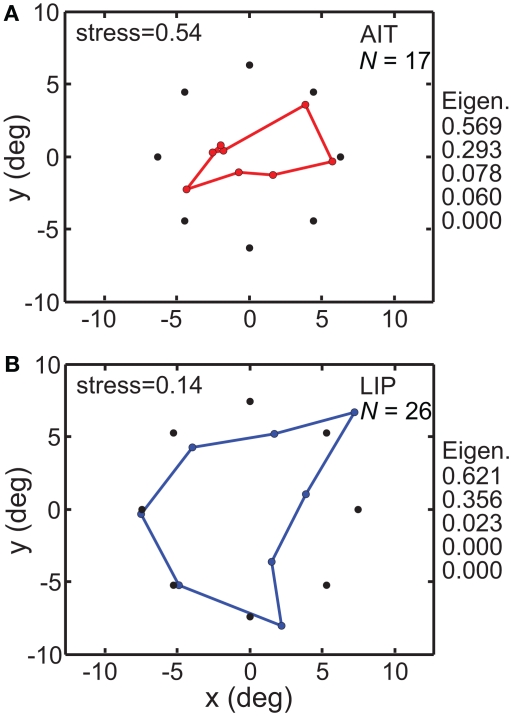
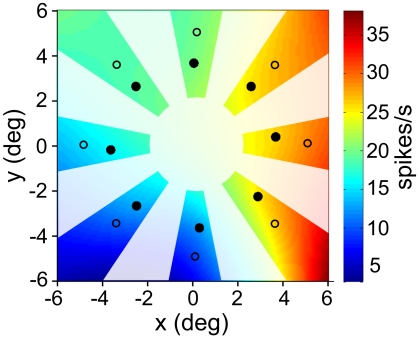
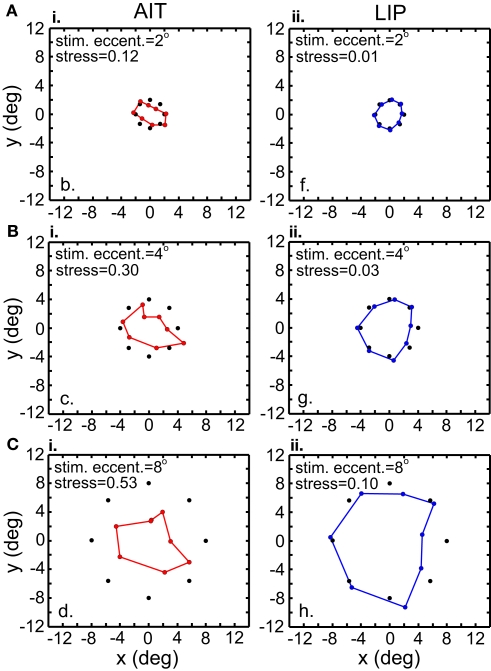
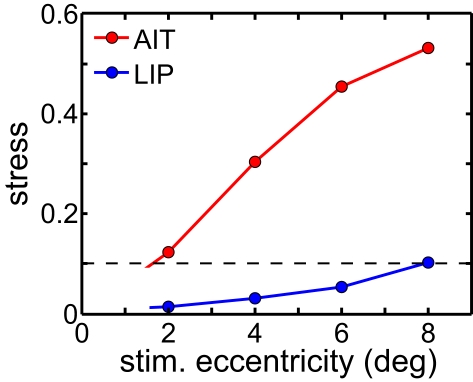
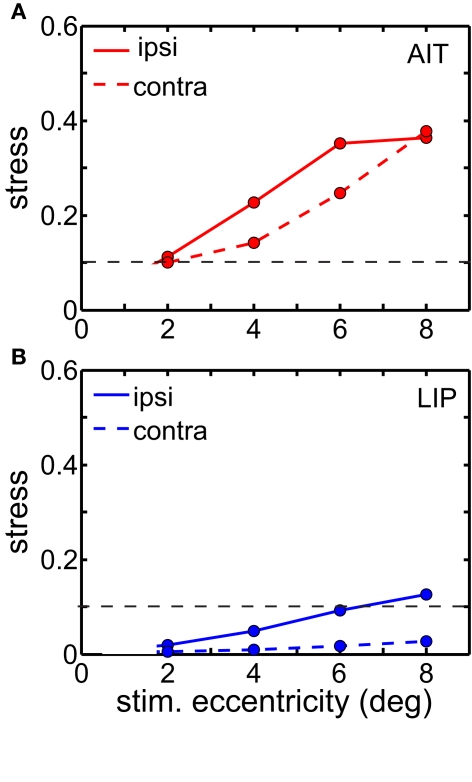
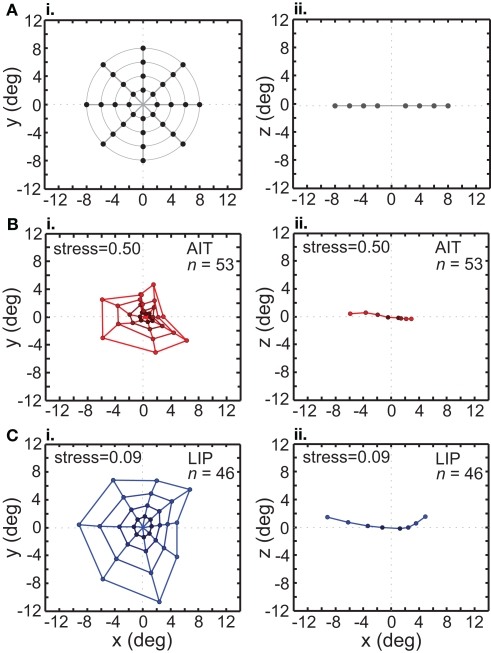
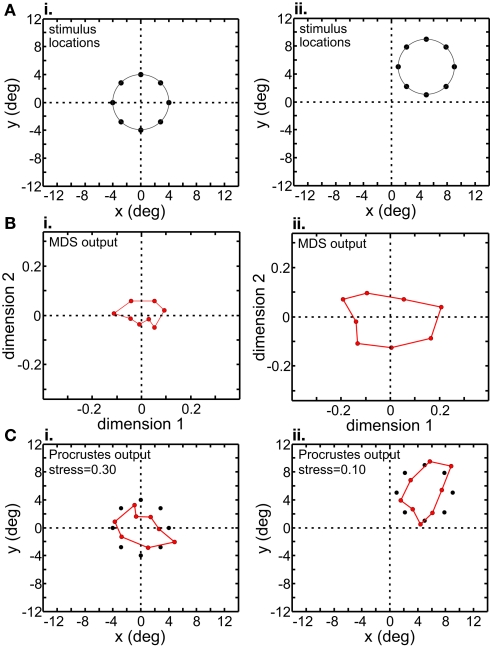
Although the representation of space is as fundamental to visual processing as the representation of shape, it has received relatively little attention from neurophysiological investigations. In this study we characterize representations of space within visual cortex, and examine how they differ in a first direct comparison between dorsal and ventral subdivisions of the visual pathways. Neural activities were recorded in anterior inferotemporal cortex (AIT) and lateral intraparietal cortex (LIP) of awake behaving monkeys, structures associated with the ventral and dorsal visual pathways respectively, as a stimulus was presented at different locations within the visual field. In spatially selective cells, we find greater modulation of cell responses in LIP with changes in stimulus position. Further, using a novel population-based statistical approach (namely, multidimensional scaling), we recover the spatial map implicit within activities of neural populations, allowing us to quantitatively compare the geometry of neural space with physical space. We show that a population of spatially selective LIP neurons, despite having large receptive fields, is able to almost perfectly reconstruct stimulus locations within a low-dimensional representation. In contrast, a population of AIT neurons, despite each cell being spatially selective, provide less accurate low-dimensional reconstructions of stimulus locations. They produce instead only a topologically (categorically) correct rendition of space, which nevertheless might be critical for object and scene recognition. Furthermore, we found that the spatial representation recovered from population activity shows greater translation invariance in LIP than in AIT. We suggest that LIP spatial representations may be dimensionally isomorphic with 3D physical space, while in AIT spatial representations may reflect a more categorical representation of space (e.g., "next to" or "above").
尽管空间表示对于视觉处理与形状表示同样基本,但它在神经生理学研究中受到的关注相对较少。在这项研究中,我们描述了视觉皮层内的空间表示,并首次在视觉通路的背侧和腹侧部分之间进行了直接比较,研究了它们的差异。在清醒活动的猴子的前下颞叶皮层(AIT)和外侧顶内皮层(LIP)中记录了神经活动,这两个结构分别与腹侧和背侧视觉通路相关,当刺激在视野内的不同位置呈现时。在空间选择性细胞中,我们发现 LIP 中细胞反应的调制随着刺激位置的变化而增加。此外,我们使用一种新的基于群体的统计方法(即多维标度),从神经群体活动中恢复出隐含的空间图,使我们能够定量地比较神经空间和物理空间的几何形状。我们表明,尽管 LIP 的空间选择性神经元具有大的感受野,但它们能够在低维表示中几乎完美地重建刺激位置。相比之下,尽管 AIT 神经元的每个细胞都是空间选择性的,但它们对刺激位置的低维重建提供的准确性较低。相反,它们只产生空间的拓扑(分类)正确表示,尽管这对于物体和场景识别可能至关重要。此外,我们发现从群体活动中恢复的空间表示在 LIP 中比在 AIT 中具有更大的平移不变性。我们认为,LIP 的空间表示可能与 3D 物理空间在维度上同构,而在 AIT 中,空间表示可能反映了空间的更分类表示(例如“旁边”或“上方”)。