Stanley Institute for Cognitive Genomics, Cold Spring Harbor Laboratory, Cold Spring Harbor, New York 12824, USA.
Nature. 2011 Mar 24;471(7339):499-503. doi: 10.1038/nature09884. Epub 2011 Feb 23.
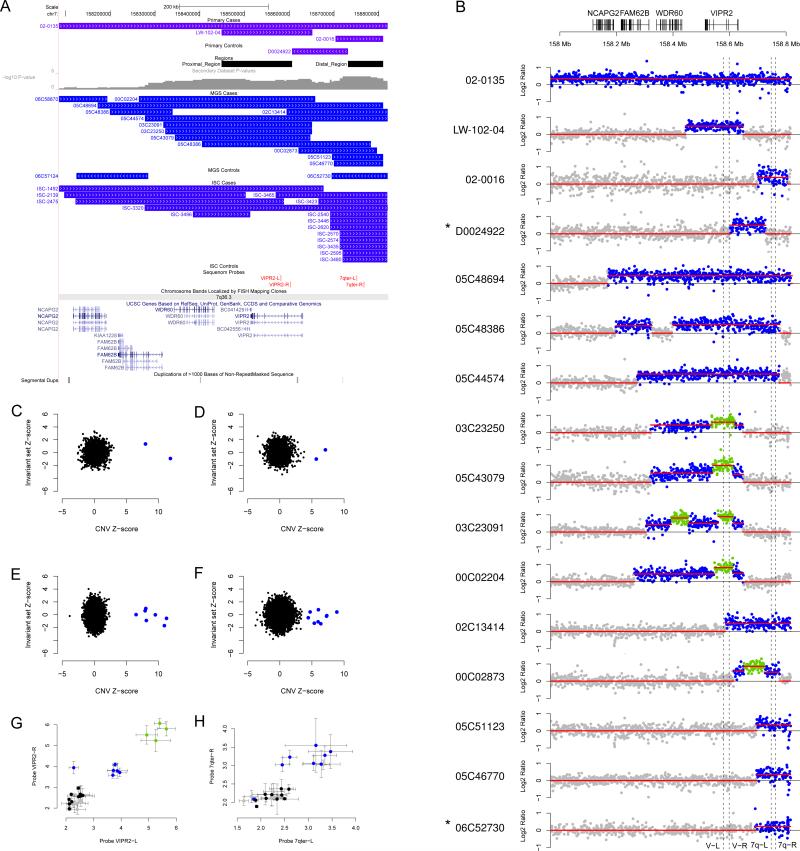
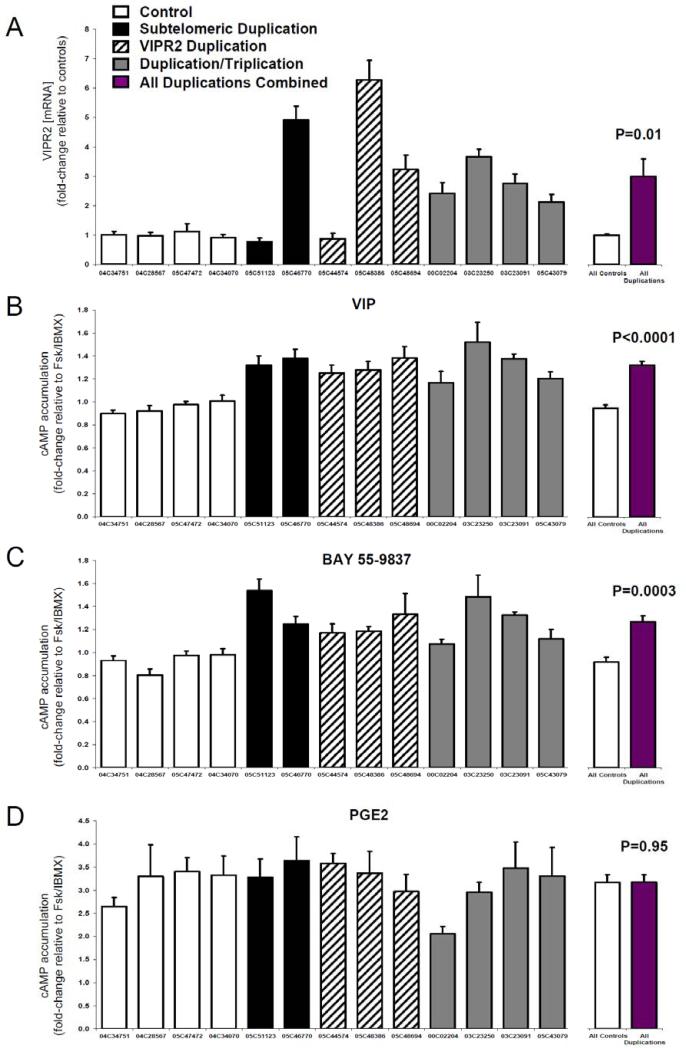
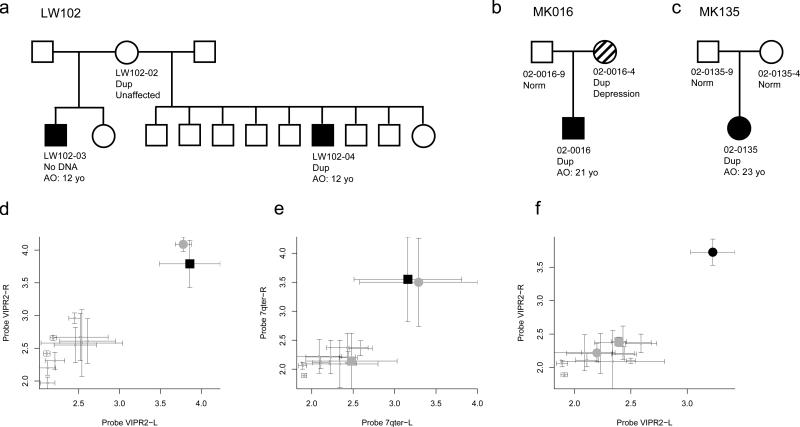
Rare copy number variants (CNVs) have a prominent role in the aetiology of schizophrenia and other neuropsychiatric disorders. Substantial risk for schizophrenia is conferred by large (>500-kilobase) CNVs at several loci, including microdeletions at 1q21.1 (ref. 2), 3q29 (ref. 3), 15q13.3 (ref. 2) and 22q11.2 (ref. 4) and microduplication at 16p11.2 (ref. 5). However, these CNVs collectively account for a small fraction (2-4%) of cases, and the relevant genes and neurobiological mechanisms are not well understood. Here we performed a large two-stage genome-wide scan of rare CNVs and report the significant association of copy number gains at chromosome 7q36.3 with schizophrenia. Microduplications with variable breakpoints occurred within a 362-kilobase region and were detected in 29 of 8,290 (0.35%) patients versus 2 of 7,431 (0.03%) controls in the combined sample. All duplications overlapped or were located within 89 kilobases upstream of the vasoactive intestinal peptide receptor gene VIPR2. VIPR2 transcription and cyclic-AMP signalling were significantly increased in cultured lymphocytes from patients with microduplications of 7q36.3. These findings implicate altered vasoactive intestinal peptide signalling in the pathogenesis of schizophrenia and indicate the VPAC2 receptor as a potential target for the development of new antipsychotic drugs.
罕见的拷贝数变异(CNVs)在精神分裂症和其他神经精神疾病的发病机制中起着重要作用。在几个位点上,包括 1q21.1(ref.2)、3q29(ref.3)、15q13.3(ref.2)和 22q11.2(ref.4)的微缺失以及 16p11.2(ref.5)的微重复,较大的(>500 千碱基)CNVs 显著增加了精神分裂症的风险。然而,这些 CNVs 总共只占一小部分(2-4%)的病例,相关基因和神经生物学机制尚不清楚。在这里,我们进行了一个大规模的 7q36.3 染色体上罕见 CNVs 的两阶段全基因组扫描,并报道了拷贝数增益与精神分裂症的显著关联。在 362 千碱基的区域内发生了具有可变断点的微重复,在合并样本中,8290 名患者中有 29 名(0.35%)患者和 7431 名对照者中有 2 名(0.03%)患者存在这种重复。所有的重复都重叠或位于血管活性肠肽受体基因 VIPR2 的上游 89 千碱基内。7q36.3 微重复患者的培养淋巴细胞中 VIPR2 转录和环 AMP 信号显著增加。这些发现表明,血管活性肠肽信号的改变可能参与了精神分裂症的发病机制,并表明 VPAC2 受体可能是开发新型抗精神病药物的潜在靶点。