Department of Molecular and Cell Biology, University of California, Berkeley, California, United States of America.
PLoS Biol. 2011 Feb 8;9(2):e1000590. doi: 10.1371/journal.pbio.1000590.
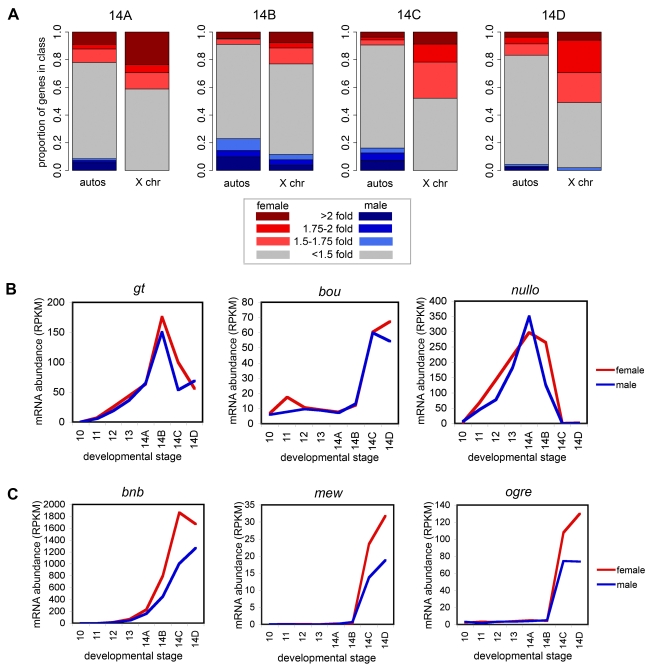
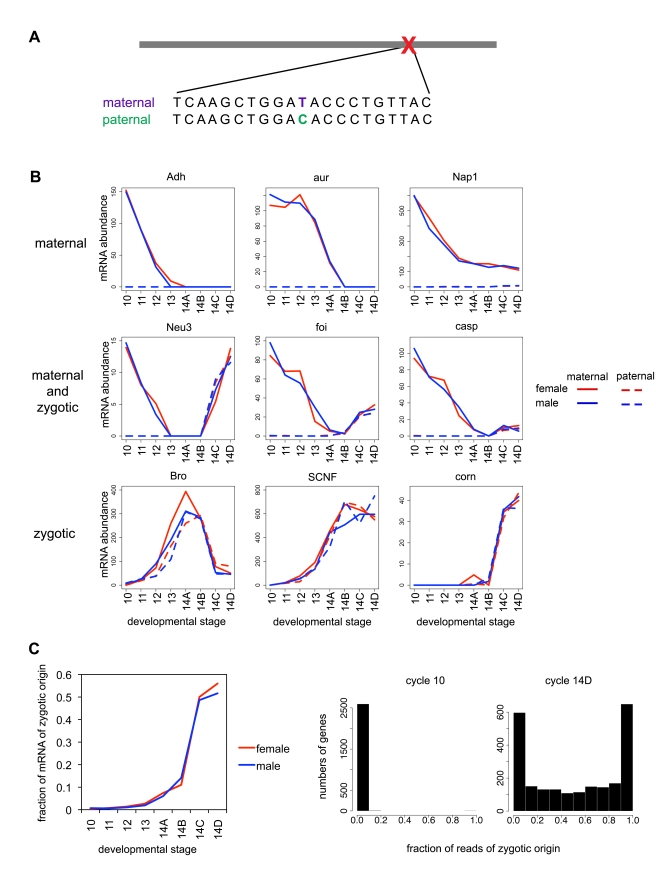
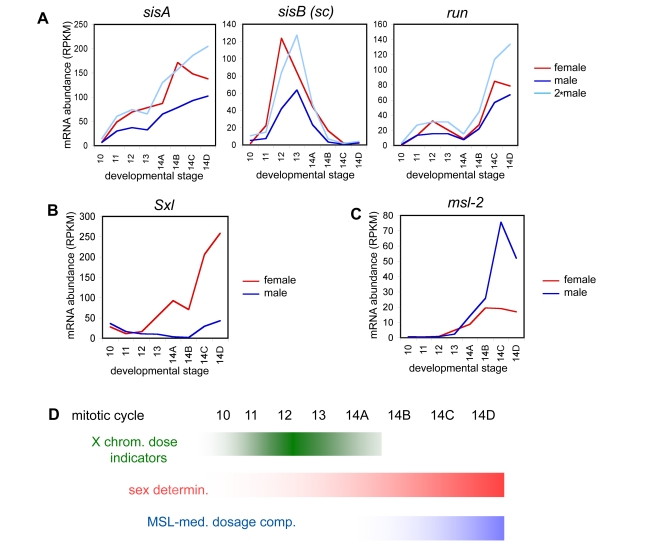
When Drosophila melanogaster embryos initiate zygotic transcription around mitotic cycle 10, the dose-sensitive expression of specialized genes on the X chromosome triggers a sex-determination cascade that, among other things, compensates for differences in sex chromosome dose by hypertranscribing the single X chromosome in males. However, there is an approximately 1 hour delay between the onset of zygotic transcription and the establishment of canonical dosage compensation near the end of mitotic cycle 14. During this time, zygotic transcription drives segmentation, cellularization, and other important developmental events. Since many of the genes involved in these processes are on the X chromosome, we wondered whether they are transcribed at higher levels in females and whether this might lead to sex-specific early embryonic patterning. To investigate this possibility, we developed methods to precisely stage, sex, and characterize the transcriptomes of individual embryos. We measured genome-wide mRNA abundance in male and female embryos at eight timepoints, spanning mitotic cycle 10 through late cycle 14, using polymorphisms between parental lines to distinguish maternal and zygotic transcription. We found limited sex-specific zygotic transcription, with a weak tendency for genes on the X to be expressed at higher levels in females. However, transcripts derived from the single X chromosome in males were more abundant that those derived from either X chromosome in females, demonstrating that there is widespread dosage compensation prior to the activation of the canonical MSL-mediated dosage compensation system. Crucially, this new system of early zygotic dosage compensation results in nearly identical transcript levels for key X-linked developmental regulators, including giant (gt), brinker (brk), buttonhead (btd), and short gastrulation (sog), in male and female embryos.
当黑腹果蝇胚胎在有丝分裂周期 10 左右开始合子转录时,X 染色体上特化基因的剂量敏感表达引发了性别决定级联反应,除其他外,通过在雄性中过度转录单个 X 染色体来补偿性染色体剂量的差异。然而,在合子转录开始和在有丝分裂周期 14 末期建立规范的剂量补偿之间大约有 1 个小时的延迟。在此期间,合子转录驱动着胚胎的分节、细胞化和其他重要的发育事件。由于这些过程中涉及的许多基因都在 X 染色体上,我们想知道它们在雌性中的转录水平是否更高,以及这是否可能导致性别特异性的早期胚胎模式。为了研究这种可能性,我们开发了精确分期、性别鉴定和单个胚胎转录组特征分析的方法。我们使用亲本系之间的多态性来区分母源和合子转录,在八个时间点测量了跨越有丝分裂周期 10 到晚期周期 14 的雄性和雌性胚胎的全基因组 mRNA 丰度,这些时间点分别是有丝分裂周期 10 到晚期周期 14。我们发现有限的性别特异性合子转录,X 染色体上的基因在雌性中表达水平较高的趋势较弱。然而,雄性中来自单个 X 染色体的转录本比雌性中来自任一 X 染色体的转录本更丰富,这表明在经典 MSL 介导的剂量补偿系统激活之前,存在广泛的剂量补偿。至关重要的是,这个早期合子剂量补偿的新系统导致关键的 X 连锁发育调节剂(包括 giant(gt)、brinker(brk)、buttonhead(btd)和 short gastrulation(sog))在雄性和雌性胚胎中的转录水平几乎相同。