Department of Chemistry, Iowa State University, Ames, Iowa 50011, USA.
Nature. 2011 Feb 24;470(7335):558-62. doi: 10.1038/nature09743.
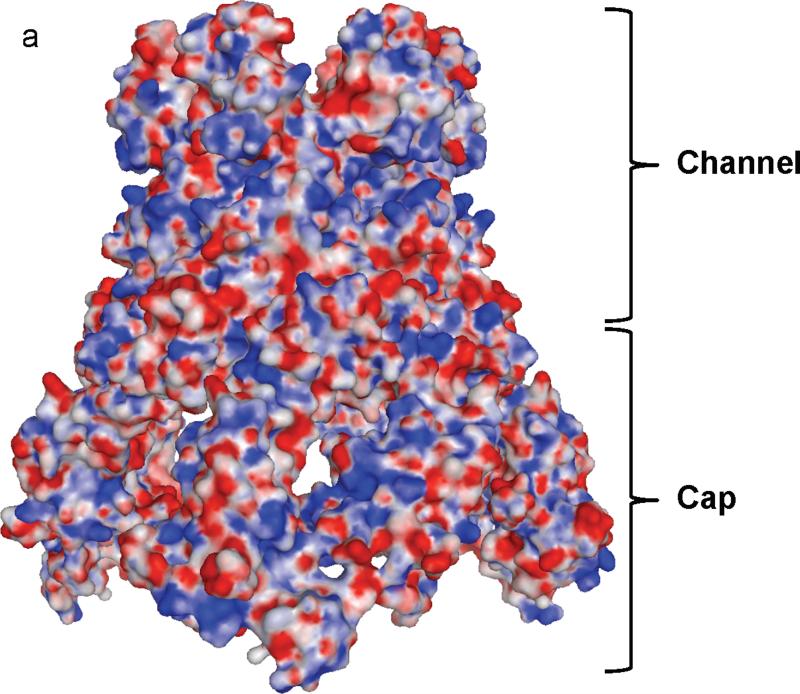
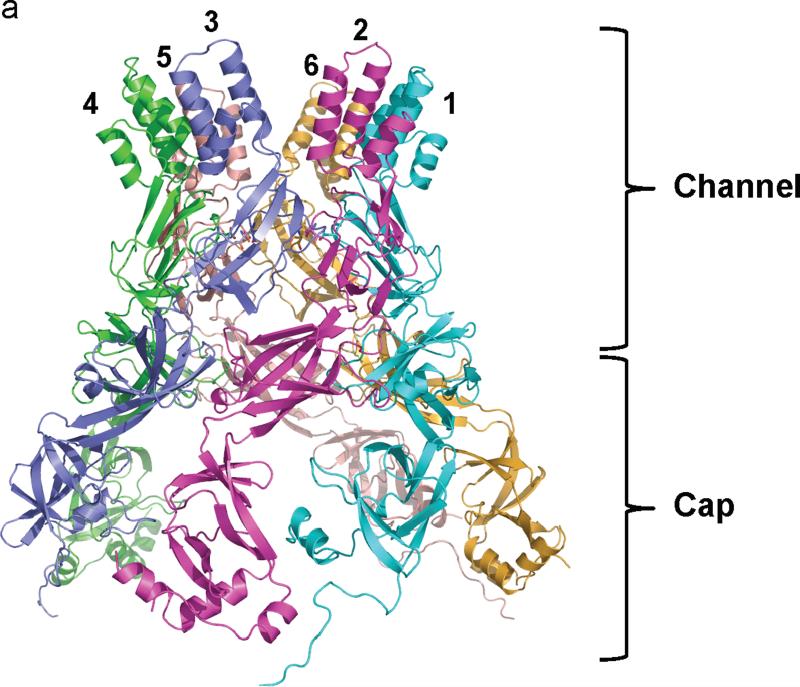
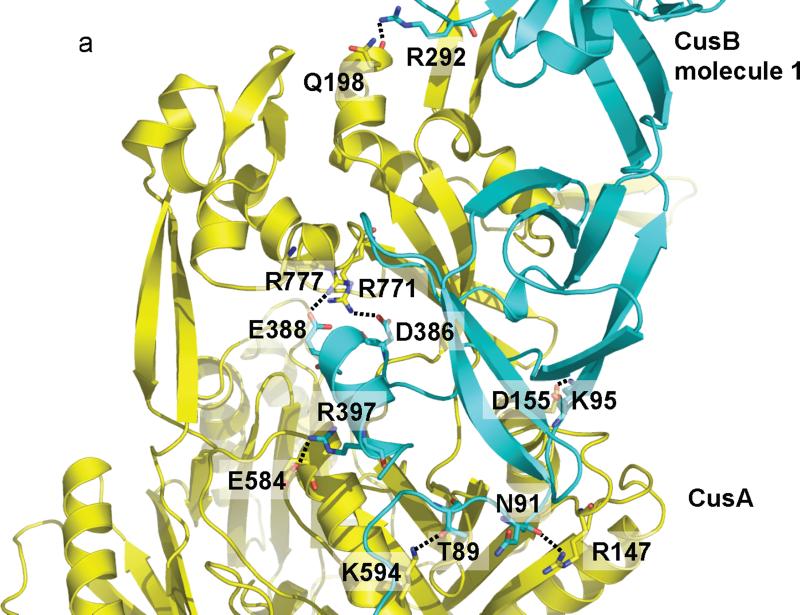
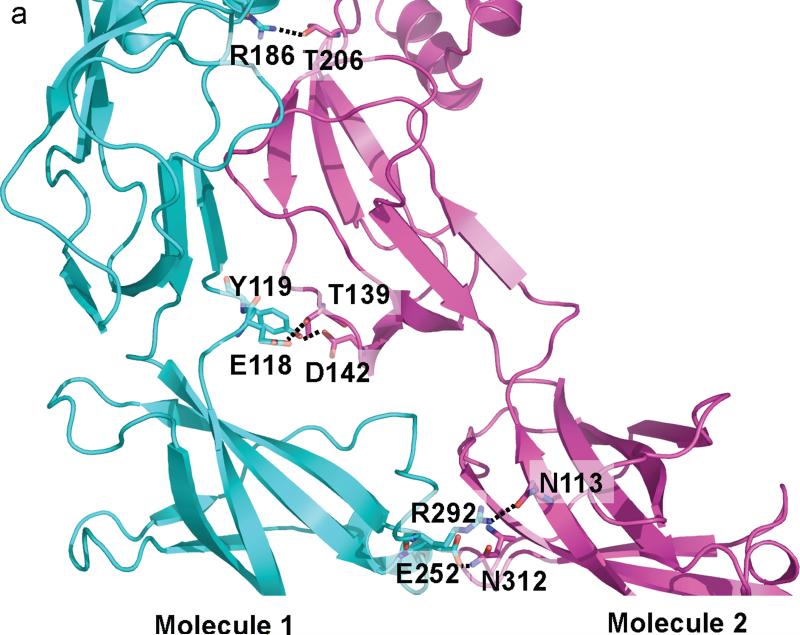
Gram-negative bacteria, such as Escherichia coli, expel toxic chemicals through tripartite efflux pumps that span both the inner and outer membrane. The three parts are an inner membrane, substrate-binding transporter; a membrane fusion protein; and an outer-membrane-anchored channel. The fusion protein connects the transporter to the channel within the periplasmic space. A crystallographic model of this tripartite efflux complex has been unavailable because co-crystallization of the various components of the system has proven to be extremely difficult. We previously described the crystal structures of both the inner membrane transporter CusA and the membrane fusion protein CusB of the CusCBA efflux system of E. coli. Here we report the co-crystal structure of the CusBA efflux complex, showing that the transporter (or pump) CusA, which is present as a trimer, interacts with six CusB protomers and that the periplasmic domain of CusA is involved in these interactions. The six CusB molecules seem to form a continuous channel. The affinity of the CusA and CusB interaction was found to be in the micromolar range. Finally, we have predicted a three-dimensional structure for the trimeric CusC outer membrane channel and developed a model of the tripartite efflux assemblage. This CusC(3)-CusB(6)-CusA(3) model shows a 750-kilodalton efflux complex that spans the entire bacterial cell envelope and exports Cu I and Ag I ions.
革兰氏阴性菌,如大肠杆菌,通过横跨内外膜的三联体外排泵排出有毒化学物质。这三个部分是一个内膜、底物结合转运蛋白;一个膜融合蛋白;和一个外膜锚定的通道。融合蛋白将转运蛋白连接到周质空间内的通道上。由于该系统的各个组件的共结晶已被证明极其困难,因此一直无法获得这种三联体外排复合物的晶体结构模型。我们之前描述了大肠杆菌 CusCBA 外排系统的内膜转运蛋白 CusA 和膜融合蛋白 CusB 的晶体结构。在这里,我们报告了 CusBA 外排复合物的共晶结构,表明作为三聚体存在的转运蛋白(或泵) CusA 与六个 CusB 原聚体相互作用,并且 CusA 的周质结构域参与这些相互作用。这六个 CusB 分子似乎形成了一个连续的通道。发现 CusA 和 CusB 相互作用的亲和力在微摩尔范围内。最后,我们预测了三聚体 CusC 外膜通道的三维结构,并构建了三联体外排组装体的模型。这个 CusC(3)-CusB(6)-CusA(3) 模型显示了一个横跨整个细菌包膜的 750 千道尔顿的外排复合物,可输出 Cu I 和 Ag I 离子。