Department of Biostatistics, University of Michigan School of Public Health, Ann Arbor, 48109, USA.
Environ Health Perspect. 2011 Mar;119(3):409-15. doi: 10.1289/ehp.1002453.
Identifying windows of vulnerability to environmental toxicants is an important area in children's health research.
We compared and contrasted statistical approaches that may help identify windows of vulnerability by formally testing differences in exposure effects across time of exposure, incorporating continuous time metrics for timing of exposure, and efficiently incorporating incomplete cases.
We considered four methods: 1) window-specific and simultaneously adjusted regression; 2) multiple informant models; 3) using features of individual exposure patterns to predict outcomes; and 4) models of population exposure patterns depending on the outcome. We illustrate them using a study of prenatal vulnerability to lead in relation to Bayley's Mental Development Index at 24 months of age (MDI24).
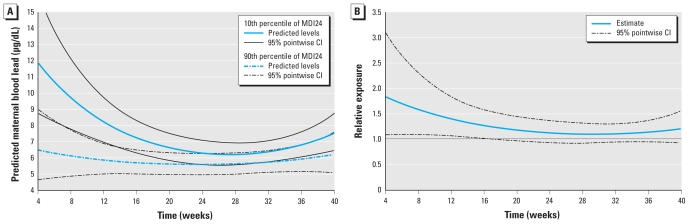
The estimated change in MDI24 score with a 1-loge-unit increase in blood lead during the first trimester was -2.74 [95% confidence interval (CI), -5.78 to 0.29] based on a window-specific regression. The corresponding change in MDI24 was -4.13 (95% CI, -7.54 to -0.72) based on a multiple informant model; estimated effects were similar across trimesters (p = 0.23). Results from method 3 suggested that blood lead levels in early pregnancy were significantly associated with reduced MDI24, but decreasing blood leads over the course of pregnancy were not. Method 4 results indicated that blood lead levels before 17 weeks of gestation were lower among children with MDI24 scores in the 90th versus the 10th percentile (p = 0.08).
Method 2 is preferred over method 1 because it enables formal testing of differences in effects across a priori-defined windows (e.g., trimesters of pregnancy). Methods 3 and 4 are preferred over method 2 when there is large variability in the timing of exposure assessments among participants. Methods 3 and 4 yielded smaller p-values for tests of the hypothesis that not only level but also timing of lead exposure are relevant predictors of MDI24; systematic power comparisons are warranted.
确定儿童健康研究中易受环境毒物影响的窗口期是一个重要领域。
我们比较和对比了可能有助于识别窗口期的统计方法,这些方法通过正式测试暴露效应随暴露时间的差异,纳入暴露时间的连续时间度量,以及有效地纳入不完整的情况来实现。
我们考虑了四种方法:1)窗口特定且同时调整的回归;2)多信息模型;3)使用个体暴露模式的特征来预测结果;4)根据结果的人口暴露模式模型。我们使用一项关于产前铅暴露与 24 个月时贝利精神发育指数(MDI24)关系的研究来说明这些方法。
基于特定窗口的回归,在第一个三个月期间,血液铅每增加 1 个对数单位,MDI24 评分的估计变化为-2.74(95%置信区间(CI),-5.78 至 0.29)。基于多信息模型,MDI24 的相应变化为-4.13(95%CI,-7.54 至-0.72);各三个月的估计效果相似(p=0.23)。方法 3 的结果表明,妊娠早期的血铅水平与 MDI24 降低显著相关,但妊娠过程中血铅水平的降低则不然。方法 4 的结果表明,在妊娠 17 周之前,MDI24 评分在第 90 百分位与第 10 百分位的儿童的血铅水平较低(p=0.08)。
方法 2 优于方法 1,因为它能够正式测试在预先定义的窗口(例如妊娠三个月)中效应的差异。当参与者之间的暴露评估时间存在很大差异时,方法 3 和 4 优于方法 2。方法 3 和 4 对以下假设的检验产生了较小的 p 值,即不仅水平而且铅暴露的时间也是 MDI24 的相关预测因素;需要进行系统的功效比较。