Institute of Multidisciplinary Research for Advanced Materials (IMRAM, Tagen), Tohoku Uni versity, Aoba-Ku, Sendai 980-0877, Japan.
Nat Commun. 2011;2:217. doi: 10.1038/ncomms1210.
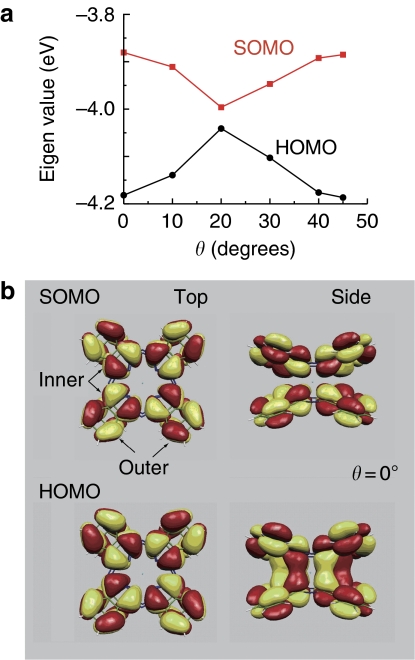
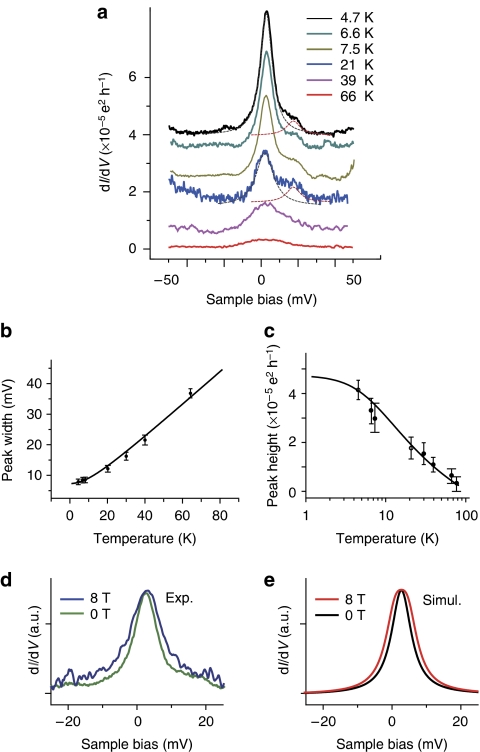
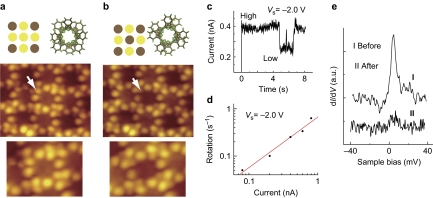
In molecular spintronics, the spin state of a molecule may be switched on and off by changing the molecular structure. Here, we switch on and off the molecular spin of a double-decker bis(phthalocyaninato)terbium(III) complex (TbPc₂) adsorbed on an Au(111) surface by applying an electric current via a scanning tunnelling microscope. The dI/dV curve of the tunnelling current recorded onto a TbPc₂ molecule shows a Kondo peak, the origin of which is an unpaired spin of a π-orbital of a phthalocyaninato (Pc) ligand. By applying controlled current pulses, we could rotate the upper Pc ligand in TbPc₂, leading to the disappearance and reappearance of the Kondo resonance. The rotation shifts the molecular frontier-orbital energies, quenching the π-electron spin. Reversible switching between two stable ligand orientations by applying a current pulse should make it possible to code information at the single-molecule level.
在分子自旋电子学中,通过改变分子结构可以打开和关闭分子的自旋状态。在这里,我们通过扫描隧道显微镜施加电流,从而打开和关闭吸附在 Au(111)表面的双层双(酞菁)铽(III)配合物(TbPc₂)的分子自旋。在 TbPc₂分子上记录的隧穿电流的 dI/dV 曲线显示出一个 Kondo 峰,其起源是酞菁(Pc)配体的π轨道的未配对自旋。通过施加受控电流脉冲,我们可以旋转 TbPc₂中的上酞菁配体,导致 Kondo 共振的消失和重现。旋转会改变分子的前线轨道能量,从而使π电子自旋猝灭。通过施加电流脉冲在两种稳定的配体取向之间进行可逆切换,应该可以实现单分子级别的信息编码。