
奖励可独立于注意力增强方向编码。
Reward sharpens orientation coding independently of attention.
作者信息
Baldassi Stefano, Simoncini Claudio
机构信息
Department of Psychology, University of Florence Florence, Italy.
出版信息
Front Neurosci. 2011 Feb 8;5:13. doi: 10.3389/fnins.2011.00013. eCollection 2011.
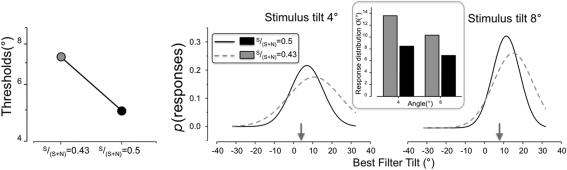
It has long been known that rewarding improves performance. However it is unclear whether this is due to high level modulations in the output modules of associated neural systems or due to low level mechanisms favoring more "generous" inputs? Some recent studies suggest that primary sensory areas, including V1 and A1, may form part of the circuitry of reward-based modulations, but there is no data indicating whether reward can be dissociated from attention or cross-trial forms of perceptual learning. Here we address this issue with a psychophysical dual task, to control attention, while perceptual performance on oriented targets associated with different levels of reward is assessed by measuring both orientation discrimination thresholds and behavioral tuning functions for tilt values near threshold. We found that reward, at any rate, improved performance. However, higher reward rates showed an improvement of orientation discrimination thresholds by about 50% across conditions and sharpened behavioral tuning functions. Data were unaffected by changing the attentional load and by dissociating the feature of the reward cue from the task-relevant feature. These results suggest that reward may act within the span of a single trial independently of attention by modulating the activity of early sensory stages through a improvement of the signal-to-noise ratio of task-relevant channels.
长期以来,人们都知道奖励能提高表现。然而,尚不清楚这是由于相关神经系统输出模块中的高级调制,还是由于有利于更“丰富”输入的低级机制?最近的一些研究表明,包括V1和A1在内的初级感觉区域可能构成基于奖励调制的神经回路的一部分,但没有数据表明奖励是否能与注意力或跨试验形式的知觉学习区分开来。在这里,我们通过一个心理物理学双重任务来解决这个问题,以控制注意力,同时通过测量方向辨别阈值和接近阈值的倾斜值的行为调谐函数,来评估与不同奖励水平相关的定向目标的知觉表现。我们发现,无论如何,奖励都能提高表现。然而,更高的奖励率在各种条件下使方向辨别阈值提高了约50%,并锐化了行为调谐函数。改变注意力负荷以及将奖励线索的特征与任务相关特征区分开来,数据不受影响。这些结果表明,奖励可能在单个试验的范围内起作用,通过改善任务相关通道的信噪比来调节早期感觉阶段的活动,从而独立于注意力。


 Zotero 插件