Center for Infectious Diseases and Microbiology Translational Research, University of Minnesota Medical School, 2001 6th Street SE, Minneapolis, MN 55455, USA.
Virol J. 2011 Mar 3;8:89. doi: 10.1186/1743-422X-8-89.
The objective of this study was to compare intravaginal (ivg) and subcutaneous (sc) administration of the guinea pig cytomegalovirus (GPCMV) in pregnant and non-pregnant guinea pigs. These studies tested the hypotheses that ivg infection would elicit immune responses, produce maternal viremia, and lead to vertical transmission, with an efficiency similar to the traditionally employed sc route.
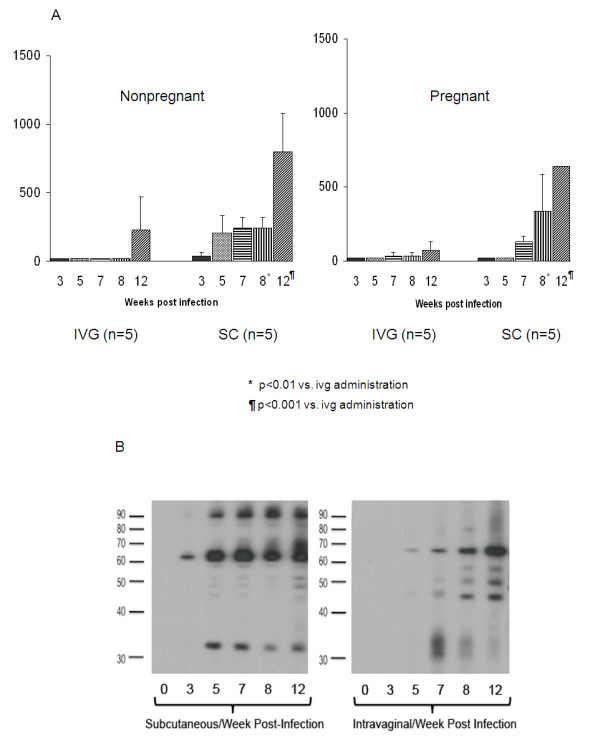
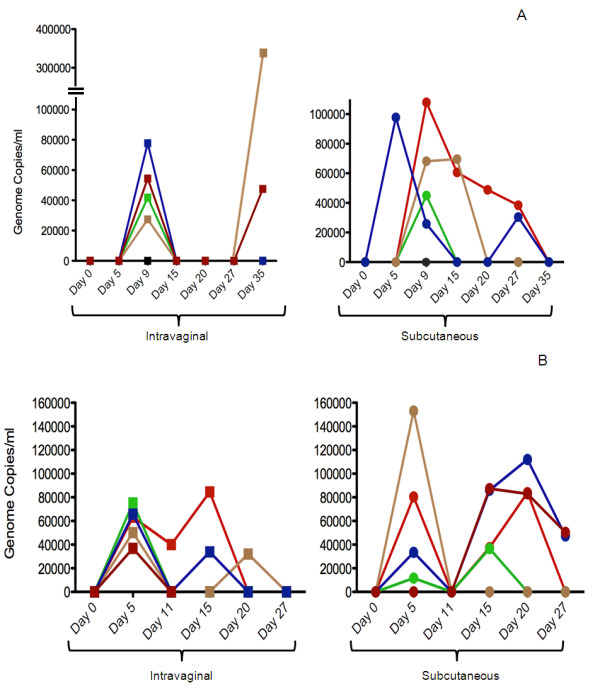
Four groups of age- and size-matched guinea pigs were studied. Two groups were pregnant, and two groups were not pregnant. Animals received 5 x 10(5) plaque-forming units (PFU) of a GPCMV reconstituted from an infectious bacterial artificial chromosome (BAC) construct containing the full-length GPCMV genome. Seroconversion was compared by IgG ELISA, and viremia (DNAemia) was monitored by PCR. In both pregnant and non-pregnant animals, sc inoculation resulted in significantly higher serum ELISA titers than ivg inoculation at 8 and 12 weeks post-infection. Patterns of viremia (DNAemia) were similar in animals inoculated by either sc or ivg route. However, in pregnant guinea pigs, animals inoculated by both routes experienced an earlier onset of DNAemia than did non-pregnant animals. Neither the percentage of dead pups nor the percentage of GPCMV positive placentas differed by inoculation route.
In the guinea pig model of congenital CMV infection, the ivg route is as efficient at causing congenital infection as the conventional but non-physiologic sc route. This finding could facilitate future experimental evaluation of vaccines and antiviral interventions in this highly relevant animal model.
本研究旨在比较经阴道(ivg)和皮下(sc)途径给予豚鼠巨细胞病毒(GPCMV)感染在妊娠和非妊娠豚鼠中的效果。这些研究检验了以下假设:ivg 感染可引起免疫反应、产生母源病毒血症并导致垂直传播,其效率与传统使用的 sc 途径相似。
本研究比较了四组年龄和体型匹配的豚鼠。两组为妊娠豚鼠,两组为非妊娠豚鼠。动物接受 5×10(5)噬斑形成单位(PFU)的由含有全长 GPCMV 基因组的感染性细菌人工染色体(BAC)构建体重建的 GPCMV。通过 IgG ELISA 比较血清转化,通过 PCR 监测病毒血症(DNAemia)。在妊娠和非妊娠动物中,sc 接种比 ivg 接种在感染后 8 周和 12 周时产生更高的血清 ELISA 滴度。通过 sc 或 ivg 途径接种的动物的病毒血症(DNAemia)模式相似。然而,在妊娠豚鼠中,两种途径接种的动物比非妊娠动物更早出现 DNAemia。接种途径对死胎率或 GPCMV 阳性胎盘率均无影响。
在先天性 CMV 感染的豚鼠模型中,ivg 途径与传统但非生理性的 sc 途径一样有效引起先天性感染。这一发现可能有助于未来在这一高度相关的动物模型中对疫苗和抗病毒干预措施进行实验评估。