Department of Veterinary and Biomedical Sciences, Center for Molecular Immunology and Infectious Disease, The Pennsylvania State University, University Park, Pennsylvania, USA.
Curr Opin Hematol. 2011 May;18(3):139-45. doi: 10.1097/MOH.0b013e32834521c8.
Acute anemic stress induces a physiological response that includes the rapid development of new erythrocytes. This process is referred to as stress erythropoiesis, which is distinct from steady state erythropoiesis. Much of what we know about stress erythropoiesis comes from the analysis of murine models. In this review, we will discuss our current understanding of the mechanisms that regulate stress erythropoiesis in mice and discuss outstanding questions in the field.
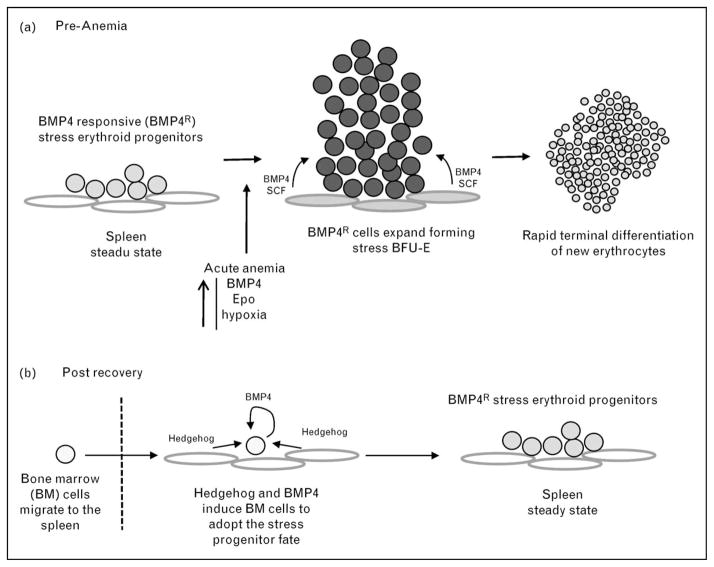
Stress erythropoiesis occurs in the murine spleen, fetal liver and adult liver. The signals that regulate this process are Hedgehog, bone morphogenetic protein 4 (BMP4), stem cell factor and hypoxia. Recent findings show that stress erythropoiesis utilizes a population of erythroid-restricted self-renewing stress progenitors. Although the BMP4-dependent stress erythropoiesis pathway was first characterized during the recovery from acute anemia, analysis of a mouse model of chronic anemia demonstrated that activation of the BMP4-dependent stress erythropoiesis pathway provides compensatory erythropoiesis in response to chronic anemia as well.
The BMP4-dependent stress erythropoiesis pathway plays a key role in the recovery from acute anemia and new data show that this pathway compensates for ineffective steady state erythropoiesis in a murine model of chronic anemia. The identification of a self-renewing population of stress erythroid progenitors in mice suggests that therapeutic manipulation of this pathway may be useful for the treatment of human anemia. However, the development of new therapies will await the characterization of an analogous pathway in humans.
急性贫血应激会引发包括新红细胞快速发育在内的生理反应。这一过程被称为应激性红细胞生成,与稳态红细胞生成不同。我们对应激性红细胞生成的了解主要来自对小鼠模型的分析。在这篇综述中,我们将讨论我们目前对调节小鼠应激性红细胞生成的机制的理解,并讨论该领域的悬而未决的问题。
应激性红细胞生成发生在小鼠的脾脏、胎儿肝脏和成人肝脏中。调节这一过程的信号有 Hedgehog、骨形态发生蛋白 4(BMP4)、干细胞因子和缺氧。最近的发现表明,应激性红细胞生成利用了一群红细胞受限的自我更新应激祖细胞。虽然 BMP4 依赖性应激性红细胞生成途径最初是在急性贫血恢复过程中被描述的,但对慢性贫血小鼠模型的分析表明,BMP4 依赖性应激性红细胞生成途径的激活也为慢性贫血提供了代偿性红细胞生成。
BMP4 依赖性应激性红细胞生成途径在急性贫血的恢复中起着关键作用,新的数据表明,该途径在慢性贫血的小鼠模型中补偿了无效的稳态红细胞生成。在小鼠中鉴定出了一群自我更新的应激性红细胞祖细胞,这表明对该途径的治疗性操纵可能对人类贫血的治疗有用。然而,新疗法的开发仍有待于在人类中对类似途径进行特征描述。