Department of Plant Pathology, College of Plant Protection, Nanjing Agricultural University, and Key Laboratory of Monitoring and Management of Crop Diseases and Pest Insects, Ministry of Agriculture, Nanjing, China.
PLoS Pathog. 2011 Feb;7(2):e1001302. doi: 10.1371/journal.ppat.1001302. Epub 2011 Feb 24.
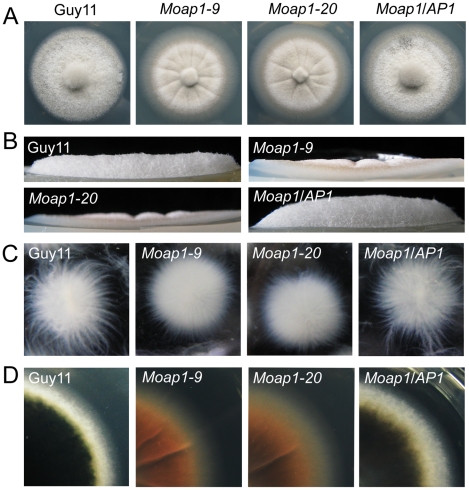
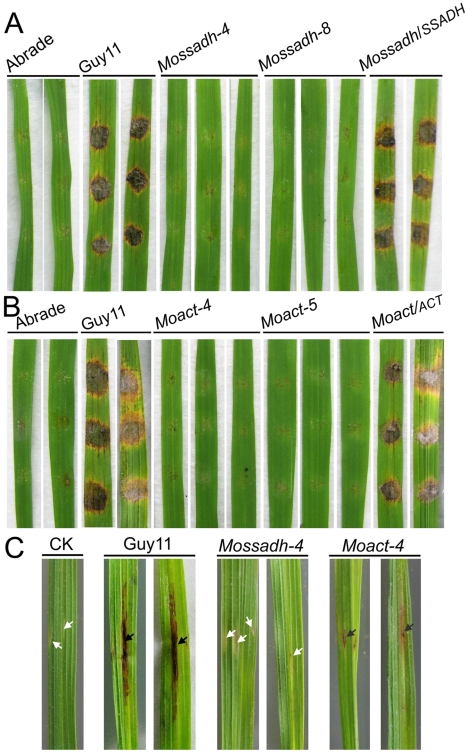
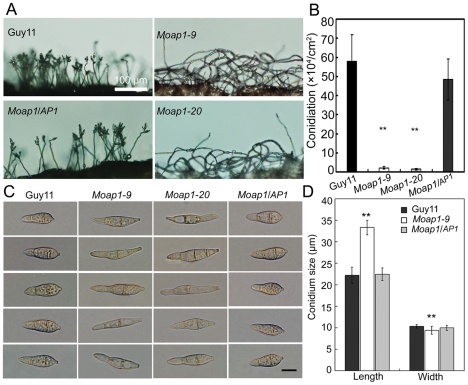
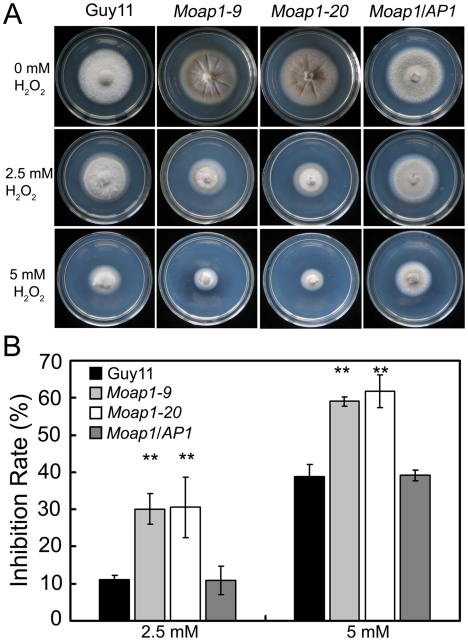
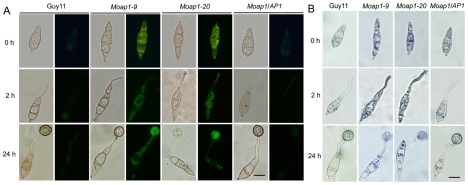
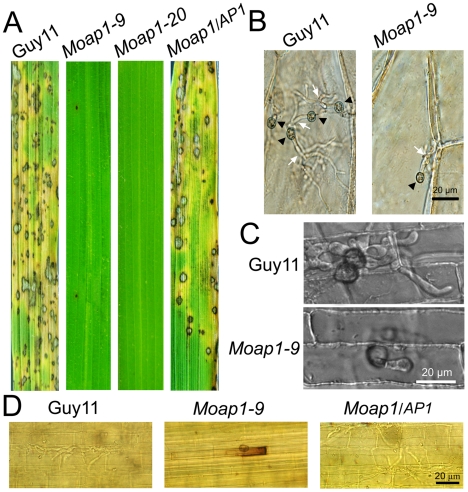
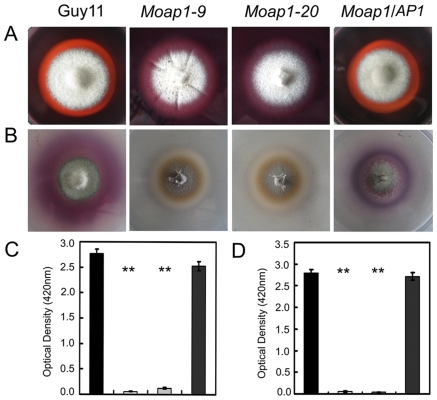
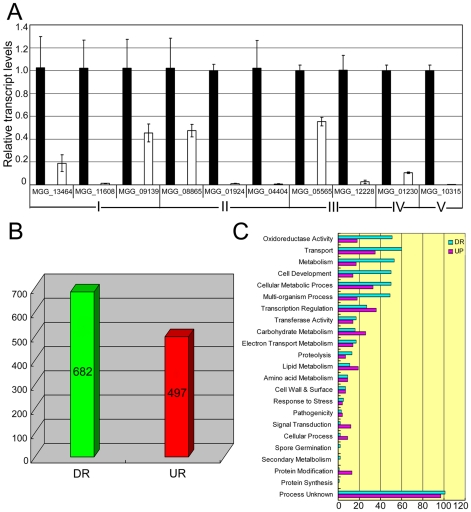
Saccharomyces cerevisiae Yap1 protein is an AP1-like transcription factor involved in the regulation of the oxidative stress response. An ortholog of Yap1, MoAP1, was recently identified from the rice blast fungus Magnaporthe oryzae genome. We found that MoAP1 is highly expressed in conidia and during invasive hyphal growth. The Moap1 mutant was sensitive to H₂O₂, similar to S. cerevisiae yap1 mutants, and MoAP1 complemented Yap1 function in resistance to H₂O₂, albeit partially. The Moap1 mutant also exhibited various defects in aerial hyphal growth, mycelial branching, conidia formation, the production of extracellular peroxidases and laccases, and melanin pigmentation. Consequently, the Moap1 mutant was unable to infect the host plant. The MoAP1-eGFP fusion protein is localized inside the nucleus upon exposure to H₂O₂, suggesting that MoAP1 also functions as a redox sensor. Moreover, through RNA sequence analysis, many MoAP1-regulated genes were identified, including several novel ones that were also involved in pathogenicity. Disruption of respective MGG_01662 (MoAAT) and MGG_02531 (encoding hypothetical protein) genes did not result in any detectable changes in conidial germination and appressorium formation but reduced pathogenicity, whereas the mutant strains of MGG_01230 (MoSSADH) and MGG_15157 (MoACT) showed marketed reductions in aerial hyphal growth, mycelial branching, and loss of conidiation as well as pathogenicity, similar to the Moap1 mutant. Taken together, our studies identify MoAP1 as a positive transcription factor that regulates transcriptions of MGG_01662, MGG_02531, MGG_01230, and MGG_15157 that are important in the growth, development, and pathogenicity of M. oryzae.
酿酒酵母 Yap1 蛋白是一种与 AP1 相似的转录因子,参与调控氧化应激反应。来自稻瘟病菌 Magnaporthe oryzae 基因组的 Yap1 直系同源物 MoAP1 最近被鉴定出来。我们发现 MoAP1 在分生孢子和侵入性菌丝生长过程中高度表达。Moap1 突变体对 H₂O₂敏感,与酿酒酵母 yap1 突变体相似,并且 MoAP1 部分互补了 yap1 对 H₂O₂的抗性。Moap1 突变体在气生菌丝生长、菌丝分枝、分生孢子形成、胞外过氧化物酶和漆酶的产生以及黑色素沉着方面也表现出各种缺陷。因此,Moap1 突变体无法感染宿主植物。MoAP1-eGFP 融合蛋白在暴露于 H₂O₂时定位于细胞核内,表明 MoAP1 也作为一种氧化还原传感器发挥作用。此外,通过 RNA 序列分析,鉴定了许多 MoAP1 调控的基因,包括一些也参与致病性的新基因。分别破坏 MGG_01662(MoAAT)和 MGG_02531(编码假定蛋白)基因不会导致分生孢子萌发和附着胞形成有任何可检测的变化,但会降低致病性,而 MGG_01230(MoSSADH)和 MGG_15157(MoACT)突变株在气生菌丝生长、菌丝分枝和分生孢子丧失以及致病性方面表现出明显降低,与 Moap1 突变体相似。总之,我们的研究确定 MoAP1 是一种正转录因子,它调节 MGG_01662、MGG_02531、MGG_01230 和 MGG_15157 的转录,这些基因在稻瘟病菌的生长、发育和致病性中很重要。