Department of Medicine, Santa Clara Valley Medical Center, San Jose, California, United States of America.
PLoS One. 2011 Feb 24;6(2):e16636. doi: 10.1371/journal.pone.0016636.
We sought to identify genes of clinical significance to predict survival and the risk for colorectal liver metastasis (CLM), the most common site of metastasis from colorectal cancer (CRC).
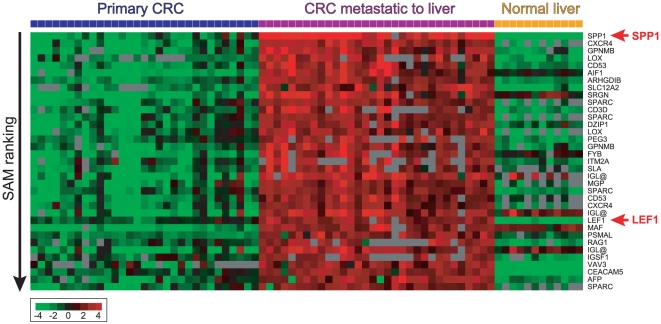
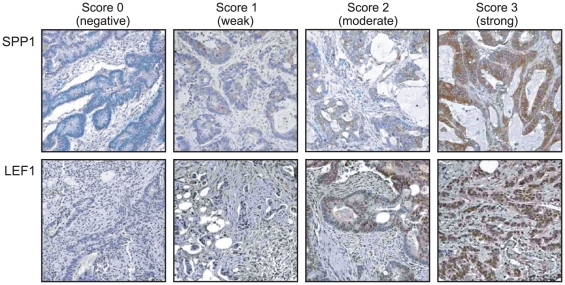
We profiled gene expression in 31 specimens from primary CRC and 32 unmatched specimens of CLM, and performed Significance Analysis of Microarrays (SAM) to identify genes differentially expressed between these two groups. To characterize the clinical relevance of two highly-ranked differentially-expressed genes, we analyzed the expression of secreted phosphoprotein 1 (SPP1 or osteopontin) and lymphoid enhancer factor-1 (LEF1) by immunohistochemistry using a tissue microarray (TMA) representing an independent set of 154 patients with primary CRC.
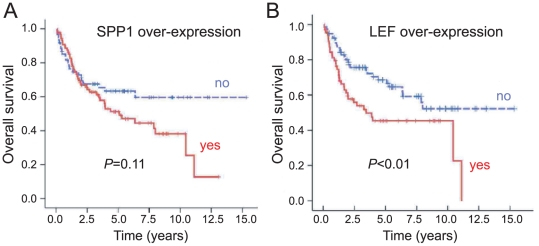
Supervised analysis using SAM identified 963 genes with significantly higher expression in CLM compared to primary CRC, with a false discovery rate of <0.5%. TMA analysis showed SPP1 and LEF1 protein overexpression in 60% and 44% of CRC cases, respectively. Subsequent occurrence of CLM was significantly correlated with the overexpression of LEF1 (chi-square p = 0.042), but not SPP1 (p = 0.14). Kaplan Meier analysis revealed significantly worse survival in patients with overexpression of LEF1 (p<0.01), but not SPP1 (p = 0.11). Both univariate and multivariate analyses identified stage (p<0.0001) and LEF1 overexpression (p<0.05) as important prognostic markers, but not tumor grade or SPP1.
Among genes differentially expressed between CLM and primary CRC, we demonstrate overexpression of LEF1 in primary CRC to be a prognostic factor for poor survival and increased risk for liver metastasis.
我们试图鉴定具有临床意义的基因,以预测结直肠癌(CRC)肝转移(CLM)的生存和风险,CLM 是 CRC 最常见的转移部位。
我们对 31 例原发 CRC 标本和 32 例非匹配 CLM 标本进行了基因表达谱分析,并进行了差异表达分析(SAM)以鉴定两组间差异表达的基因。为了描述两个高排名差异表达基因的临床相关性,我们使用组织微阵列(TMA)对 154 例原发性 CRC 患者的独立样本进行了免疫组织化学分析,分析了分泌磷蛋白 1(SPP1 或骨桥蛋白)和淋巴增强因子 1(LEF1)的表达。
使用 SAM 进行的有监督分析鉴定了 963 个在 CLM 中与原发性 CRC 相比表达明显升高的基因,假发现率<0.5%。TMA 分析显示 SPP1 和 LEF1 蛋白在分别在 60%和 44%的 CRC 病例中过表达。随后发生 CLM 与 LEF1 过表达显著相关(卡方检验,p=0.042),但与 SPP1 无关(p=0.14)。Kaplan-Meier 分析显示,LEF1 过表达的患者生存明显较差(p<0.01),但 SPP1 过表达患者的生存无差异(p=0.11)。单因素和多因素分析均表明,分期(p<0.0001)和 LEF1 过表达(p<0.05)是重要的预后标志物,但肿瘤分级或 SPP1 不是。
在 CLM 和原发性 CRC 之间差异表达的基因中,我们证明原发性 CRC 中 LEF1 的过表达是生存不良和肝转移风险增加的预后因素。