Department of Biochemistry, Faculty of Medicine and Health Sciences-Gomail, University of Aljabal Algharbil, Zawia-16418, Libya.
BMC Immunol. 2011 Mar 8;12:19. doi: 10.1186/1471-2172-12-19.
Autoantibodies against glutamate decarboxylase-65 (GAD₆₅Abs) are thought to be a major immunological tool involved in pathogenic autoimmunity development in various diseases. GAD₆₅Abs are a sensitive and specific marker for type 1 diabetes (T1D). These autoantibodies can also be found in 6-10% of patients classified with type 2 diabetes (T2D), as well as in 1-2% of the healthy population. The latter individuals are at low risk of developing T1D because the prevalence rate of GAD₆₅Abs is only about 0.3%. It has, therefore, been suggested that the antibody binding to GAD₆₅ in these three different GAD₆₅Ab-positive phenotypes differ with respect to epitope specificity. The specificity of reactive oxygen species modified GAD₆₅ (ROS-GAD₆₅) is already well established in the T1D. However, its association in secondary complications of T1D has not yet been ascertained. Hence this study focuses on identification of autoantibodies against ROS-GAD₆₅ (ROS-GAD₆₅Abs) and quantitative assays in T1D associated complications.
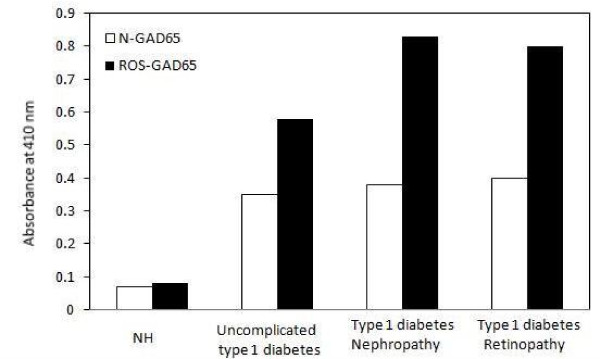
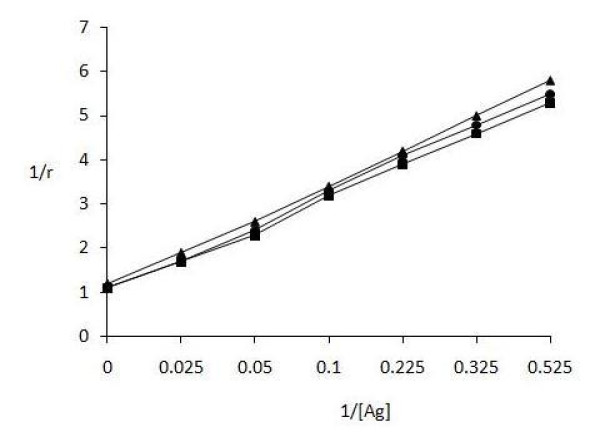
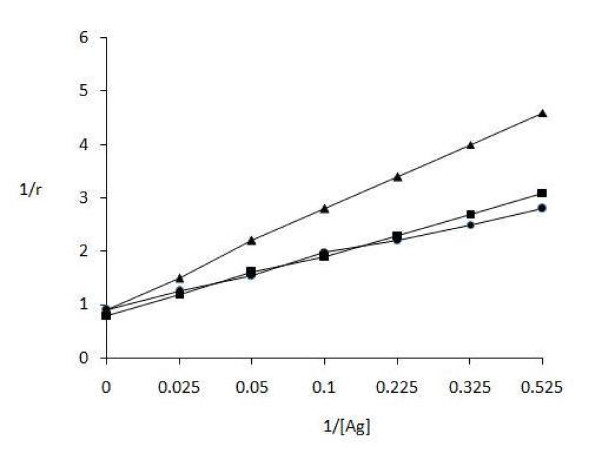
From the cohort of samples, serum autoantibodies from T1D retinopathic and nephropathic patients showed high recognition of ROS-GAD₆₅ as compared to native GAD₆₅ (N-GAD₆₅). Uncomplicated T1D subjects also exhibited reactivity towards ROS-GAD65. However, this was found to be less as compared to the binding recorded from complicated subjects. These results were further proven by competitive ELISA estimations. The apparent association constants (AAC) indicate greater affinity of IgG from retinopathic T1D patients (1.90 x 10⁻⁶ M) followed by nephropathic (1.81 x 10⁻⁶ M) and uncomplicated (3.11 x 10⁻⁷ M) T1D patients for ROS-GAD₆₅ compared to N-GAD₆₅.
Increased oxidative stress and blood glucose levels with extended duration of disease in complicated T1D could be responsible for the gradual formation and/or exposing cryptic epitopes on GAD₆₅ that induce increased production of ROS-GAD₆₅Abs. Hence regulation of ROS-GAD₆₅Abs could offer novel tools for analysing and possibly treating T1D complications.
谷氨酸脱羧酶-65(GAD₆₅Abs)自身抗体被认为是参与各种疾病中致病性自身免疫发展的主要免疫工具。GAD₆₅Abs 是 1 型糖尿病(T1D)的敏感和特异性标志物。这些自身抗体也存在于 6-10%的 2 型糖尿病(T2D)患者中,以及 1-2%的健康人群中。后者发生 T1D 的风险较低,因为 GAD₆₅Abs 的流行率仅约为 0.3%。因此,有人认为,这三种不同的 GAD₆₅Ab 阳性表型中与 GAD₆₅结合的抗体在表位特异性方面存在差异。在 T1D 中,已经证实活性氧修饰的谷氨酸脱羧酶 65(ROS-GAD₆₅)的特异性。然而,其在 T1D 继发并发症中的关联尚未确定。因此,本研究专注于鉴定与 T1D 相关并发症的 ROS-GAD₆₅(ROS-GAD₆₅Abs)自身抗体和定量检测。
从样本队列中,T1D 视网膜病变和肾病患者的血清自身抗体对 ROS-GAD₆₅的识别率高于天然 GAD₆₅(N-GAD₆₅)。未经治疗的 T1D 患者也表现出对 ROS-GAD65 的反应性。然而,与复杂组记录的结合相比,这被发现要少。这些结果通过竞争性 ELISA 估算进一步得到证实。表观结合常数(AAC)表明,来自视网膜病变 T1D 患者的 IgG 对 ROS-GAD₆₅的亲和力更高(1.90 x 10⁻⁶ M),其次是肾病(1.81 x 10⁻⁶ M)和未经治疗的 T1D 患者(3.11 x 10⁻⁷ M),与 N-GAD₆₅相比。
复杂 T1D 中氧化应激和血糖水平的升高以及疾病持续时间的延长可能导致 GAD₆₅上逐渐形成和/或暴露隐匿表位,从而诱导 ROS-GAD₆₅Abs 的产生增加。因此,ROS-GAD₆₅Abs 的调节可能为分析和可能治疗 T1D 并发症提供新的工具。