Department of Ecology and Genetics, Evolutionary Biology Centre, Uppsala University, Uppsala, Sweden.
PLoS One. 2011 Feb 28;6(2):e17358. doi: 10.1371/journal.pone.0017358.
The evolution of female choice mechanisms favouring males of their own kind is considered a crucial step during the early stages of speciation. However, although the genomics of mate choice may influence both the likelihood and speed of speciation, the identity and location of genes underlying assortative mating remain largely unknown.
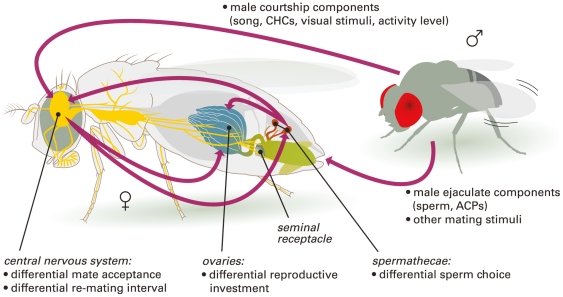
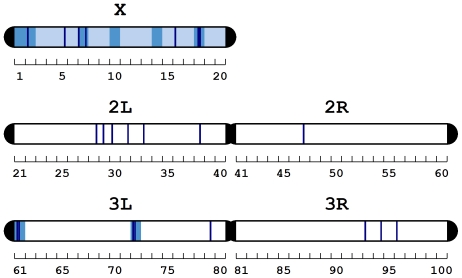
We used mate choice experiments and gene expression analysis of female Drosophila melanogaster to examine three key components influencing speciation. We show that the 1,498 genes in Zimbabwean female D. melanogaster whose expression levels differ when mating with more (Zimbabwean) versus less (Cosmopolitan strain) preferred males include many with high expression in the central nervous system and ovaries, are disproportionately X-linked and form a number of clusters with low recombination distance. Significant involvement of the brain and ovaries is consistent with the action of a combination of pre- and postcopulatory female choice mechanisms, while sex linkage and clustering of genes lead to high potential evolutionary rate and sheltering against the homogenizing effects of gene exchange between populations.
Taken together our results imply favourable genomic conditions for the evolution of reproductive isolation through mate choice in Zimbabwean D. melanogaster and suggest that mate choice may, in general, act as an even more important engine of speciation than previously realized.
雌性选择机制向同种雄性进化被认为是物种形成早期的关键步骤。然而,尽管配偶选择的基因组学可能会影响物种形成的可能性和速度,但导致选择性交配的基因的身份和位置在很大程度上仍然未知。
我们使用果蝇的交配选择实验和基因表达分析来研究影响物种形成的三个关键因素。我们表明,在与更喜欢的雄性(津巴布韦种群)相比,与不太喜欢的雄性(世界性种群)交配时,津巴布韦种群的 1498 个果蝇的基因表达水平存在差异,其中包括许多在中枢神经系统和卵巢中高表达的基因,不成比例地位于 X 染色体上,并形成了许多重组距离较小的基因簇。大脑和卵巢的显著参与与一系列的预交配和交配后雌性选择机制的作用一致,而性连锁和基因聚类则导致了高的潜在进化率,并防止了种群间基因交换的同质化效应。
总的来说,我们的结果表明,津巴布韦果蝇通过交配选择进化生殖隔离具有有利的基因组条件,并表明配偶选择可能比以前认为的更能成为物种形成的重要引擎。