Neuroscience Program, University of Michigan, Ann Arbor, MI 48109-0520, USA.
Horm Behav. 2011 Jun;60(1):46-57. doi: 10.1016/j.yhbeh.2011.03.001. Epub 2011 Mar 21.
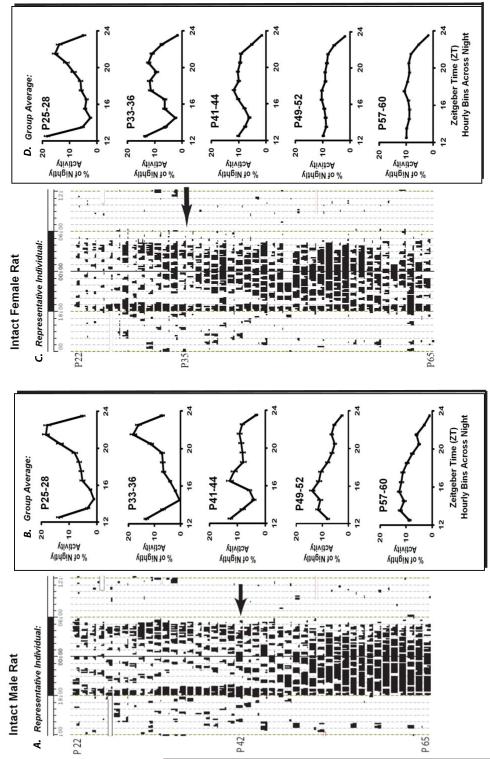
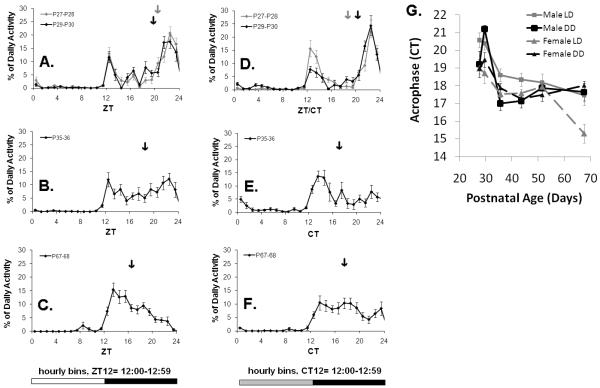
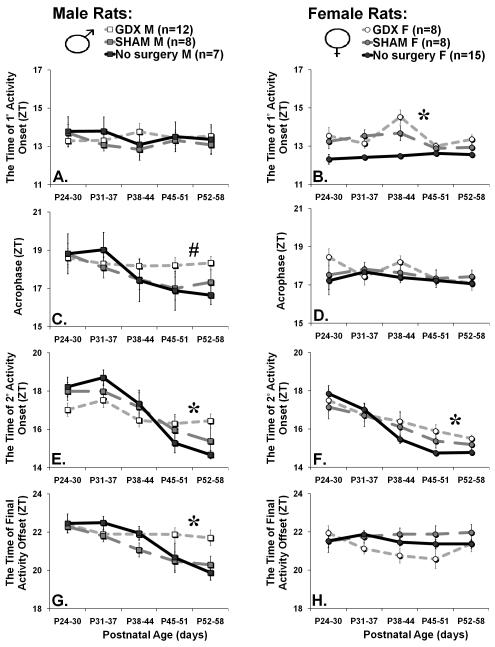
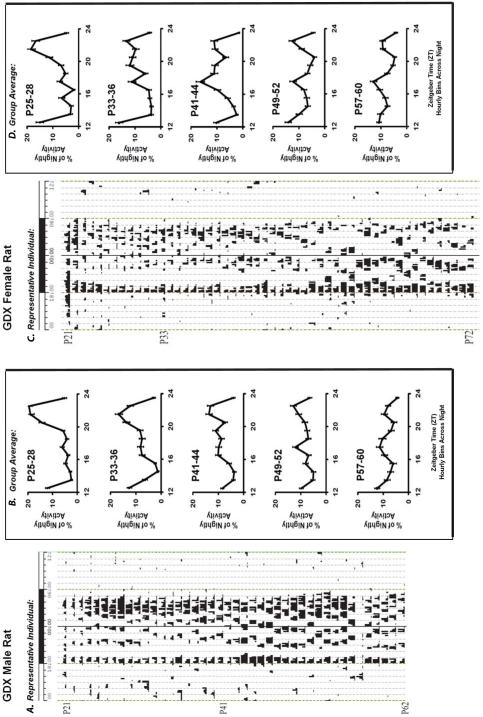
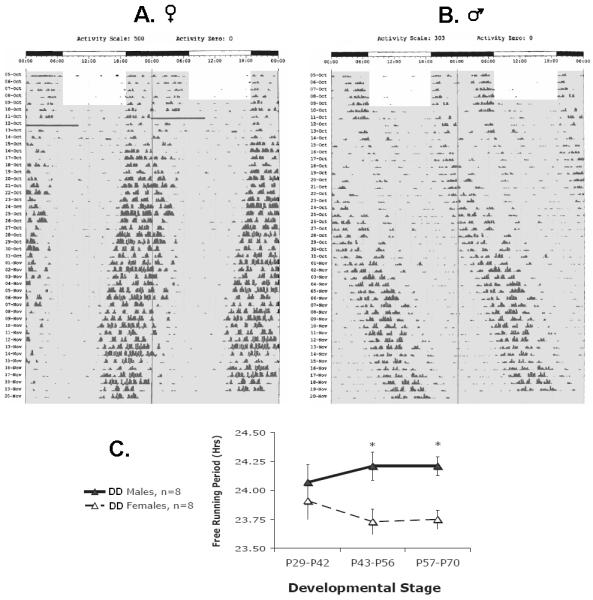
During puberty, humans develop a later chronotype, exhibiting a phase-delayed daily rest/activity rhythm. The purpose of this study was to determine: 1) whether similar changes in chronotype occur during puberty in a laboratory rodent species, 2) whether these changes are due to pubertal hormones affecting the circadian timekeeping system. We tracked the phasing and distribution of wheel-running activity rhythms during post-weaning development in rats that were gonadectomized before puberty or left intact. We found that intact peripubertal rats had activity rhythms that were phase-delayed relative to adults. Young rats also exhibited a bimodal nocturnal activity distribution. As puberty progressed, bimodality diminished and late-night activity phase-advanced until it consolidated with early-night activity. By late puberty, intact rats showed a strong, unimodal rhythm that peaked at the beginning of the night. These pubertal changes in circadian phase were more pronounced in males than females. Increases in gonadal hormones during puberty partially accounted for these changes, as rats that were gonadectomized before puberty demonstrated smaller phase changes than intact rats and maintained ultradian rhythms into adulthood. We investigated the role of photic entrainment by comparing circadian development under constant and entrained conditions. We found that the period (τ) of free-running rhythms developed sex differences during puberty. These changes in τ did not account for pubertal changes in entrained circadian phase, as the consolidation of activity at the beginning of the subjective night persisted under constant conditions in both sexes. We conclude that the circadian system continues to develop in a hormone-sensitive manner during puberty.
在青春期,人类的生物钟会延迟,表现为日常休息/活动节律的相位延迟。本研究旨在确定:1)在实验室啮齿动物物种中,青春期是否会发生类似的生物钟变化;2)这些变化是否是由于青春期激素影响昼夜节律计时系统。我们跟踪了去势前或未去势的青春期前大鼠在断奶后发育过程中轮跑活动节律的相位和分布。我们发现,未去势的青春期前大鼠的活动节律相对于成年大鼠存在相位延迟。年轻大鼠还表现出双峰夜间活动分布。随着青春期的发展,双峰性减少,深夜活动相位提前,直到与清晨活动合并。到青春期后期,未去势的大鼠表现出强烈的、单一模式的节律,峰值出现在夜晚开始时。这些昼夜节律相位的青春期变化在雄性中比雌性更为明显。青春期期间性腺激素的增加部分解释了这些变化,因为青春期前去势的大鼠比未去势的大鼠表现出较小的相位变化,并保持超昼夜节律进入成年期。我们通过比较恒定和受约束条件下的昼夜节律发育来研究光感适应的作用。我们发现,自由运行节律的周期(τ)在青春期出现性别差异。这些τ 的变化并不能解释受约束的昼夜节律相位的青春期变化,因为在两种性别中,活动在主观夜晚开始时的整合在恒定条件下仍然存在。我们得出结论,在青春期,昼夜节律系统继续以激素敏感的方式发育。