Department of Oncology and the Medical Research Council Cancer Cell Unit, Hutchison/MRC Research Centre, University of Cambridge, Cambridge, UK.
Oncogene. 2011 Jul 28;30(30):3360-9. doi: 10.1038/onc.2011.55. Epub 2011 Mar 14.
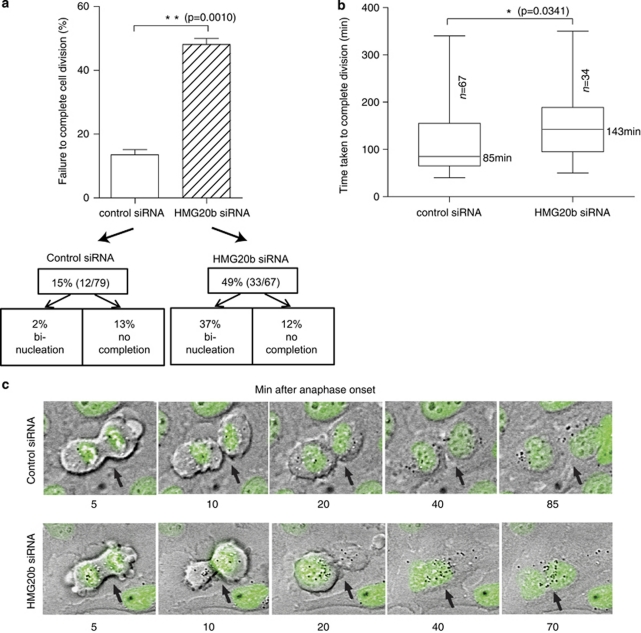
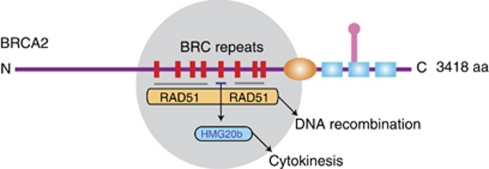
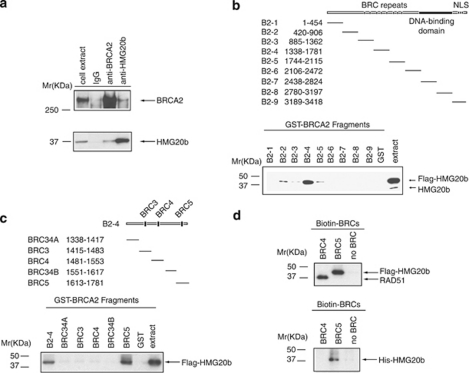
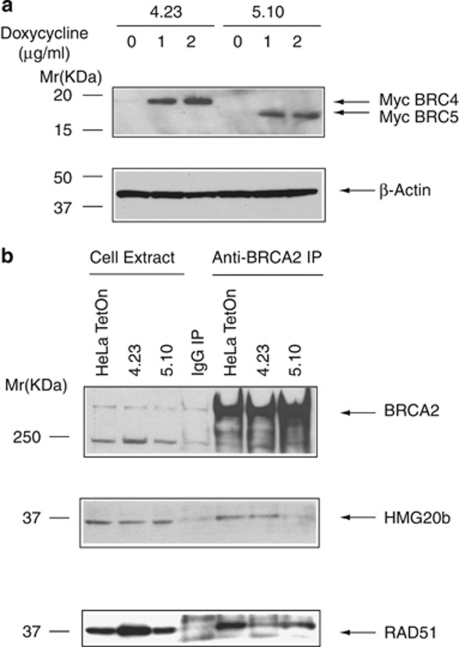
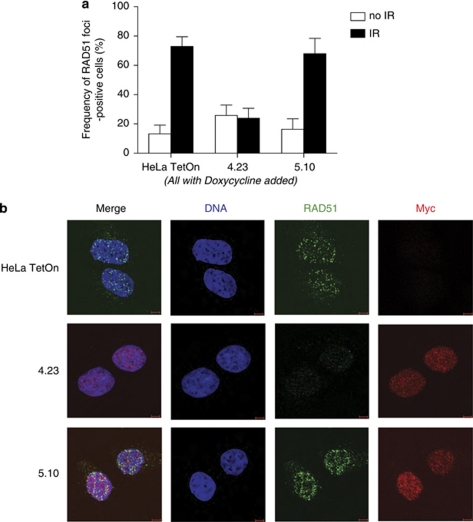
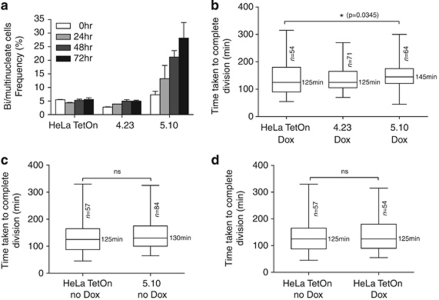
The inactivation of BRCA2, a suppressor of breast, ovarian and other epithelial cancers, triggers instability in chromosome structure and number, which are thought to arise from defects in DNA recombination and mitotic cell division, respectively. Human BRCA2 controls DNA recombination via eight BRC repeats, evolutionarily conserved motifs of ∼35 residues, that interact directly with the recombinase RAD51. How BRCA2 controls mitotic cell division is debated. Several studies by different groups report that BRCA2 deficiency affects cytokinesis. Moreover, its interaction with HMG20b, a protein of uncertain function containing a promiscuous DNA-binding domain and kinesin-like coiled coils, has been implicated in the G2-M transition. We show here that HMG20b depletion by RNA interference disturbs the completion of cell division, suggesting a novel function for HMG20b. In vitro, HMG20b binds directly to the BRC repeats of BRCA2, and exhibits the highest affinity for BRC5, a motif that binds poorly to RAD51. Conversely, the BRC4 repeat binds strongly to RAD51, but not to HMG20b. In vivo, BRC5 overexpression inhibits the BRCA2-HMG20b interaction, recapitulating defects in the completion of cell division provoked by HMG20b depletion. In contrast, BRC4 inhibits the BRCA2-RAD51 interaction and the assembly of RAD51 at sites of DNA damage, but not the completion of cell division. Our findings suggest that a novel function for HMG20b in cytokinesis is regulated by its interaction with the BRC repeats of BRCA2, and separate this unexpected function for the BRC repeats from their known activity in DNA recombination. We propose that divergent tumor-suppressive pathways regulating chromosome segregation as well as chromosome structure may be governed by the conserved BRC motifs in BRCA2.
BRCA2 是一种抑制乳腺癌、卵巢癌和其他上皮癌的抑癌基因,其失活会导致染色体结构和数量的不稳定,分别被认为源于 DNA 重组和有丝分裂细胞分裂的缺陷。人类 BRCA2 通过八个 BRC 重复序列控制 DNA 重组,这些重复序列是进化上保守的约 35 个残基的基序,直接与重组酶 RAD51 相互作用。BRCA2 如何控制有丝分裂细胞分裂存在争议。不同小组的几项研究报告称,BRCA2 缺陷会影响胞质分裂。此外,它与 HMG20b 的相互作用也被牵涉其中,HMG20b 是一种功能未知的蛋白,含有一个混杂的 DNA 结合域和驱动蛋白样卷曲螺旋。我们在这里表明,通过 RNA 干扰耗尽 HMG20b 会扰乱细胞分裂的完成,这表明 HMG20b 具有新的功能。在体外,HMG20b 直接与 BRCA2 的 BRC 重复序列结合,并且对结合 RAD51 能力较弱的 BRC5 基序具有最高亲和力。相反,BRC4 重复序列与 RAD51 结合紧密,但不与 HMG20b 结合。在体内,BRC5 过表达抑制 BRCA2-HMG20b 相互作用,再现了由 HMG20b 耗尽引起的细胞分裂完成缺陷。相比之下,BRC4 抑制 BRCA2-RAD51 相互作用和 RAD51 在 DNA 损伤部位的组装,但不影响细胞分裂的完成。我们的研究结果表明,HMG20b 在胞质分裂中的新功能受其与 BRCA2 的 BRC 重复序列相互作用的调节,并且将 BRC 重复序列的这一意外功能与其在 DNA 重组中的已知活性分开。我们提出,调节染色体分离和染色体结构的新的肿瘤抑制途径可能由 BRCA2 中的保守 BRC 基序控制。