Motwani Jyoti, Eccles Michael R
Department of Pathology, Dunedin School of Medicine, University of Otago, Dunedin 9016, New Zealand.
Maurice Wilkins Centre for Molecular Biodiscovery, Auckland 1010, New Zealand.
Genes (Basel). 2021 Sep 28;12(10):1543. doi: 10.3390/genes12101543.
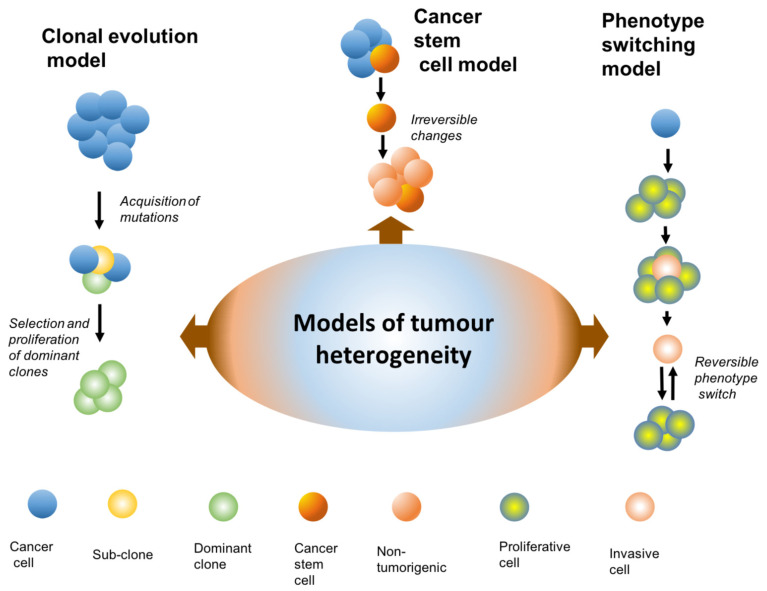
Melanoma is a serious form of skin cancer that accounts for 80% of skin cancer deaths. Recent studies have suggested that melanoma invasiveness is attributed to phenotype switching, which is a reversible type of cell behaviour with similarities to epithelial to mesenchymal transition. Phenotype switching in melanoma is reported to be independent of genetic alterations, whereas changes in gene transcription, and epigenetic alterations have been associated with invasiveness in melanoma cell lines. Here, we review mutational, transcriptional, and epigenomic alterations that contribute to tumour heterogeneity in melanoma, and their potential to drive melanoma invasion and metastasis. We also discuss three models that are hypothesized to contribute towards aspects of tumour heterogeneity and tumour progression in melanoma, namely the clonal evolution model, the cancer stem cell model, and the phenotype switching model. We discuss the merits and disadvantages of each model in explaining tumour heterogeneity in melanoma, as a precursor to invasion and metastasis.
黑色素瘤是一种严重的皮肤癌形式,占皮肤癌死亡人数的80%。最近的研究表明,黑色素瘤的侵袭性归因于表型转换,这是一种可逆的细胞行为类型,类似于上皮-间质转化。据报道,黑色素瘤中的表型转换与基因改变无关,而基因转录的变化和表观遗传改变与黑色素瘤细胞系的侵袭性有关。在这里,我们综述了导致黑色素瘤肿瘤异质性的突变、转录和表观基因组改变,以及它们驱动黑色素瘤侵袭和转移的潜力。我们还讨论了三种被假设有助于黑色素瘤肿瘤异质性和肿瘤进展的模型,即克隆进化模型、癌症干细胞模型和表型转换模型。我们讨论了每种模型在解释黑色素瘤肿瘤异质性(作为侵袭和转移的前兆)方面的优缺点。