Laboratorio de Terapias Regenerativas y Protectoras del Sistema Nervioso, Fundación Instituto Leloir, Patricias Argentinas 435, C1405BWE Buenos Aires, Argentina.
Parkinsons Dis. 2011 Feb 22;2011:436813. doi: 10.4061/2011/436813.
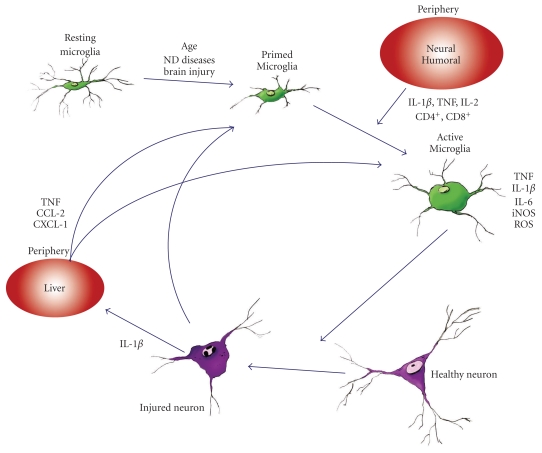
Peripheral inflammation triggers exacerbation in the central brain's ongoing damage in several neurodegenerative diseases. Systemic inflammatory stimulus induce a general response known as sickness behaviour, indicating that a peripheral stimulus can induce the synthesis of cytokines in the brain. In Parkinson's disease (PD), inflammation was mainly associated with microglia activation that can underlie the neurodegeneration of neurons in the substantia nigra (SN). Peripheral inflammation can transform the "primed" microglia into an "active" state, which can trigger stronger responses dealing with neurodegenerative processes. Numerous evidences show that systemic inflammatory processes exacerbate ongoing neurodegeneration in PD patient and animal models. Anti-inflammatory treatment in PD patients exerts a neuroprotective effect. In the present paper, we analyse the effect of peripheral infections in the etiology and progression in PD patients and animal models, suggesting that these peripheral immune challenges can exacerbate the symptoms in the disease.
外周炎症会触发几种神经退行性疾病中中枢大脑持续损伤的恶化。全身炎症刺激会引起一种被称为疾病行为的一般反应,表明外周刺激可以诱导大脑中的细胞因子合成。在帕金森病 (PD) 中,炎症主要与小胶质细胞激活有关,这可能是黑质 (SN) 神经元神经退行性变的基础。外周炎症可以将“致敏”的小胶质细胞转化为“激活”状态,从而引发更强的反应来应对神经退行性过程。大量证据表明,全身炎症过程会加剧 PD 患者和动物模型中持续的神经退行性变。PD 患者的抗炎治疗具有神经保护作用。在本文中,我们分析了外周感染在 PD 患者和动物模型发病和进展中的作用,表明这些外周免疫挑战会加重疾病的症状。