
比较不同培养条件对向血管内皮细胞系定向分化的血液和骨髓细胞生长和分化的影响。
Comparison between Culture Conditions Improving Growth and Differentiation of Blood and Bone Marrow Cells Committed to the Endothelial Cell Lineage.
机构信息
Department of Biochemistry, University of Bologna and National Institute for Cardiovascular Research, Bologna, Italy.
出版信息
Biol Proced Online. 2010 Feb 6;12(1):9023. doi: 10.1007/s12575-009-9023-y.
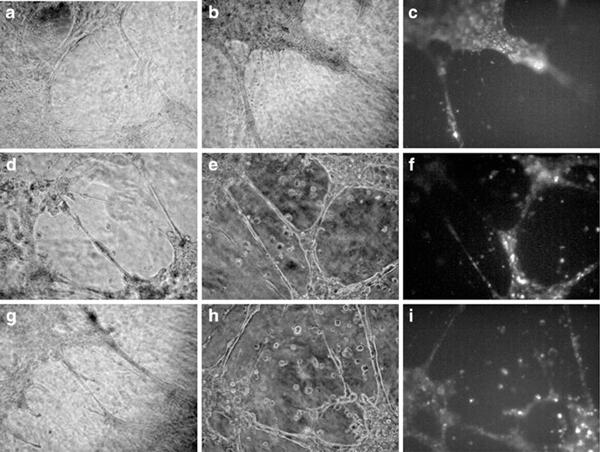
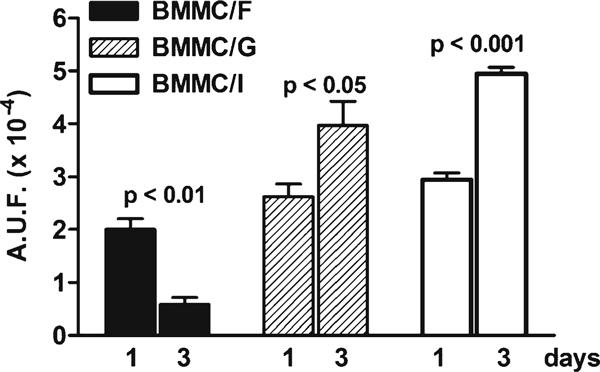
The aim of this study was to compare different cell sources and culture conditions to obtain endothelial progenitor cells (EPCs) with predictable antigen pattern, proliferation potential and in vitro vasculogenesis. Pig mononuclear cells were isolated from blood (PBMCs) and bone marrow (BMMCs). Mesenchymal stem cells (MSCs) were also derived from pig bone marrow. Cells were cultured on fibronectin in the presence of a high concentration of VEGF and low IGF-1 and FGF-2 levels, or on gelatin with a lower amount of VEGF and higher IGF-1 and FGF-2 concentrations. Endothelial commitment was relieved in almost all PBMCs and BMMCs irrespective of the protocol used, whilst MSCs did not express a reliable pattern of EPC markers under these conditions. BMMCs were more prone to expand on gelatin and showed a better viability than PBMCs. Moreover, about 90% of the BMMCs pre-cultured on gelatin could adhere to a hyaluronan-based scaffold and proliferate on it up to 3 days. Pre-treatment of BMMCs on fibronectin generated well-shaped tubular structures on Matrigel, whilst BMMCs exposed to the gelatin culture condition were less prone to form vessel-like structures. MSCs formed rough tubule-like structures, irrespective of the differentiating condition used. In a relative short time, pig BMMCs could be expanded on gelatin better than PBMCs, in the presence of a low amount of VEGF. BMMCs could better specialize for capillary formation in the presence of fibronectin and an elevated concentration of VEGF, whilst pig MSCs anyway showed a limited capability to differentiate into the endothelial cell lineage.
本研究旨在比较不同的细胞来源和培养条件,以获得具有可预测抗原表型、增殖潜能和体外血管生成能力的内皮祖细胞(EPC)。从血液(PBMCs)和骨髓(BMMCs)中分离出猪单核细胞。间充质干细胞(MSCs)也来源于猪骨髓。细胞在高浓度 VEGF 和低 IGF-1 和 FGF-2 水平的纤维连接蛋白上,或在 VEGF 浓度较低、IGF-1 和 FGF-2 浓度较高的明胶上培养。无论使用何种方案,几乎所有 PBMCs 和 BMMCs 都能释放内皮细胞的定向信号,而 MSCs 在这些条件下不能表达可靠的 EPC 标志物模式。BMMCs 更倾向于在明胶上扩展,并且比 PBMCs 具有更好的活力。此外,约 90%的在明胶上预培养的 BMMCs 能够附着在透明质酸基支架上,并在其上增殖至 3 天。BMMCs 在纤维连接蛋白上的预处理在 Matrigel 上生成了形状良好的管状结构,而暴露于明胶培养条件下的 BMMCs 形成管状结构的倾向较小。MSCs 形成了粗糙的管状结构,无论使用何种分化条件。在相对较短的时间内,BMMCs 在明胶中的生长优于 PBMCs,且 VEGF 含量较低。BMMCs 在纤维连接蛋白和高浓度 VEGF 的存在下能够更好地专门用于毛细血管形成,而猪 MSCs 无论如何都显示出有限的分化为内皮细胞谱系的能力。


 Zotero 插件