Department of Biomedical and Neuromotor Sciences (DIBINEM), University of Bologna, Via Irnerio 48, 40126, Bologna, Italy.
J Biomed Sci. 2013 Aug 29;20(1):63. doi: 10.1186/1423-0127-20-63.
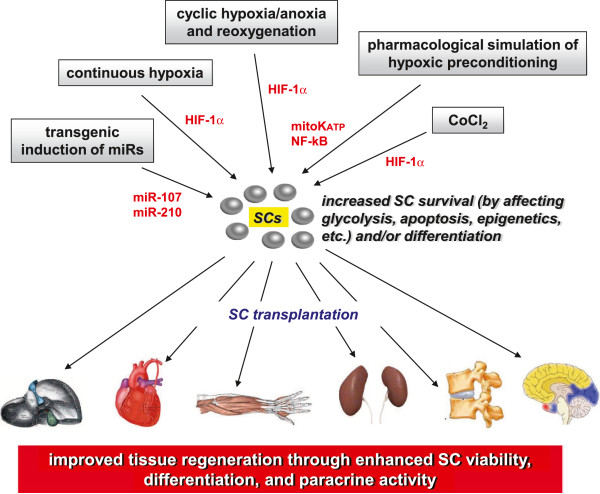
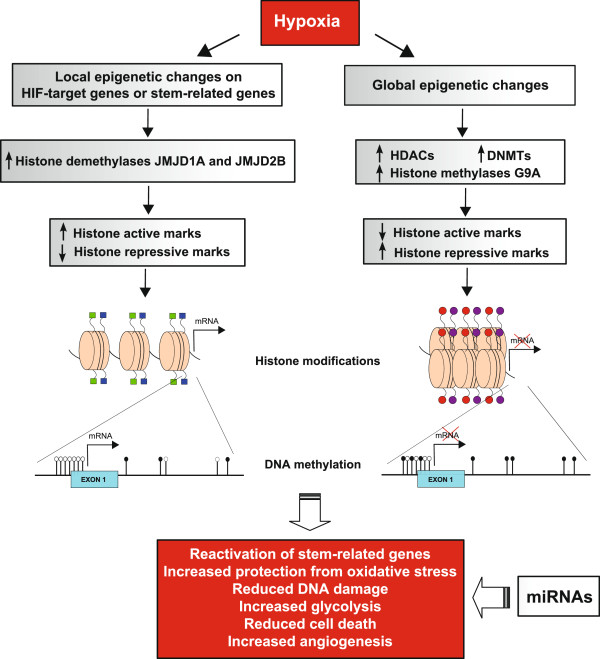
The efficiency of regenerative medicine can be ameliorated by improving the biological performances of stem cells before their transplantation. Several ex-vivo protocols of non-damaging cell hypoxia have been demonstrated to significantly increase survival, proliferation and post-engraftment differentiation potential of stem cells. The best results for priming cultured stem cells against a following, otherwise lethal, ischemic stress have been obtained with brief intermittent episodes of hypoxia, or anoxia, and reoxygenation in accordance with the extraordinary protection afforded by the conventional maneuver of ischemic preconditioning in severely ischemic organs. These protocols of hypoxic preconditioning can be rather easily reproduced in a laboratory; however, more suitable pharmacological interventions inducing stem cell responses similar to those activated in hypoxia are considered among the most promising solutions for future applications in cell therapy. Here we want to offer an up-to-date review of the molecular mechanisms translating hypoxia into beneficial events for regenerative medicine. To this aim the involvement of epigenetic modifications, microRNAs, and oxidative stress, mainly activated by hypoxia inducible factors, will be discussed. Stem cell adaptation to their natural hypoxic microenvironments (niche) in healthy and neoplastic tissues will be also considered.
通过改善干细胞在移植前的生物学性能,可以提高再生医学的效率。已经证明,几种对细胞无损伤的体外低氧处理方案可以显著提高干细胞的存活率、增殖能力和植入后的分化潜能。对于培养的干细胞,在随后的、否则会致命的缺血应激下,短暂的间歇性缺氧或缺氧和复氧,与严重缺血器官中缺血预处理提供的特殊保护相吻合,可以获得最佳的预适应效果。这些低氧预处理方案在实验室中可以很容易地复制;然而,人们认为,诱导干细胞产生类似于低氧激活的反应的更合适的药物干预措施,是细胞治疗未来应用中最有希望的解决方案之一。在这里,我们希望提供一个关于将低氧转化为再生医学有益事件的分子机制的最新综述。为此,将讨论表观遗传修饰、microRNAs 和氧化应激,这些主要是由缺氧诱导因子激活的。还将考虑健康和肿瘤组织中干细胞对其天然低氧微环境(生态位)的适应。