Toronto Western Research Institute, Toronto Western Hospital, University Health Network, Toronto, Ontario, Canada.
PLoS One. 2011 Mar 7;6(3):e17698. doi: 10.1371/journal.pone.0017698.
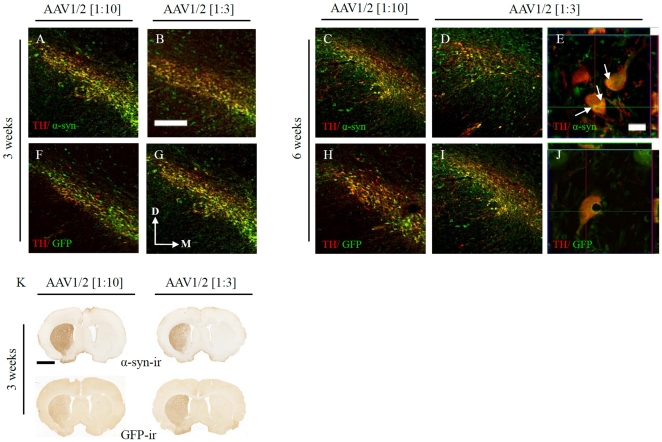
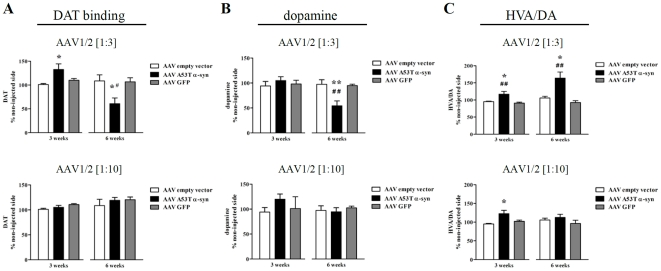
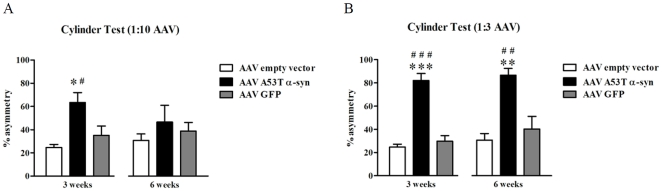
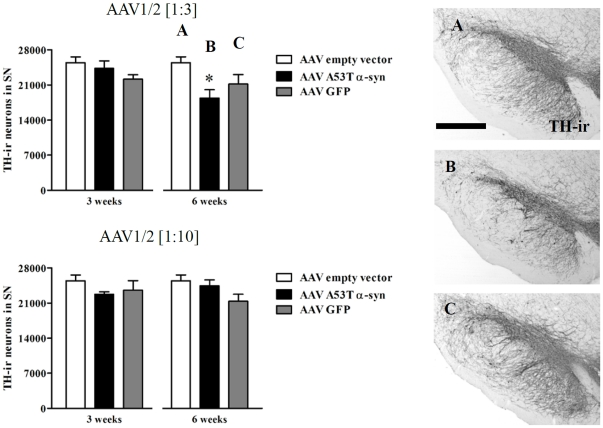
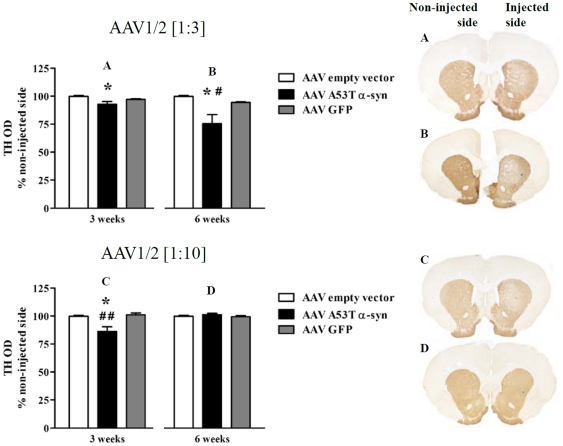
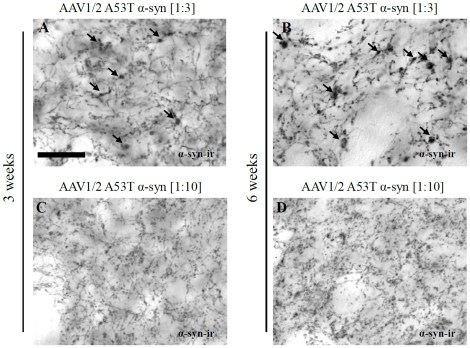
The pathological hallmarks of Parkinson's disease (PD) are degeneration of dopamine (DA) neurons of the substantia nigra (SN) and the presence of alpha-synuclein (α-syn)-rich Lewy bodies in DA cells that remain. To model these aspects of the disease, we previously showed that high titer (5.1×10exp12 gp/ml) AAV1/2 driven expression of A53T α-syn in the SN of rats caused nigrostriatal pathology including a loss of DA neurons, but also with toxicity in the GFP control group. In the current study, we evaluate the effects of two lower titers by dilution of the vector (1∶3 [1.7×10exp12] and 1∶10 [5.1×10exp11]) to define a concentration that produced pathology specific for α-syn. In GFP and empty vector groups there were no behavioural or post-mortem changes at 3 or 6 weeks post-administration at either vector dose. Dilution of the AAV1/2 A53T α-syn (1:3) produced significant paw use asymmetry, reductions in striatal tyrosine hydroxylase (TH), and increases in DA turnover at 3 weeks in the absence of overt pathology. By 6 weeks greater evidence of pathology was observed and included, reductions in SN DA neurons, striatal DA, TH and DA-transporter, along with a sustained behavioural deficit. In contrast, the 1:10 AAV1/2 A53T α-syn treated animals showed normalization between 3 and 6 weeks in paw use asymmetry, reductions in striatal TH, and increased DA turnover. Progression of dopaminergic deficits using the 1:3 titer of AAV1/2 A53Tα-syn provides a platform for evaluating treatments directed at preventing and/or reversing synucleinopathy. Use of the 1:10 titer of AAV1/2 A53T α-syn provides an opportunity to study mechanisms of endogenous compensation. Furthermore, these data highlight the need to characterize the titer of vector being utilized, when using AAV to express pathogenic proteins and model disease process, to avoid producing non-specific effects.
帕金森病(PD)的病理特征是黑质(SN)中的多巴胺(DA)神经元退化,以及剩余的 DA 细胞中富含α-突触核蛋白(α-syn)的路易体。为了模拟疾病的这些方面,我们之前曾表明,高滴度(5.1×10^12 gp/ml)AAV1/2 驱动的 A53T α-syn 在大鼠 SN 中的表达导致黑质纹状体病理学,包括 DA 神经元丧失,但 GFP 对照组也有毒性。在本研究中,我们通过稀释载体(1∶3[1.7×10^12]和 1∶10[5.1×10^11])来评估两种较低滴度的影响,以确定产生特定于 α-syn 的病理学的浓度。在 GFP 和空载体组中,在任何载体剂量下,在给药后 3 或 6 周时,没有行为或死后变化。AAV1/2 A53T α-syn(1∶3)的稀释在 3 周时导致明显的爪使用不对称、纹状体酪氨酸羟化酶(TH)减少和 DA 周转率增加,但没有明显的病理学。到 6 周时,观察到更多的病理学证据,包括 SN DA 神经元、纹状体 DA、TH 和 DA 转运体减少,以及持续的行为缺陷。相比之下,1∶10 AAV1/2 A53T α-syn 处理的动物在 3 至 6 周之间爪使用不对称、纹状体 TH 减少和 DA 周转率增加方面出现了正常化。使用 AAV1/2 A53Tα-syn 的 1∶3 滴度进行多巴胺能缺陷的进展为预防和/或逆转突触核蛋白病提供了一个平台。使用 AAV1/2 A53T α-syn 的 1∶10 滴度提供了研究内源性补偿机制的机会。此外,这些数据强调了在使用 AAV 表达致病性蛋白和模拟疾病过程时,需要对载体的滴度进行特征描述,以避免产生非特异性效应。