Toronto Western Research Institute, Toronto Western Hospital, University Health Network, 399 Bathurst Street, Toronto, ON, M5T 2S8, Canada.
Mol Neurodegener. 2010 Oct 28;5:43. doi: 10.1186/1750-1326-5-43.
The pathological hallmarks of Parkinson's disease (PD) include the presence of alpha-synuclein (α-syn) rich Lewy bodies and neurites and the loss of dopaminergic (DA) neurons of the substantia nigra (SN). Animal models of PD based on viral vector-mediated over-expression of α-syn have been developed and show evidence of DA toxicity to varying degrees depending on the type of virus used, its concentration, and the serotype of vector employed. To date these models have been variable, difficult to reproduce, and slow in their evolution to achieve a desired phenotype, hindering their use as a model for testing novel therapeutics. To address these issues we have taken a novel vector in this context, that can be prepared in high titer and which possesses an ability to produce neuronally-directed expression, with expression dynamics optimised to provide a rapid rise in gene product expression. Thus, in the current study, we have used a high titer chimeric AAV1/2 vector, to express human A53T α-syn, an empty vector control (EV), or green fluorescent protein (GFP), the latter to control for the possibility that high levels of protein in themselves might contribute to damage.
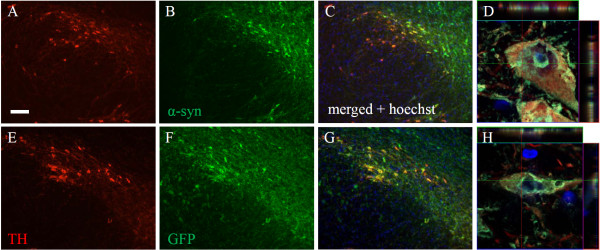
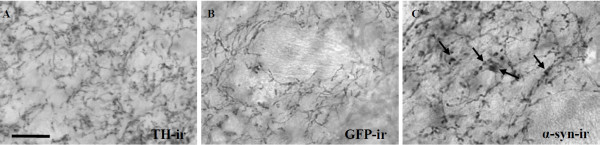
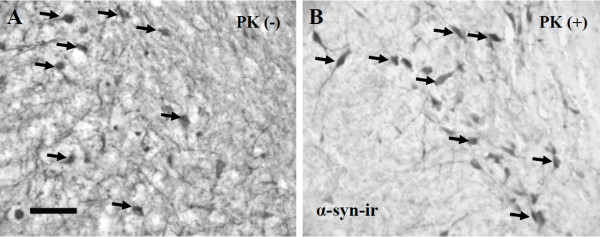
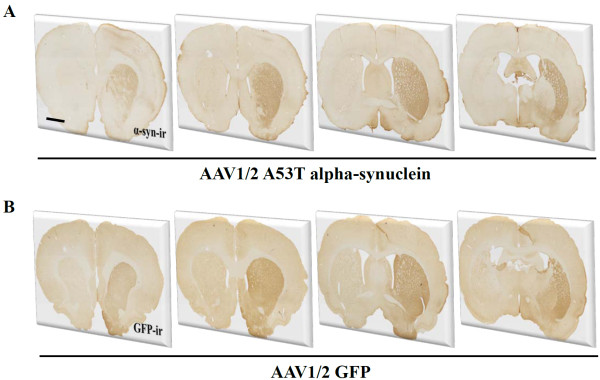
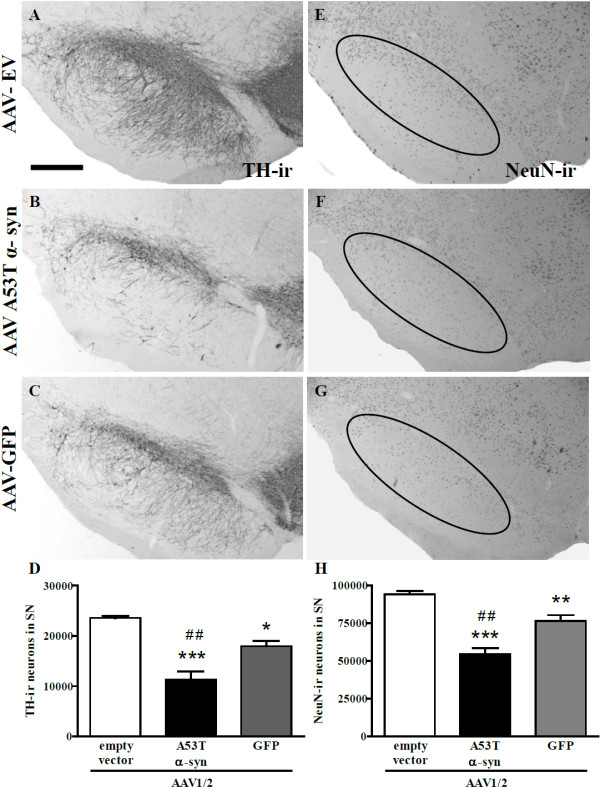
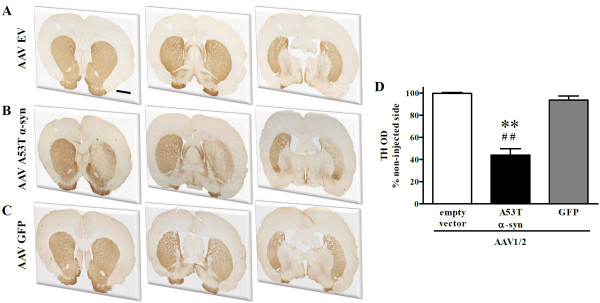
We show that following a single 2 μl injection into the rat SN there is near complete coverage of the structure and expression of A53T α-syn or GFP appears throughout the striatum. Within 3 weeks of SN delivery of their respective vectors, aggregations of insoluble α-syn were observed in SN DA neurons. The numbers of DA neurons in the SN were significantly reduced by expression of A53T α-syn (52%), and to a lesser extent by GFP (24%), compared to EV controls (both P < 0.01). At the level of the striatum, AAV1/2-A53T α-syn injection produced dystrophic neurites and a significant reduction in tyrosine hydroxylase levels (by 53%, P < 0.01), this was not seen in the AAV1/2-GFP condition.
In the current implementation of the model, we recapitulate the primary pathological hallmarks of PD, although a proportion of the SN damage may relate to general protein overload and may not be specific for A53T α-syn. Future studies will thus be required to optimise the dose of AAV1/2 employed before fully characterizing this model. The dynamics of the evolution of the pathology however, provide advantages over current models with respect to providing an initial screen to assess efficacy of novel treatments that might prevent/reverse α-syn aggregation.
帕金森病(PD)的病理特征包括富含α-突触核蛋白(α-syn)的路易体和神经突以及黑质(SN)多巴胺能(DA)神经元的丧失。基于病毒载体介导的α-syn 过表达的 PD 动物模型已经开发出来,并根据所使用的病毒类型、浓度和载体血清型表现出不同程度的 DA 毒性。迄今为止,这些模型一直存在变异性、难以复制和进化缓慢,难以达到所需的表型,这阻碍了它们作为测试新疗法的模型的应用。为了解决这些问题,我们在这种情况下使用了一种新型载体,该载体可以高滴度制备,并具有神经元定向表达的能力,表达动力学得到优化,以提供基因产物表达的快速上升。因此,在当前的研究中,我们使用了高滴度嵌合 AAV1/2 载体来表达人 A53Tα-syn、空载体对照(EV)或绿色荧光蛋白(GFP),后者用于控制高浓度蛋白质本身可能导致损伤的可能性。
我们发现,在将 2μl 病毒单次注入大鼠 SN 后,A53Tα-syn 的表达几乎完全覆盖了结构,GFP 出现在纹状体的各个部位。在 SN 递送各自载体后的 3 周内,SN 中的 DA 神经元中观察到不溶性α-syn 的聚集物。与 EV 对照相比,A53Tα-syn(52%)和 GFP(24%)的表达显著减少了 SN 中的 DA 神经元数量(均 P < 0.01)。在纹状体水平,AAV1/2-A53Tα-syn 注射产生了扭曲的神经突,并显著降低了酪氨酸羟化酶水平(降低了 53%,P < 0.01),而在 AAV1/2-GFP 条件下则没有观察到这种情况。
在目前的模型实施中,我们再现了 PD 的主要病理特征,尽管 SN 损伤的一部分可能与一般的蛋白质过载有关,并且可能不是 A53Tα-syn 特异性的。因此,在充分表征该模型之前,需要进一步研究来优化 AAV1/2 的剂量。然而,与当前模型相比,该病理学演变的动力学具有优势,因为它提供了一个初始筛选,以评估可能预防/逆转α-syn 聚集的新型治疗方法的疗效。