UMR CNRS 7205 Origine, Structure et Evolution de la Biodiversité, Muséum National d'Histoire Naturelle, Paris, France.
PLoS One. 2011 Mar 10;6(3):e17658. doi: 10.1371/journal.pone.0017658.
Ambrosia artemisiifolia is a North American native that has become one of the most problematic invasive plants in Europe and Asia. We studied its worldwide population genetic structure, using both nuclear and chloroplast microsatellite markers and an unprecedented large population sampling. Our goals were (i) to identify the sources of the invasive populations; (ii) to assess whether all invasive populations were founded by multiple introductions, as previously found in France; (iii) to examine how the introductions have affected the amount and structure of genetic variation in Europe; (iv) to document how the colonization of Europe proceeded; (v) to check whether populations exhibit significant heterozygote deficiencies, as previously observed.
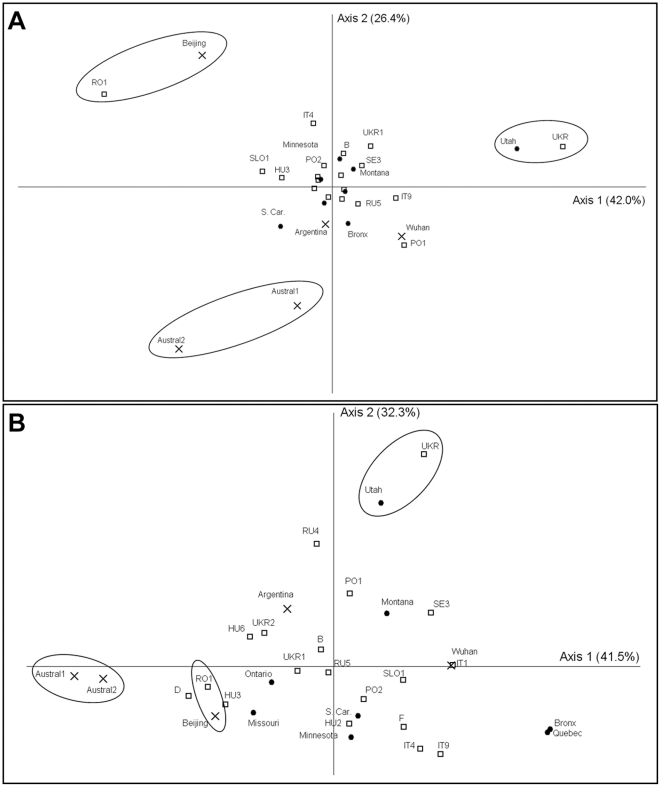
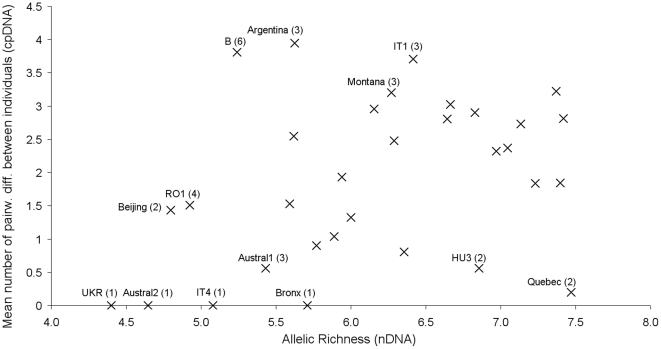
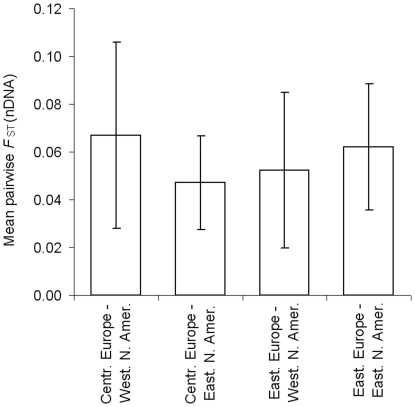
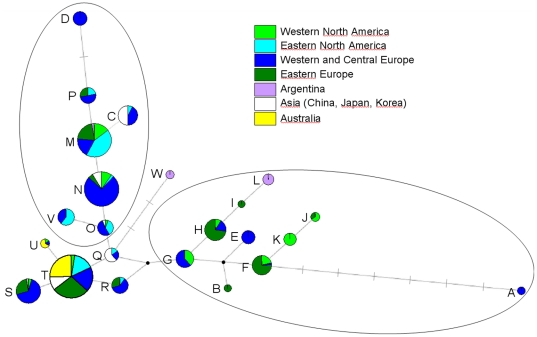
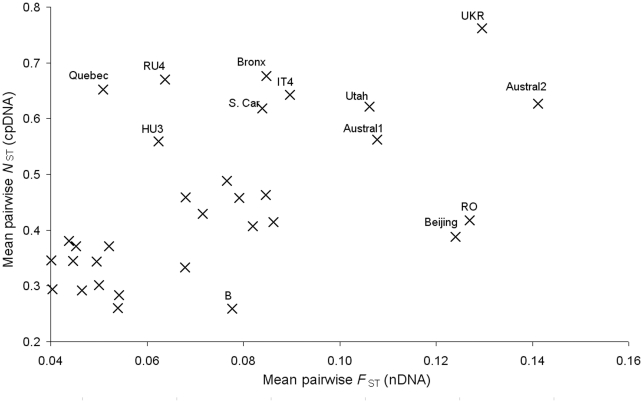
We found evidence for multiple introductions of A. artemisiifolia, within regions but also within populations in most parts of its invasive range, leading to high levels of diversity. In Europe, introductions probably stem from two different regions of the native area: populations established in Central Europe appear to have originated from eastern North America, and Eastern European populations from more western North America. This may result from differential commercial exchanges between these geographic regions. Our results indicate that the expansion in Europe mostly occurred through long-distance dispersal, explaining the absence of isolation by distance and the weak influence of geography on the genetic structure in this area in contrast to the native range. Last, we detected significant heterozygote deficiencies in most populations. This may be explained by partial selfing, biparental inbreeding and/or a Wahlund effect and further investigation is warranted.
This insight into the sources and pathways of common ragweed expansion may help to better understand its invasion success and provides baseline data for future studies on the evolutionary processes involved during range expansion in novel environments.
豚草是一种北美原生植物,已成为欧洲和亚洲最具问题的入侵植物之一。我们使用核和叶绿体微卫星标记以及前所未有的大种群采样研究了其全球种群遗传结构。我们的目标是:(i)确定入侵种群的来源;(ii)评估所有入侵种群是否如先前在法国发现的那样,由多次引入构成;(iii)研究这些引入如何影响欧洲遗传变异的数量和结构;(iv)记录欧洲的殖民化进程;(v)检查种群是否存在显著的杂合子缺失,如先前观察到的那样。
我们发现,在其入侵范围的大部分地区,包括区域内和种群内,都有豚草的多次引入,导致了高度的多样性。在欧洲,引入可能来自原生区域的两个不同区域:中欧建立的种群似乎起源于北美东部,东欧种群则起源于更西部的北美。这可能是由于这些地理区域之间的商业交流不同。我们的结果表明,欧洲的扩张主要是通过长距离扩散发生的,这解释了在该地区没有距离隔离和地理对遗传结构的影响较弱的现象,而与原生范围相反。最后,我们在大多数种群中检测到显著的杂合子缺失。这可能是由部分自交、双亲近亲繁殖和/或 Wahlund 效应引起的,需要进一步研究。
对豚草扩张的来源和途径的深入了解可能有助于更好地理解其入侵成功,并为未来在新环境中进行的与范围扩张相关的进化过程研究提供基线数据。