Department of Pharmacology and Therapeutics, School of Biomedical Sciences, University of Liverpool, Liverpool, UK.
J Antimicrob Chemother. 2011 Jun;66(6):1332-9. doi: 10.1093/jac/dkr087. Epub 2011 Mar 25.
Nevirapine is metabolized by CYP2B6 and polymorphisms within the CYP2B6 gene partly explain inter-patient variability in pharmacokinetics. The aim of this study was to model the complex relationship between nevirapine exposure, weight and genetics (based on combined analysis of CYP2B6 516G > T and 983T > C single nucleotide polymorphisms).
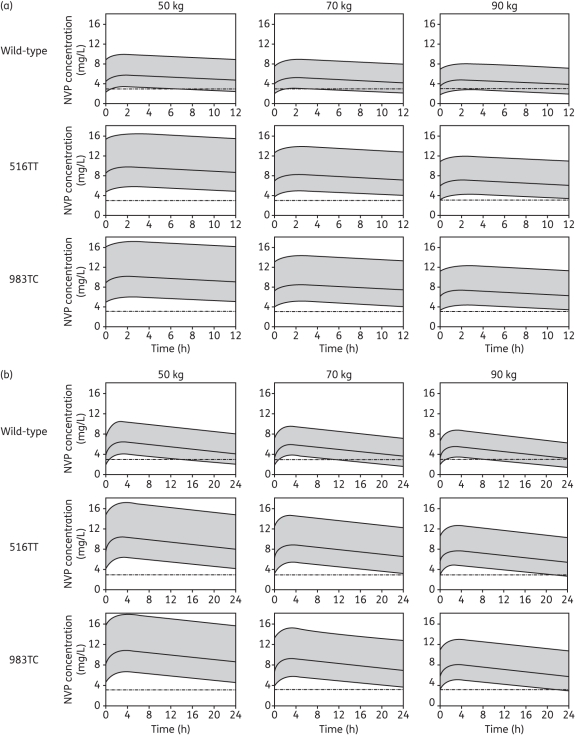
Non-linear mixed-effects modelling was used to estimate pharmacokinetic parameters from 275 patients. Simulations of the nevirapine concentration profile were performed with dosing regimens of 200 mg twice daily and 400 mg once daily for individuals with body weights of 50, 70 and 90 kg in combination with CYP2B6 genetic variation.
A one-compartment model with first-order absorption best described the data. Population clearance was 3.5 L/h with inter-patient variability of 24.6%. 516T homozygosity and 983C heterozygosity were associated with 37% and 40% lower clearance, respectively. Body weight was the only significant demographic factor influencing clearance, which increased by 5% for every 10 kg increase. For individuals with higher body weight, once-daily nevirapine was associated with a greater risk of sub-therapeutic drug exposure than a twice-daily regimen. This risk was offset in individuals who were 516T homozygous or 983C heterozygous in which drug exposure was optimal for > 95% of patients with body weight of ≤ 70 kg.
The data suggest that a 400 mg once-daily dose could be implemented in accordance with CYP2B6 polymorphism and body weight. However, the use of nevirapine once daily (immediate release; off-label) in the absence of therapeutic drug monitoring is not recommended due to the risk of inadequate exposure to nevirapine in a high proportion of patients. There are different considerations for the extended-release formulation (nevirapine XR) that demonstrate minimal peak-to-trough fluctuations in plasma nevirapine levels.
奈韦拉平由 CYP2B6 代谢,CYP2B6 基因内的多态性部分解释了药代动力学的个体间变异性。本研究的目的是建立奈韦拉平暴露、体重和遗传(基于 CYP2B6 516G>T 和 983T>C 单核苷酸多态性的联合分析)之间复杂关系的模型。
使用非线性混合效应模型对 275 名患者的药代动力学参数进行了估算。对体重为 50、70 和 90 kg 的个体,采用 200 mg 每日两次和 400 mg 每日一次的给药方案,并结合 CYP2B6 遗传变异,对奈韦拉平浓度曲线进行了模拟。
数据最好用单室模型加一级吸收来描述。人群清除率为 3.5 L/h,个体间变异性为 24.6%。516T 纯合子和 983C 杂合子的清除率分别降低了 37%和 40%。体重是唯一显著影响清除率的人口统计学因素,每增加 10 kg,清除率增加 5%。对于体重较高的个体,与每日两次方案相比,每日一次奈韦拉平与治疗药物暴露不足的风险更大。对于体重≤70 kg 的个体,如果是 516T 纯合子或 983C 杂合子,那么药物暴露对 95%以上的患者都是最佳的,这种风险就会得到缓解。
数据表明,根据 CYP2B6 多态性和体重,可以实施 400 mg 每日一次的剂量。然而,在没有治疗药物监测的情况下,不建议使用奈韦拉平每日一次(即释型;超适应证),因为在很大一部分患者中,奈韦拉平的暴露不足的风险很高。对于奈韦拉平扩展释放制剂(奈韦拉平 XR),需要考虑不同的因素,因为它在血浆奈韦拉平水平上显示出最小的峰谷波动。