Division of Mental Health, Department of Suicide Research and Prevention, Norwegian Institute of Public Health, Oslo, Norway.
BMC Health Serv Res. 2011 Mar 28;11:68. doi: 10.1186/1472-6963-11-68.
Mental disorders are strongly associated with excess suicide risk, and successful treatment might prevent suicide. Since 1990, and particularly after 1998, there has been a substantial increase in mental health service resources in Norway. This study aimed to investigate whether these changes have had an impact on suicide mortality.
We used Poisson regression analyses to assess the effect of changes in five mental health services variables on suicide mortality in five Norwegian health regions during the period 1990-2006. These variables included: number of man-labour years by all personnel, number of discharges, number of outpatient consultations, number of inpatient days, and number of hospital beds. Adjustments were made for sales of alcohol, sales of antidepressants, education, and unemployment.
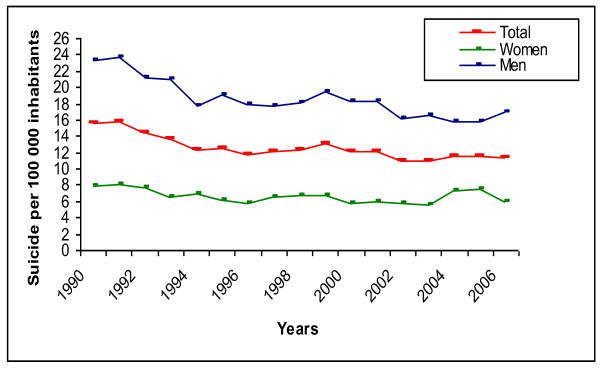
In the period 1990-2006, we observed a total of 9480 suicides and the total suicide rate declined by 26%. None of the mental health services variables were significantly associated with female or male suicide mortality in the adjusted analyses (p > 0.05). Sales of antidepressants (adjusted Incidence Rate Ratio = 0.98; 95% CI = 0.97-1.00) and sales of alcohol (adjusted IRR = 1.41; 95% CI = 1.18-1.72) were significantly associated with female suicide mortality; education (adjusted IRR = 0.86; 95% CI = 0.79-0.94) and unemployment (adjusted IRR = 0.91; 95% CI = 0.85-0.97) were significantly associated with male suicide mortality.
The adjusted analyses in the present study indicate that increased resources in Norwegian mental health services in the period 1990-2006 were statistically unrelated to suicide mortality.
精神障碍与自杀风险增加密切相关,成功治疗可能预防自杀。自 1990 年以来,特别是 1998 年以来,挪威的精神卫生服务资源大幅增加。本研究旨在调查这些变化是否对自杀死亡率产生了影响。
我们使用泊松回归分析评估了 1990-2006 年期间挪威五个卫生区的五种精神卫生服务变量的变化对自杀死亡率的影响。这些变量包括:所有人员的劳动工时数、出院人数、门诊就诊人数、住院天数和病床数。调整了酒精销售、抗抑郁药销售、教育和失业率。
在 1990-2006 年期间,我们共观察到 9480 例自杀,自杀总死亡率下降了 26%。在调整分析中,五种精神卫生服务变量均与女性或男性自杀死亡率无显著相关性(p>0.05)。抗抑郁药销售(调整发病率比=0.98;95%置信区间=0.97-1.00)和酒精销售(调整发病率比=1.41;95%置信区间=1.18-1.72)与女性自杀死亡率显著相关;教育(调整发病率比=0.86;95%置信区间=0.79-0.94)和失业率(调整发病率比=0.91;95%置信区间=0.85-0.97)与男性自杀死亡率显著相关。
本研究的调整分析表明,1990-2006 年挪威精神卫生服务资源的增加与自杀死亡率无统计学关联。