Department of Pathology, The University of Texas M. D. Anderson Cancer Center, Houston, Texas, United States of America.
PLoS One. 2011 Mar 17;6(3):e17745. doi: 10.1371/journal.pone.0017745.
Colorectal cancer (CRC) remains one of the major cancer types and cancer related death worldwide. Sensitive, non-invasive biomarkers that can facilitate disease detection, staging and prediction of therapeutic outcome are highly desirable to improve survival rate and help to determine optimized treatment for CRC. The small non-coding RNAs, microRNAs (miRNAs), have recently been identified as critical regulators for various diseases including cancer and may represent a novel class of cancer biomarkers. The purpose of this study was to identify and validate circulating microRNAs in human plasma for use as such biomarkers in colon cancer.
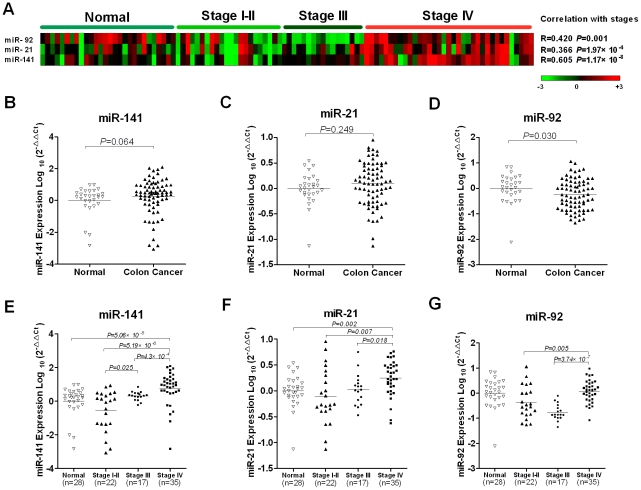
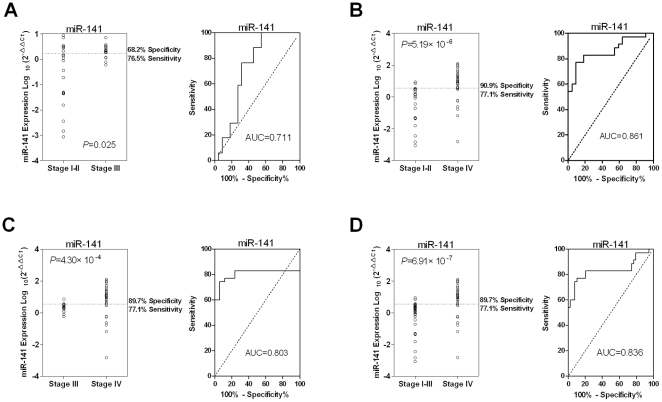
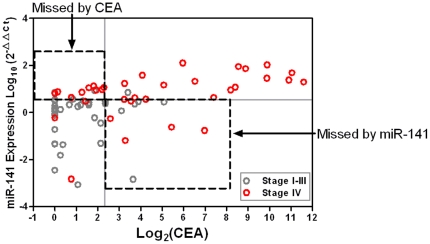
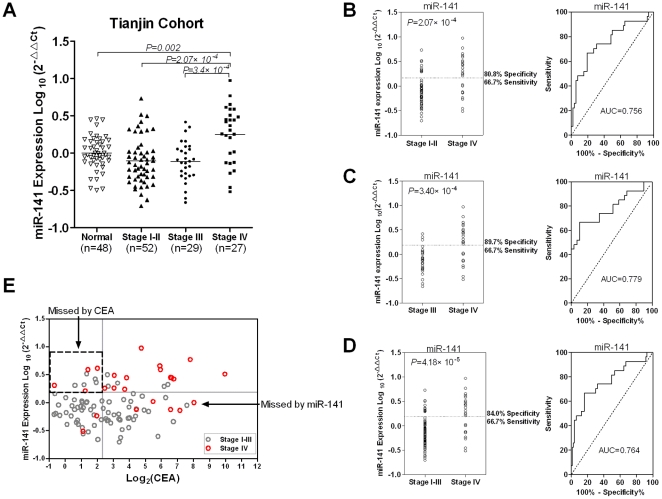
METHODOLOGY/PRINCIPAL FINDINGS: By using quantitative reverse transcription-polymerase chain reaction, we found that circulating miR-141 was significantly associated with stage IV colon cancer in a cohort of 102 plasma samples. Receiver operating characteristic (ROC) analysis was used to evaluate the sensitivity and specificity of candidate plasma microRNA markers. We observed that combination of miR-141 and carcinoembryonic antigen (CEA), a widely used marker for CRC, further improved the accuracy of detection. These findings were validated in an independent cohort of 156 plasma samples collected at Tianjin, China. Furthermore, our analysis showed that high levels of plasma miR-141 predicted poor survival in both cohorts and that miR-141 was an independent prognostic factor for advanced colon cancer.
CONCLUSIONS/SIGNIFICANCE: We propose that plasma miR-141 may represent a novel biomarker that complements CEA in detecting colon cancer with distant metastasis and that high levels of miR-141 in plasma were associated with poor prognosis.
结直肠癌(CRC)仍然是全球主要的癌症类型和癌症相关死亡原因之一。能够促进疾病检测、分期和预测治疗效果的敏感、非侵入性生物标志物,对于提高生存率和帮助确定 CRC 的最佳治疗方案非常重要。小非编码 RNA,microRNAs(miRNAs),最近被确定为包括癌症在内的各种疾病的关键调节剂,可能代表一类新型的癌症生物标志物。本研究旨在鉴定和验证人血浆中的循环 microRNAs,作为结肠癌的此类生物标志物。
方法/主要发现:通过使用定量逆转录聚合酶链反应,我们发现 102 个血浆样本的队列中,循环 miR-141 与 IV 期结肠癌显著相关。接收者操作特征(ROC)分析用于评估候选血浆 microRNA 标志物的灵敏度和特异性。我们观察到 miR-141 和癌胚抗原(CEA)的组合,CEA 是 CRC 的广泛使用标志物,进一步提高了检测的准确性。这些发现在中国天津的 156 个血浆样本的独立队列中得到了验证。此外,我们的分析表明,两个队列中血浆 miR-141 水平高预示着预后不良,并且 miR-141 是晚期结肠癌的独立预后因素。
结论/意义:我们提出,血浆 miR-141 可能代表一种新型生物标志物,与 CEA 互补,用于检测有远处转移的结肠癌,并且血浆中 miR-141 水平高与预后不良相关。