Faculty of Psychology and Neuroscience, Maastricht University, Maastricht, The Netherlands.
Mem Cognit. 2011 Aug;39(6):1033-41. doi: 10.3758/s13421-011-0091-2.
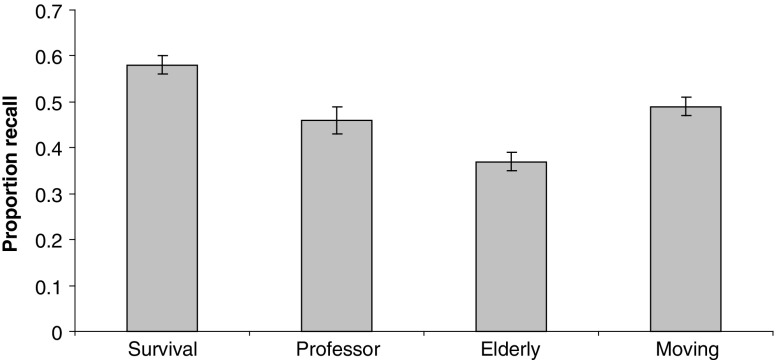
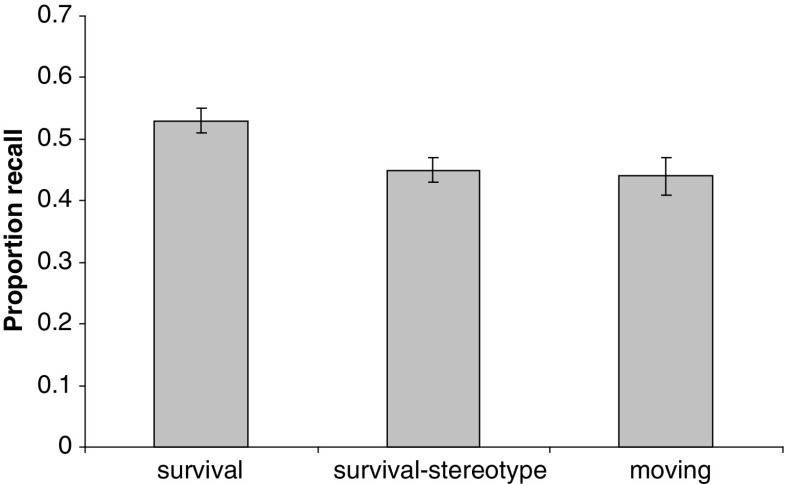
Studies have shown that survival processing leads to superior memorability. The aim of the present study was to examine whether this survival recall advantage might result from stereotype activation. To test this hypothesis, we conducted a pilot study and two experiments in which participants were primed with stereotypes (Experiment 1, professor and elderly person; Experiment 2, survival-stereotype). In Experiment 1, 120 undergraduates were randomly assigned to a survival, professor stereotype, elderly person stereotype, or moving scenario and rated words for their relevance to the imagined scenario. In Experiment 2, 75 undergraduates were given a survival, survival-stereotype (based on our pilot study), or moving scenario. Both experiments showed that survival processing leads to a greater recall advantage over the stereotype groups and control group. These data indicate that the mere activation of stereotypes cannot explain the survival recall advantage.
研究表明,生存处理会导致更好的记忆能力。本研究的目的是检验这种生存回忆优势是否可能源于刻板印象的激活。为了检验这一假设,我们进行了一项初步研究和两项实验,其中参与者被启动了刻板印象(实验 1:教授和老年人;实验 2:生存刻板印象)。在实验 1 中,120 名本科生被随机分配到生存、教授刻板印象、老年人刻板印象或移动场景中,并对单词与想象场景的相关性进行评分。在实验 2 中,75 名本科生被给予生存、生存刻板印象(基于我们的初步研究)或移动场景。这两个实验都表明,生存处理会导致比刻板印象组和对照组更好的回忆优势。这些数据表明,刻板印象的单纯激活并不能解释生存回忆优势。