Institute of Psychological Sciences, University of Leeds, Leeds, United Kingdom.
PLoS One. 2011 Mar 23;6(3):e17743. doi: 10.1371/journal.pone.0017743.
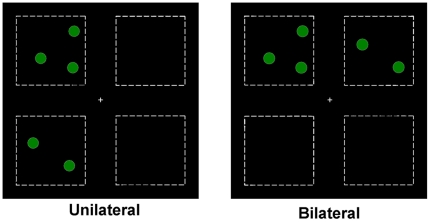
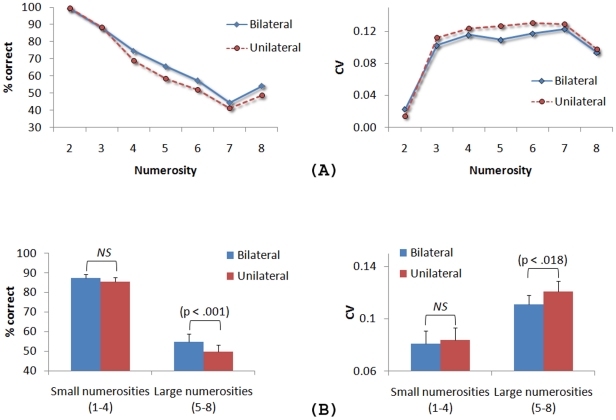
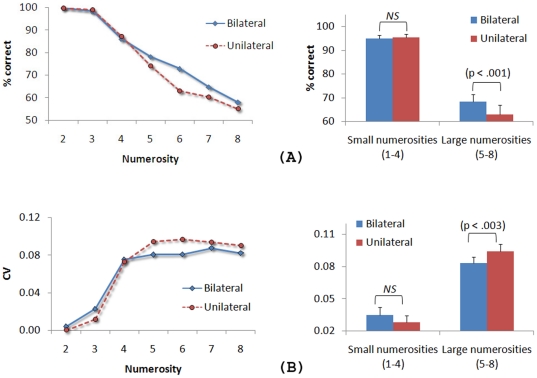
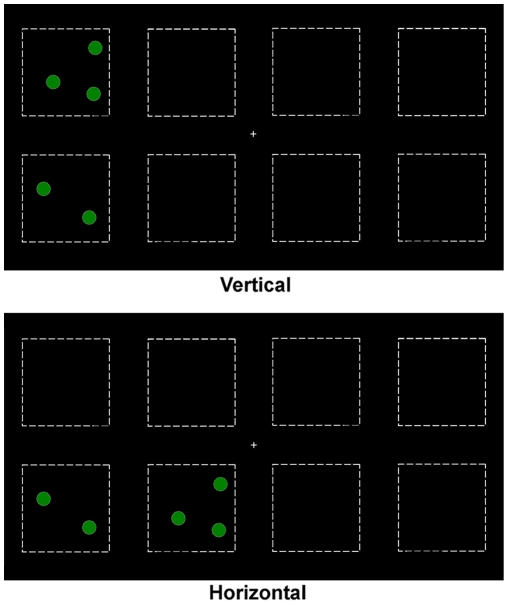
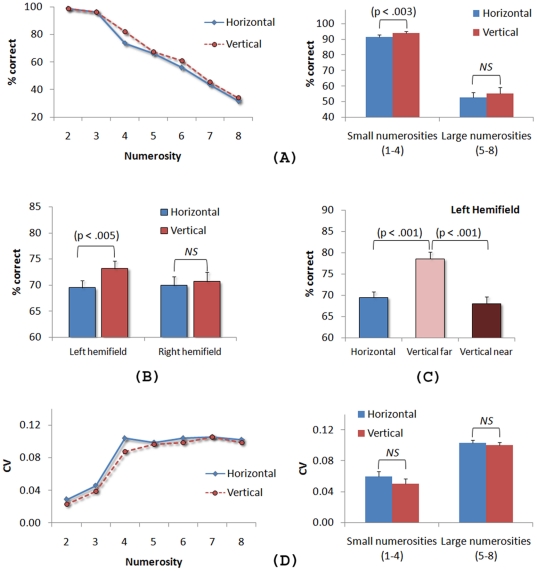
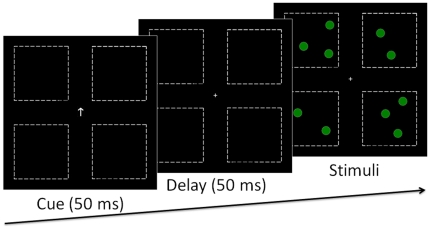
A number of recent studies have demonstrated superior visual processing when the information is distributed across the left and right visual fields than if the information is presented in a single hemifield (the bilateral field advantage). This effect is thought to reflect independent attentional resources in the two hemifields and the capacity of the neural responses to the left and right hemifields to process visual information in parallel. Here, we examined whether a bilateral field advantage can also be observed in a high-level visual task that requires the information from both hemifields to be combined. To this end, we used a visual enumeration task--a task that requires the assimilation of separate visual items into a single quantity--where the to-be-enumerated items were either presented in one hemifield or distributed between the two visual fields. We found that enumerating large number (>4 items), but not small number (<4 items), exhibited the bilateral field advantage: enumeration was more accurate when the visual items were split between the left and right hemifields than when they were all presented within the same hemifield. Control experiments further showed that this effect could not be attributed to a horizontal alignment advantage of the items in the visual field, or to a retinal stimulation difference between the unilateral and bilateral displays. These results suggest that a bilateral field advantage can arise when the visual task involves inter-hemispheric integration. This is in line with previous research and theory indicating that, when the visual task is attentionally demanding, parallel processing by the neural responses to the left and right hemifields can expand the capacity of visual information processing.
许多最近的研究表明,当信息分布在左右视野中时,视觉处理效果优于信息仅在单一视野中呈现时(双侧视野优势)。这种效应被认为反映了两个视野中的独立注意资源,以及左右视野中神经反应并行处理视觉信息的能力。在这里,我们研究了在需要结合两个视野中的信息的高级视觉任务中是否也可以观察到双侧视野优势。为此,我们使用了视觉计数任务——一项需要将单独的视觉项目组合成单个数量的任务,其中要计数的项目要么出现在一个视野中,要么分布在两个视野之间。我们发现,当数量较大(>4 个)而不是数量较小时(<4 个)进行计数时,会出现双侧视野优势:当视觉项目分布在左、右视野之间时,计数比当它们都出现在同一视野中时更准确。控制实验进一步表明,这种效应不能归因于视野中项目的水平对齐优势,也不能归因于单侧和双侧显示之间的视网膜刺激差异。这些结果表明,当视觉任务涉及半球间整合时,可能会出现双侧视野优势。这与之前的研究和理论一致,表明当视觉任务需要注意力时,左右视野中神经反应的并行处理可以扩展视觉信息处理的能力。