Department of Paediatrics, Monash University Sunway Campus, Jeffrey Cheah School of Medicine and Health Sciences, JKR 1235, Bukit Azah, 80100, Johor Bahru, Johor, Malaysia.
BMC Med. 2011 Mar 30;9:30. doi: 10.1186/1741-7015-9-30.
Independent evaluation of clinical evidence is advocated in evidence-based medicine (EBM). However, authors' conclusions are often appealing for readers who look for quick messages. We assessed how well a group of Malaysian hospital practitioners and medical students derived their own conclusions from systematic reviews (SRs) and to what extent these were influenced by their prior beliefs and the direction of the study results.
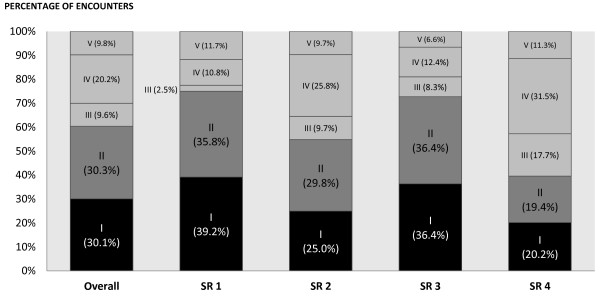
We conducted two cross-sectional studies: one with hospital practitioners (n = 150) attending an EBM course in June 2008 in a tertiary hospital and one with final-year medical students (n = 35) in November 2008. We showed our participants four Cochrane SR abstracts without the authors' conclusions. For each article, the participants chose a conclusion from among six options comprising different combinations of the direction of effect and the strength of the evidence. We predetermined the single option that best reflected the actual authors' conclusions and labelled this as our best conclusion. We compared the participants' choices with our predetermined best conclusions. Two chosen reviews demonstrated that the intervention was beneficial ("positive"), and two others did not ("negative"). We also asked the participants their prior beliefs about the intervention.
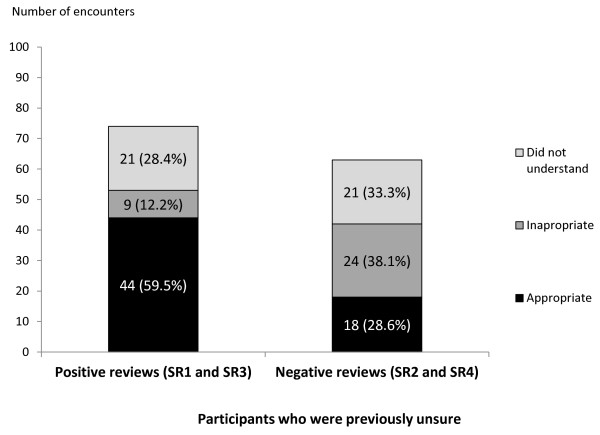
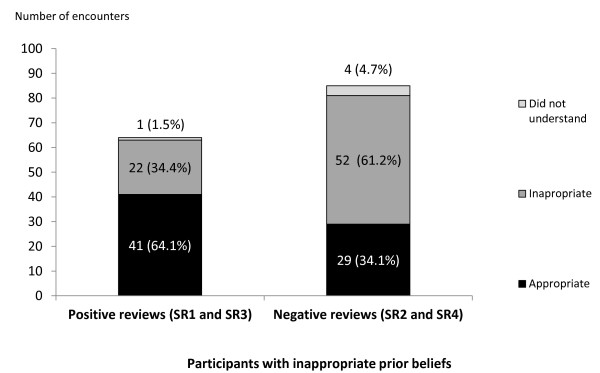
Overall, 60.3% correctly identified the direction of effect, and 30.1% chose the best conclusions, having identified both the direction of effect and the strength of evidence. More students (48.2%) than practitioners (22.2%) chose the best conclusions (P < 0.001). Fewer than one-half (47%) correctly identified the direction of effect against their prior beliefs. "Positive" SRs were more likely than "negative" SRs to change the participants' beliefs about the effect of the intervention (relative risk (RR) 1.8, 95% confidence interval 1.3 to 2.6) and "convert" those who were previously unsure by making them choose the appropriate direction of effect (RR 1.9, 95% confidence interval 1.3 to 2.8).
The majority of our participants could not generate appropriate conclusions from SRs independently. Judicious direction from the authors' conclusions still appears crucial to guiding our health care practitioners in identifying appropriate messages from research. Authors, editors and reviewers should ensure that the conclusions of a paper accurately reflect the results. Similar studies should be conducted in other settings where awareness and application of EBM are different.
在循证医学(EBM)中提倡对临床证据进行独立评估。然而,作者的结论往往对那些寻求快速信息的读者具有吸引力。我们评估了一组马来西亚医院从业者和医学生从系统评价(SRs)中得出自己的结论的能力,以及他们的先入之见和研究结果的方向在多大程度上影响了他们的结论。
我们进行了两项横断面研究:一项是在 2008 年 6 月在一家三级医院参加 EBM 课程的医院从业者(n = 150),另一项是在 2008 年 11 月的最后一年医学生(n = 35)。我们向参与者展示了四篇 Cochrane SR 摘要,没有作者的结论。对于每一篇文章,参与者从六个选项中选择一个结论,这些选项包含不同的效果方向和证据强度的组合。我们预先确定了最能反映实际作者结论的单一选项,并将其标记为我们的最佳结论。我们将参与者的选择与我们预先确定的最佳结论进行了比较。两个选定的综述表明干预是有益的(“阳性”),另外两个则没有(“阴性”)。我们还询问了参与者对干预的先入之见。
总体而言,60.3%的人正确识别了效果方向,30.1%的人选择了最佳结论,既识别了效果方向,又识别了证据强度。选择最佳结论的学生(48.2%)多于从业者(22.2%)(P < 0.001)。不到一半(47%)的人能够根据自己的先入之见正确识别效果方向。“阳性”SRs 比“阴性”SRs 更有可能改变参与者对干预效果的信念(相对风险(RR)1.8,95%置信区间 1.3 至 2.6),并通过使他们选择适当的效果方向来“转换”那些先前不确定的人(RR 1.9,95%置信区间 1.3 至 2.8)。
我们的大多数参与者无法独立从 SRs 中得出适当的结论。明智的做法是让作者的结论来指导我们的医疗保健从业者从研究中识别适当的信息,这似乎仍然至关重要。作者、编辑和审稿人应确保论文的结论准确反映研究结果。应在其他循证医学意识和应用情况不同的环境中进行类似的研究。