Hallett Robin M, Hassell John A
Department of Biochemistry and Biomedical Sciences, Centre for Functional Genomics, McMaster University, 1200 Main Street West, Hamilton, Ontario, L8N 3Z5, Canada.
BMC Res Notes. 2011 Mar 31;4:95. doi: 10.1186/1756-0500-4-95.
Gene expression profiling of human breast tumors has uncovered several molecular signatures that can divide breast cancer patients into good and poor outcome groups. However, these signatures typically comprise many genes (~50-100), and the prognostic tests associated with identifying these signatures in patient tumor specimens require complicated methods, which are not routinely available in most hospital pathology laboratories, thus limiting their use. Hence, there is a need for more practical methods to predict patient survival.
We modified a feature selection algorithm and used survival analysis to derive a 2-gene signature that accurately predicts breast cancer patient survival.
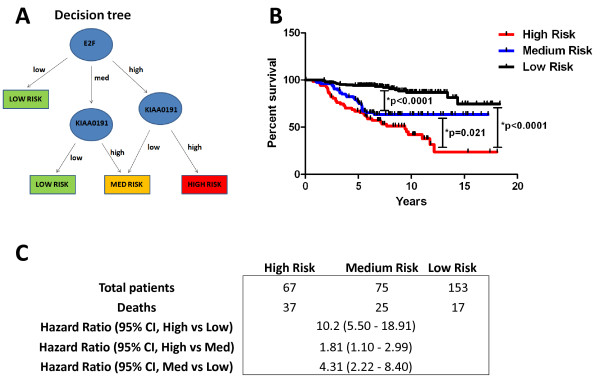
We developed a tree based decision method that segregated patients into various risk groups using KIAA0191 expression in the context of E2F1 expression levels. This approach led to highly accurate survival predictions in a large cohort of breast cancer patients using only a 2-gene signature.
Our observations suggest a possible relationship between E2F1 and KIAA0191 expression that is relevant to the pathogenesis of breast cancer. Furthermore, our findings raise the prospect that the practicality of patient prognosis methods may be improved by reducing the number of genes required for analysis. Indeed, our E2F1/KIAA0191 2-gene signature would be highly amenable for an immunohistochemistry based test, which is commonly used in hospital laboratories.
人类乳腺肿瘤的基因表达谱分析发现了几种分子特征,可将乳腺癌患者分为预后良好和不良的组。然而,这些特征通常包含许多基因(约50 - 100个),并且在患者肿瘤标本中识别这些特征的预后测试需要复杂的方法,大多数医院病理实验室通常无法常规使用,因此限制了它们的应用。因此,需要更实用的方法来预测患者的生存情况。
我们修改了一种特征选择算法,并使用生存分析得出了一个能准确预测乳腺癌患者生存情况的双基因特征。
我们开发了一种基于树的决策方法,根据E2F1表达水平,利用KIAA0191的表达将患者分为不同的风险组。这种方法仅使用一个双基因特征就能在一大群乳腺癌患者中实现高度准确的生存预测。
我们的观察结果表明E2F1和KIAA0191的表达之间可能存在与乳腺癌发病机制相关的关系。此外,我们的研究结果提出了一个前景,即通过减少分析所需的基因数量,可能会提高患者预后方法的实用性。事实上,我们的E2F1/KIAA0191双基因特征非常适合基于免疫组织化学的检测,这种检测在医院实验室中常用。