Department of Plant Pathology, University of California Davis, Davis, California, United States of America.
PLoS One. 2011 Mar 24;6(3):e18260. doi: 10.1371/journal.pone.0018260.
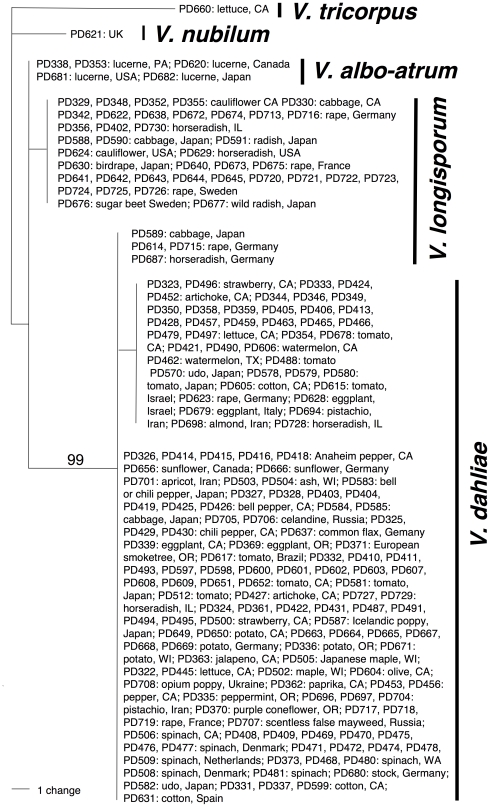
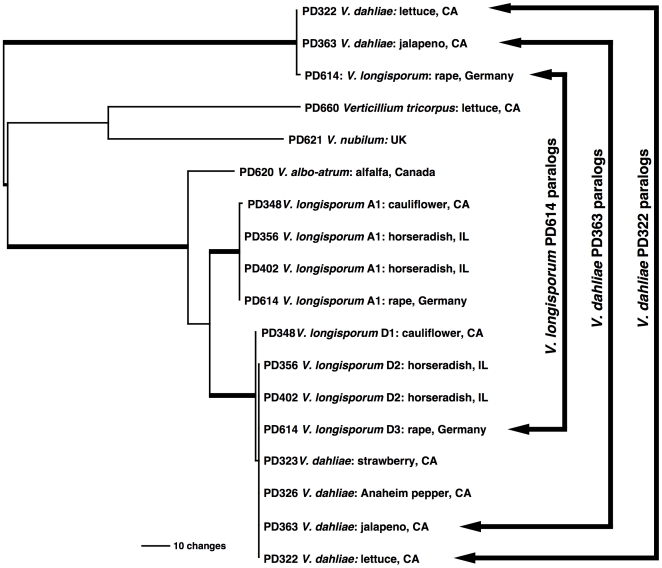
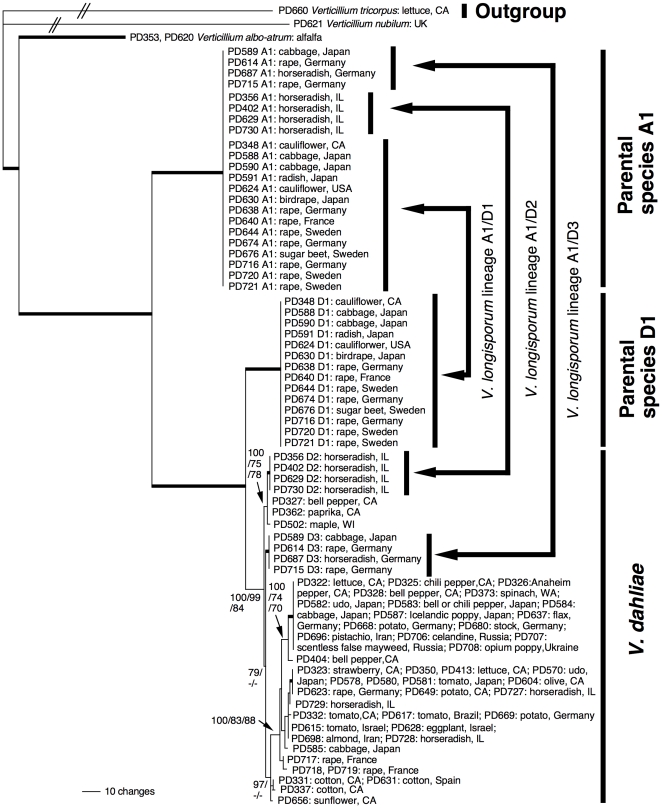
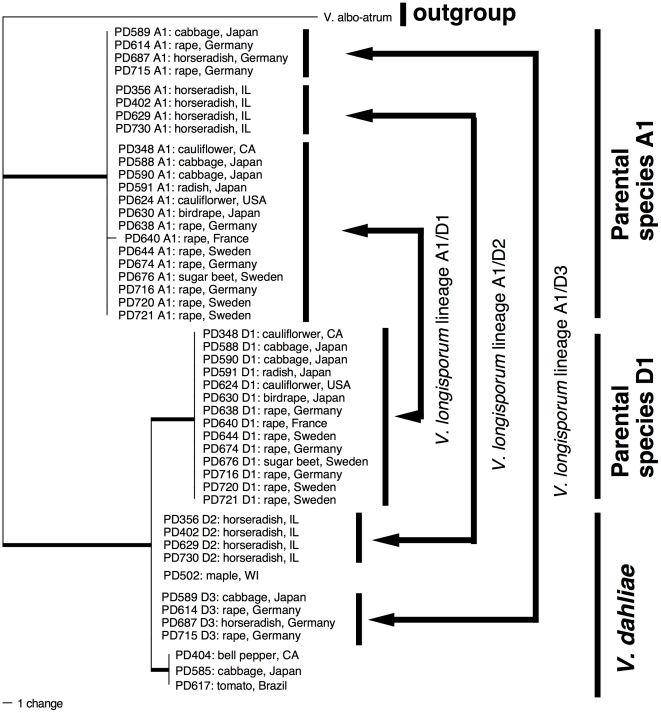
Hybridization plays a central role in plant evolution, but its overall importance in fungi is unknown. New plant pathogens are thought to arise by hybridization between formerly separated fungal species. Evolution of hybrid plant pathogens from non-pathogenic ancestors in the fungal-like protist Phytophthora has been demonstrated, but in fungi, the most important group of plant pathogens, there are few well-characterized examples of hybrids. We focused our attention on the hybrid and plant pathogen Verticillium longisporum, the causal agent of the Verticillium wilt disease in crucifer crops. In order to address questions related to the evolutionary origin of V. longisporum, we used phylogenetic analyses of seven nuclear loci and a dataset of 203 isolates of V. longisporum, V. dahliae and related species. We confirmed that V. longisporum was diploid, and originated three different times, involving four different lineages and three different parental species. All hybrids shared a common parent, species A1, that hybridized respectively with species D1, V. dahliae lineage D2 and V. dahliae lineage D3, to give rise to three different lineages of V. longisporum. Species A1 and species D1 constituted as yet unknown taxa. Verticillium longisporum likely originated recently, as each V. longisporum lineage was genetically homogenous, and comprised species A1 alleles that were identical across lineages.
杂交在植物进化中起着核心作用,但在真菌中的总体重要性尚不清楚。新的植物病原体被认为是由以前分离的真菌物种之间的杂交产生的。已经证明,从真菌状原生生物 Phytophthora 的非致病性祖先进化而来的杂交植物病原体,但在真菌中,最重要的植物病原体群体中,很少有经过充分描述的杂种例子。我们将注意力集中在杂种和植物病原体Verticillium longisporum 上,它是十字花科作物黄萎病的病原体。为了解决与 V. longisporum 的进化起源相关的问题,我们使用了七个核基因座的系统发育分析和 V. longisporum、V. dahliae 和相关物种的 203 个分离株数据集。我们证实 V. longisporum 是二倍体,并且起源于三个不同的时间,涉及四个不同的谱系和三个不同的亲本物种。所有杂种都有一个共同的亲本物种 A1,它分别与物种 D1、V. dahliae 谱系 D2 和 V. dahliae 谱系 D3 杂交,产生了三个不同的 V. longisporum 谱系。物种 A1 和物种 D1 构成了未知的分类群。V. longisporum 可能是最近才出现的,因为每个 V. longisporum 谱系在遗传上都是同质的,并且包含了在谱系之间完全相同的物种 A1 等位基因。