Department of Medicine, University of Louisville Alcohol Research Center, University of Louisville, Louisville, KY 40202, USA.
Alcohol Clin Exp Res. 2011 Aug;35(8):1435-44. doi: 10.1111/j.1530-0277.2011.01479.x. Epub 2011 Apr 4.
Alcohol abuse has long-term deleterious effects on the immune system, and results in a depletion and loss of function of CD4(+) T lymphocytes, which regulate both innate and adaptive immunity. T-lymphocyte activation via T-cell receptor (TCR) involves the lipid raft colocalization and aggregation of proteins into the immunological signalosome, which triggers a signaling cascade resulting in the production of interleukin-2 (IL-2). IL-2 regulates the proliferation and clonal expansion of activated T cells and is essential for an effective immune response. The present work examines the mechanisms underlying ethanol-induced dysfunction of CD4(+) T lymphocytes based on the hypothesis that ethanol downregulates lipid raft-mediated TCR signal transduction and resultant IL-2 production.
Primary or cultured human T lymphocytes were exposed to ethanol for 24 hours prior to stimulation with anti-CD3/anti-CD28 antibodies or phytohemagglutinin. Effects of ethanol exposure on TCR-signaling (including activation of Lck, ZAP70, LAT, and PLCγ1) and IL-2 gene expression were examined.
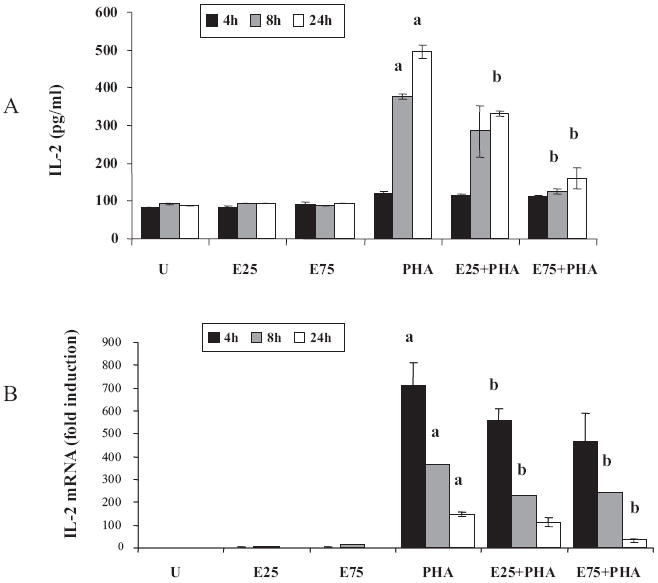
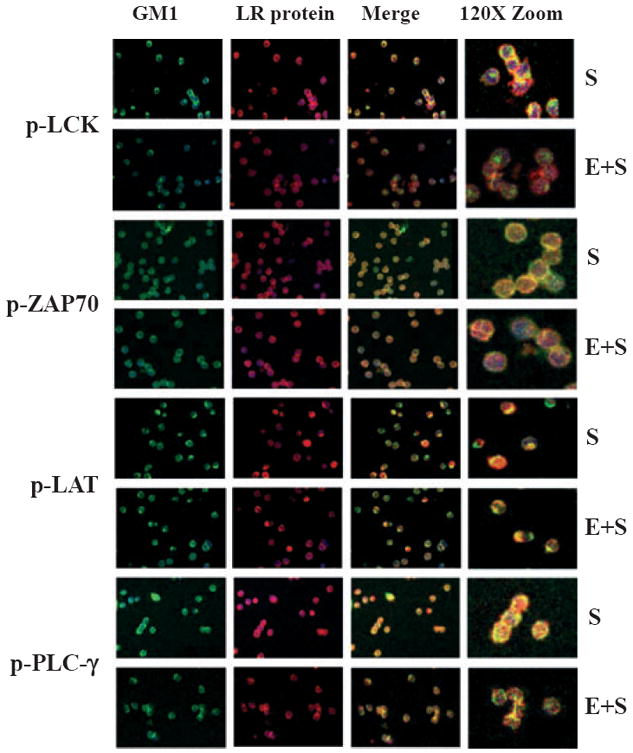
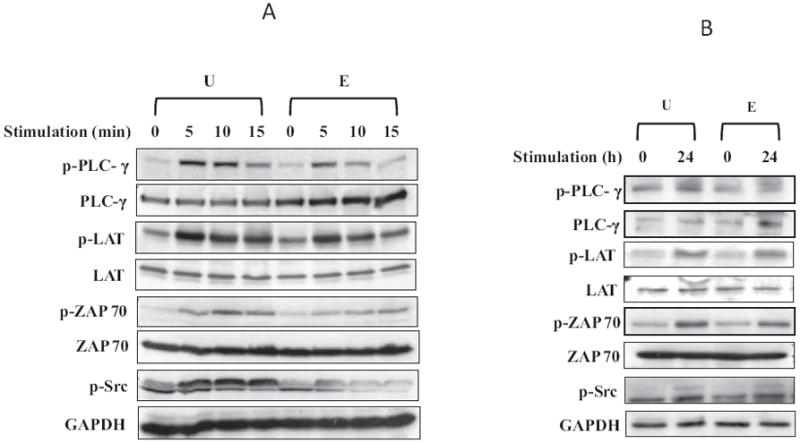
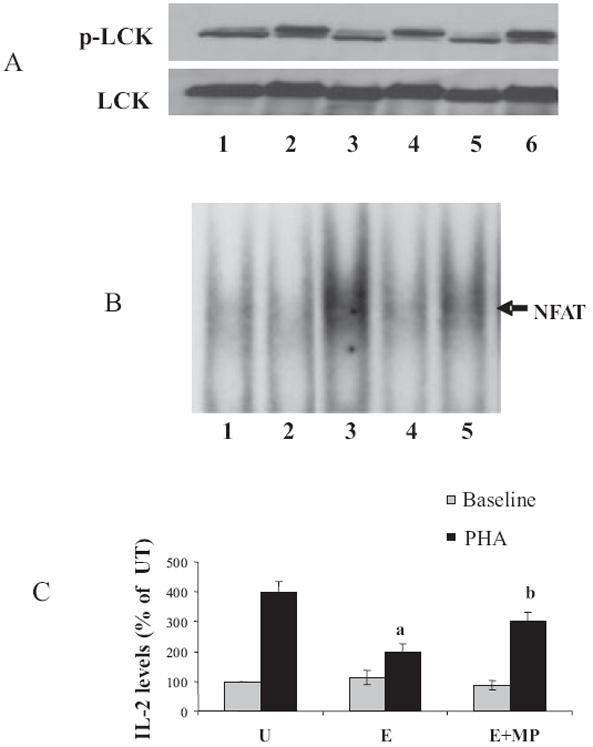
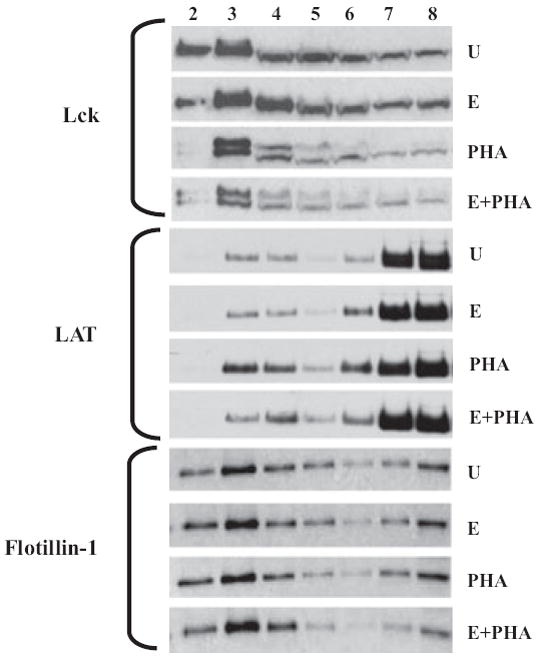
Exposure of both primary and cultured human CD4(+) T lymphocytes to physiologically relevant concentrations of ethanol leads to down-regulation of IL-2 mRNA and protein via inhibition of DNA-binding activity of NFAT, the essential transcription factor for IL-2. Ethanol decreases tyrosine phosphorylation and activation of upstream signaling proteins PLCγ1, LAT, ZAP70, and Lck. These effects are prevented by inhibition of metabolism of ethanol. Sucrose density gradient fractionation and confocal microscopy revealed that ethanol inhibited essential upstream lipid raft-mediated TCR-dependent signaling events, namely colocalization of Lck, ZAP70, LAT, and PLCγ1 with plasma membrane lipid rafts.
Overall, our data demonstrate that ethanol inhibits lipid raft-mediated TCR-signaling in CD4(+) T lymphocytes, resulting in suppression of IL-2 production. These findings may represent a novel mechanism underlying alcohol abuse-associated immune suppression and may be particularly relevant in diseases such as HIV/AIDS and hepatitis C virus infection where alcohol abuse is a known comorbidity.
酒精滥用对免疫系统有长期的有害影响,导致 CD4(+)T 淋巴细胞耗竭和功能丧失,而这些细胞调节着先天和适应性免疫。T 细胞受体 (TCR) 的 T 淋巴细胞激活涉及脂质筏的共定位和蛋白质聚集到免疫信号小体中,从而触发信号级联反应,导致白细胞介素-2 (IL-2) 的产生。IL-2 调节激活的 T 细胞的增殖和克隆扩增,是有效免疫反应的关键。本研究基于以下假设,即乙醇下调脂质筏介导的 TCR 信号转导和随后的 IL-2 产生,研究了 CD4(+)T 淋巴细胞乙醇诱导功能障碍的机制:乙醇暴露对 TCR 信号转导(包括 Lck、ZAP70、LAT 和 PLCγ1 的激活)和 IL-2 基因表达的影响。
在使用抗 CD3/抗 CD28 抗体或植物血球凝集素刺激之前,将原代或培养的人 T 淋巴细胞暴露于乙醇中 24 小时。研究乙醇暴露对 TCR 信号转导(包括 Lck、ZAP70、LAT 和 PLCγ1 的激活)和 IL-2 基因表达的影响。
将生理相关浓度的乙醇暴露于原代和培养的人 CD4(+)T 淋巴细胞中,通过抑制 NFAT 的 DNA 结合活性,导致 IL-2mRNA 和蛋白的下调,NFAT 是 IL-2 的必需转录因子。乙醇降低了酪氨酸磷酸化和上游信号蛋白 PLCγ1、LAT、ZAP70 和 Lck 的激活。这些作用可被乙醇代谢抑制所阻止。蔗糖密度梯度分级分离和共聚焦显微镜显示,乙醇抑制了必需的上游脂质筏介导的 TCR 依赖性信号事件,即 Lck、ZAP70、LAT 和 PLCγ1 与质膜脂质筏的共定位。
总之,我们的数据表明,乙醇抑制 CD4(+)T 淋巴细胞中脂质筏介导的 TCR 信号转导,导致 IL-2 产生受到抑制。这些发现可能代表了酒精滥用相关免疫抑制的一种新机制,在艾滋病病毒/艾滋病和丙型肝炎病毒感染等疾病中可能特别相关,在这些疾病中,酒精滥用是一种已知的合并症。