Department of Biochemistry, University of Wisconsin-Madison, Madison, Wisconsin 53706, USA.
J Cell Biochem. 2011 Aug;112(8):2030-45. doi: 10.1002/jcb.23123.
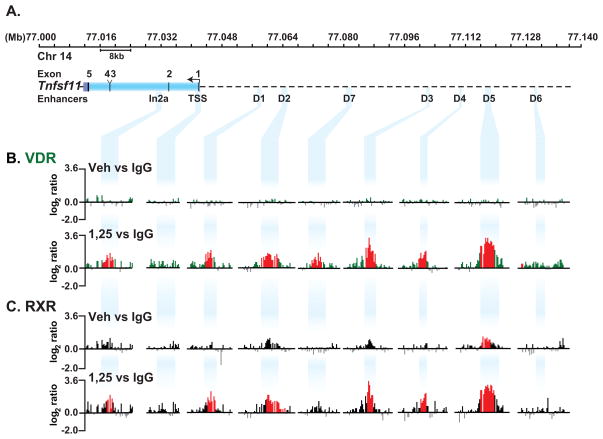
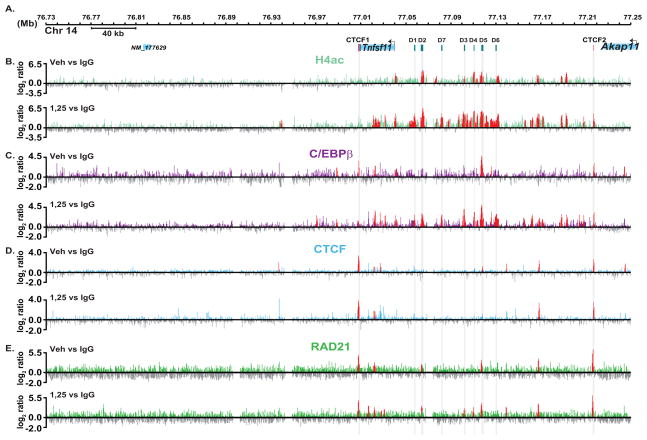
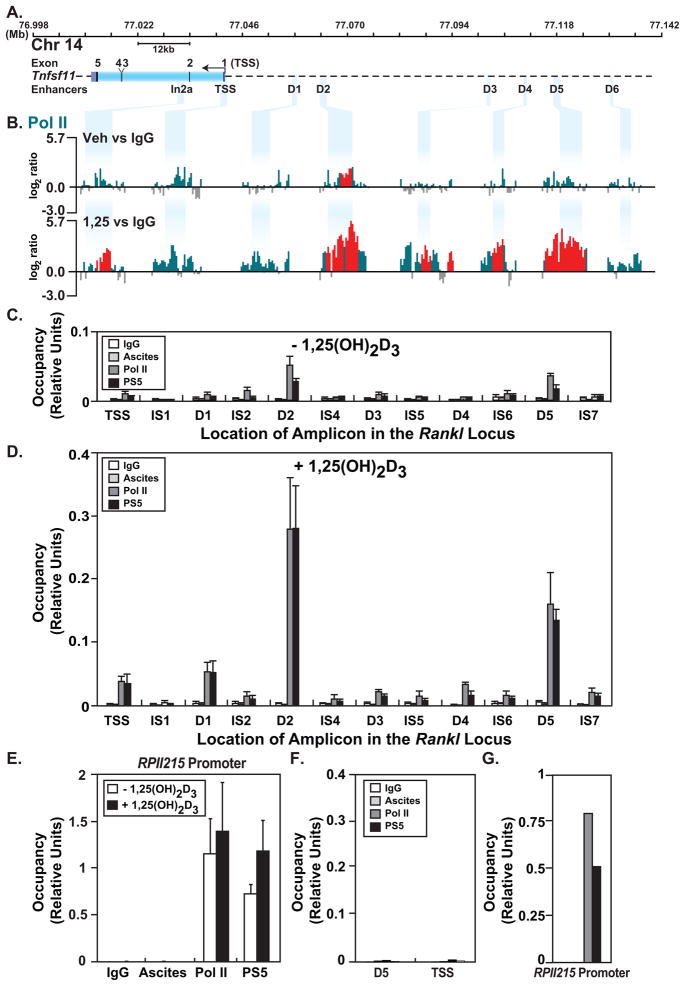
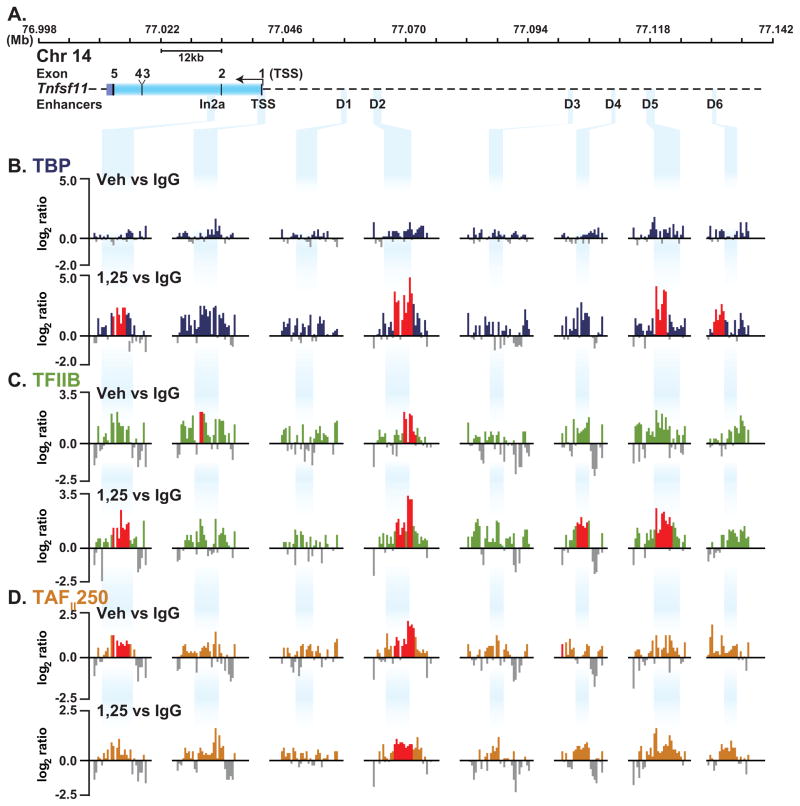
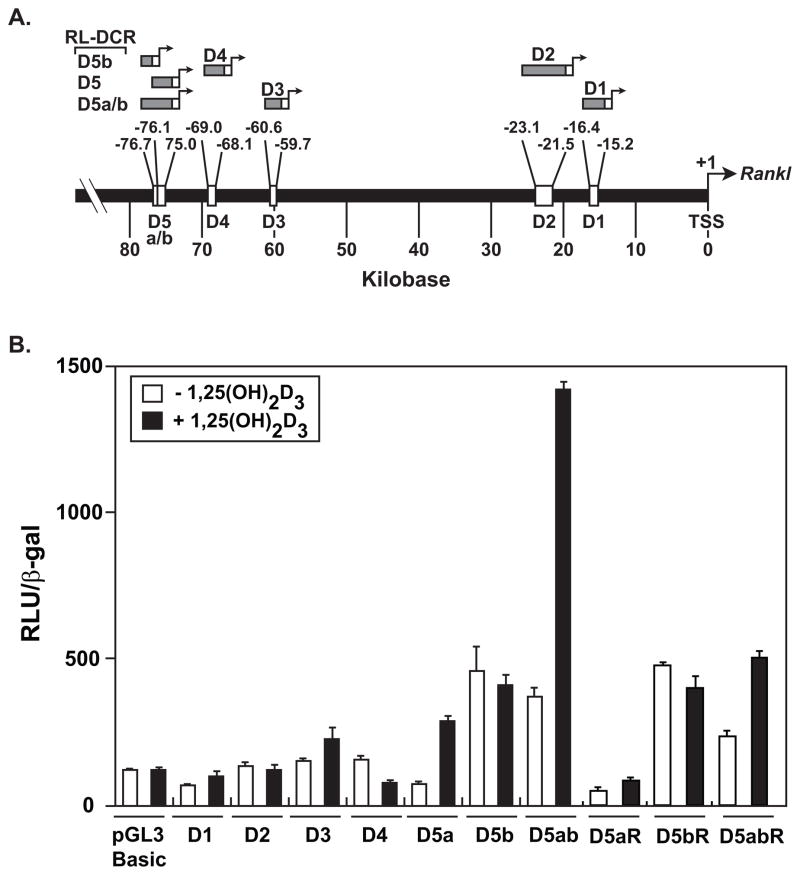
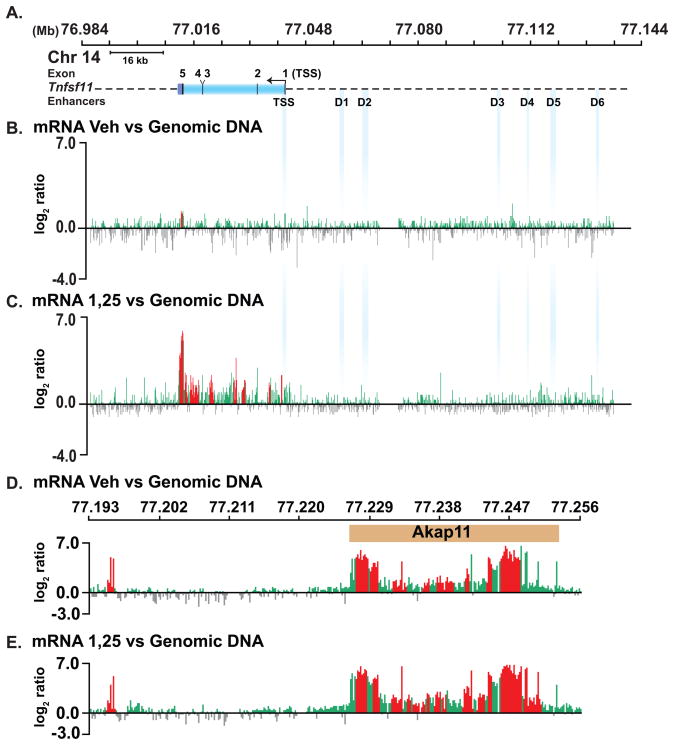
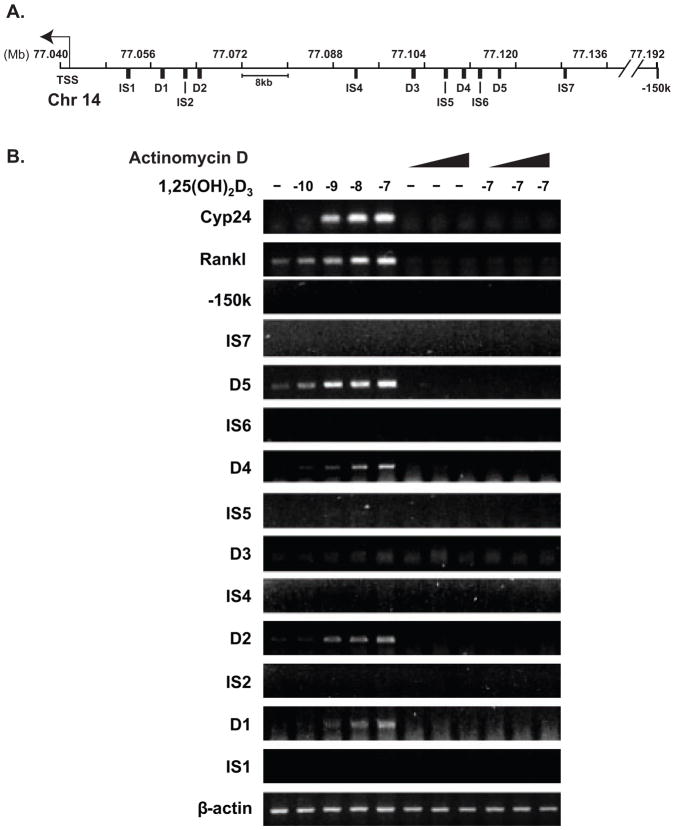
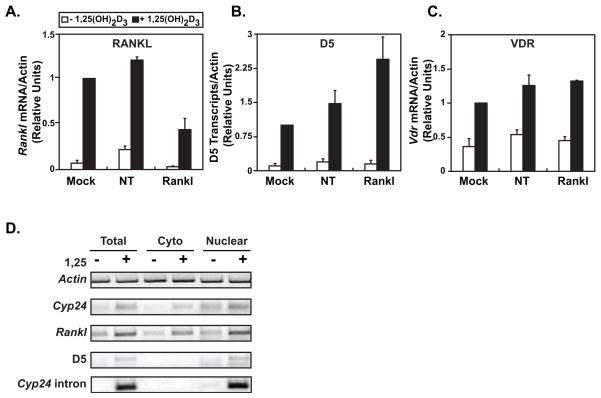
RANKL is a stromal cell-derived tumor necrosis factor (TNF)-like factor that plays a primary role in osteoclast formation and function. Recent studies suggest that 1,25(OH)(2) D(3) induces Rankl expression via vitamin D receptor (VDR) interaction at several enhancers located up to 76 kb upstream of the gene's transcriptional start site (TSS). In the current studies, we explored these interactions further using ChIP-chip and RNA analysis. We confirm VDR and RXR binding to the five enhancers described previously and identify two additional sites, one located within the Rankl coding region. We also show that RNA polymerase II is recruited to these enhancers, most likely through transcription factors TBP, TFIIB, and TAF(II) 250. Interestingly, the recruitment of these factors leads to the production of RNA transcripts, although their role at present is unknown. We also discovered that histone H4 acetylation (H4ac) marks many upstream Rankl enhancers under basal conditions and that H4ac is increased upon 1,25(OH)(2) D(3) treatment. Surprisingly, the hormone also induces C/EBPβ binding across the Rankl locus. C/EBPβ binding correlates directly with increased H4ac activity following 1,25(OH)(2) D(3) treatment. Finally, elevated H4ac is restricted to an extended region located between two potential insulator sites occupied by CTCF and Rad21. These data suggest a mechanism whereby 1,25(OH)(2) D(3) functions via the VDR and C/EBPβ to upregulate Rankl expression.
RANKL 是一种基质细胞衍生的肿瘤坏死因子(TNF)样因子,在破骨细胞的形成和功能中起着主要作用。最近的研究表明,1,25(OH)(2)D(3) 通过维生素 D 受体(VDR)与位于基因转录起始位点(TSS)上游多达 76kb 的几个增强子相互作用,诱导 Rankl 表达。在目前的研究中,我们使用 ChIP-chip 和 RNA 分析进一步探讨了这些相互作用。我们证实了 VDR 和 RXR 与之前描述的五个增强子结合,并确定了另外两个位点,其中一个位于 Rankl 编码区内。我们还表明,RNA 聚合酶 II 被招募到这些增强子上,很可能是通过 TBP、TFIIB 和 TAF(II)250 等转录因子。有趣的是,这些因子的募集导致 RNA 转录本的产生,尽管它们目前的作用尚不清楚。我们还发现,组蛋白 H4 乙酰化(H4ac)在基础条件下标记许多 Rankl 上游增强子,并且 1,25(OH)(2)D(3) 处理后 H4ac 增加。令人惊讶的是,该激素还诱导 C/EBPβ 在 Rankl 基因座上结合。C/EBPβ 结合与 1,25(OH)(2)D(3) 处理后 H4ac 活性的增加直接相关。最后,升高的 H4ac 仅限于位于由 CTCF 和 Rad21 占据的两个潜在绝缘子位点之间的扩展区域。这些数据表明,1,25(OH)(2)D(3) 通过 VDR 和 C/EBPβ 上调 Rankl 表达的机制。