Department of Chemistry, University of California, Riverside, CA 92521, USA.
J Am Soc Mass Spectrom. 2011 Mar;22(3):399-407. doi: 10.1007/s13361-010-0042-3. Epub 2011 Jan 15.
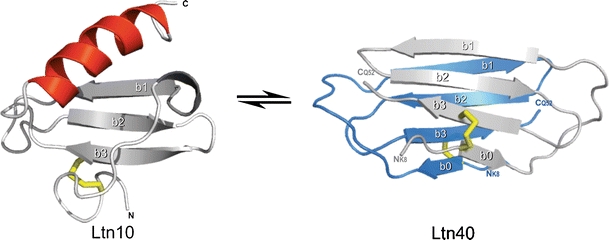
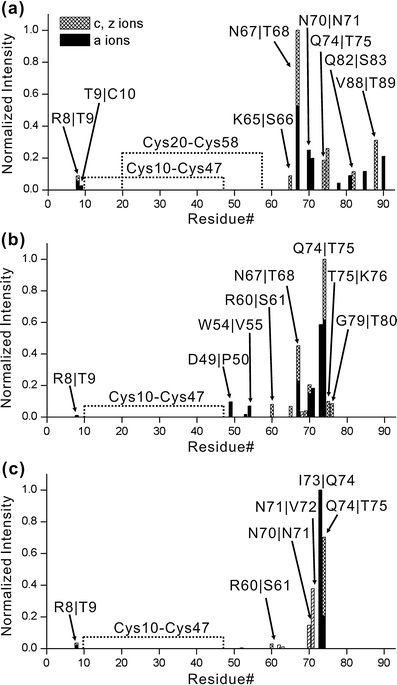
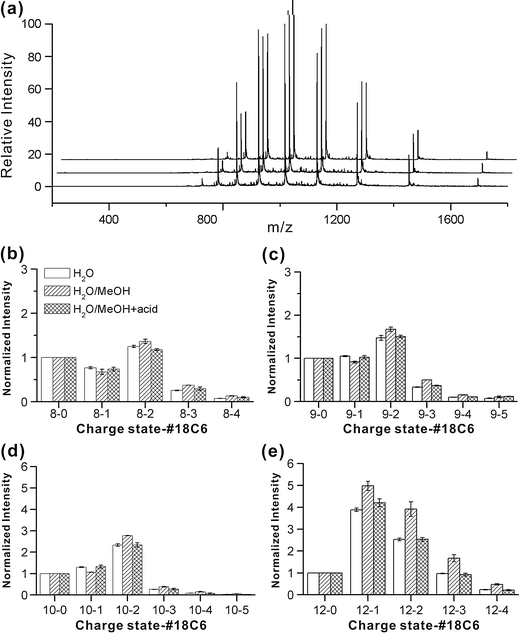
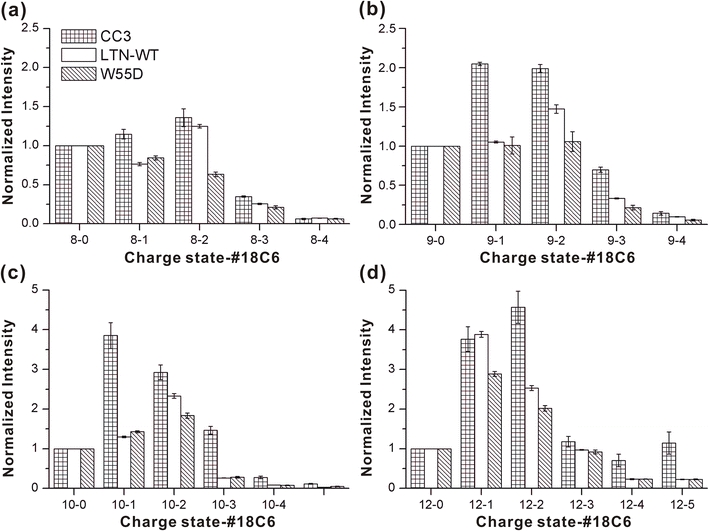
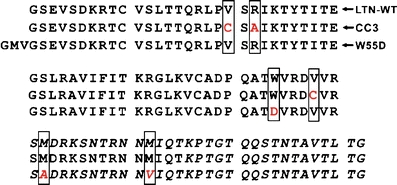
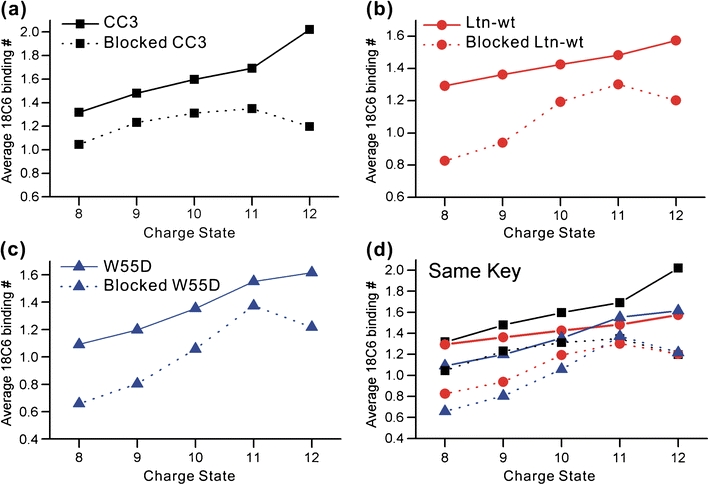
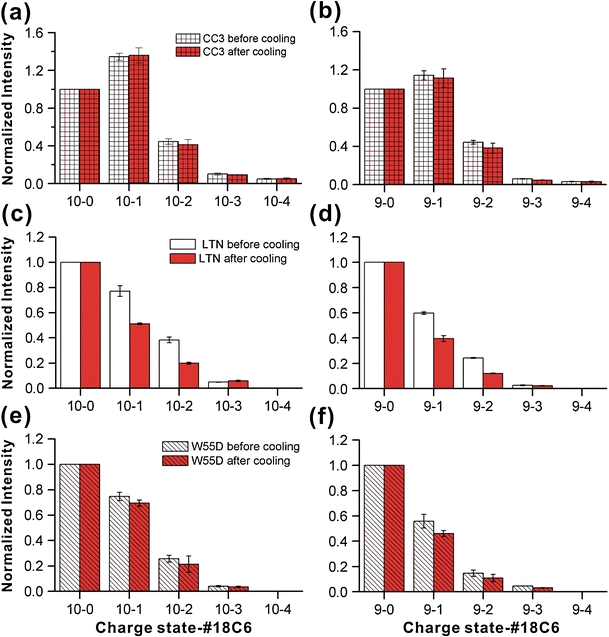
The human chemokine lymphotactin (Ltn) is a remarkable protein that interconverts between two unrelated native state structures in the condensed phase. It is possible to shift the equilibrium toward either conformation with selected sequence substitutions. Previous results have shown that a disulfide-stabilized variant preferentially adopts the canonical chemokine fold (Ltn10), while a single amino acid change (W55D) favors the novel Ltn40 dimeric structure. Selective noncovalent adduct protein probing (SNAPP) is a recently developed method for examining solution phase protein structure. Herein, it is demonstrated that SNAPP can easily recognize and distinguish between the Ltn10 and Ltn40 states of lymphotactin in aqueous solution. The effects of organic denaturants, acid, and disulfide bond reduction and blocking were also examined using SNAPP for the CC3, W55D, and wild type proteins. Only disulfide reduction was shown to significantly perturb the protein, and resulted in considerably decreased adduct formation consistent with loss of tertiary/secondary structure. Cold denaturation experiments demonstrated that wild-type Ltn is the most temperature sensitive of the three proteins. Examination of the higher charge states in all experiments, which are presumed to represent transition state structures between Ltn-10 and Ltn-40, reveals increased 18C6 attachment relative to the more folded structures. This observation is consistent with increased competitive intramolecular hydrogen bonding, which may guide the transition. Experiments examining the gas phase structures revealed that all three proteins can be structurally distinguished in the gas phase. In addition, the gas phase experiments enabled identification of preferred adduct binding sites.
人源趋化因子淋蛋白(Ltn)是一种非常独特的蛋白,它在凝聚相中可以在两种不相关的天然结构之间转换。通过选择特定的序列取代,可以使平衡向任一构象移动。先前的结果表明,二硫键稳定的变体优先采用经典趋化因子折叠(Ltn10),而单个氨基酸的改变(W55D)有利于新型 Ltn40 二聚体结构。选择性非共价加合物蛋白探测(SNAPP)是一种最近开发的用于检查溶液相蛋白结构的方法。本文证明,SNAPP 可以轻松识别和区分淋巴蛋白在水溶液中的 Ltn10 和 Ltn40 状态。还使用 SNAPP 研究了有机溶剂变性剂、酸、二硫键还原和阻断对 CC3、W55D 和野生型蛋白的影响。只有二硫键还原被证明会显著扰乱蛋白,并且导致与三级/二级结构丧失一致的加合物形成显著减少。冷变性实验表明野生型 Ltn 是三种蛋白中最敏感的。在所有实验中检查较高的电荷状态,这些状态被认为代表 Ltn-10 和 Ltn-40 之间的过渡态结构,相对于更折叠的结构,发现 18C6 附着增加。这一观察结果与增加的竞争分子内氢键一致,这可能指导过渡。检查气相结构的实验表明,在气相中可以区分所有三种蛋白质的结构。此外,气相实验能够确定首选的加合物结合位点。