University of Salzburg, Department of Physiological Psychology, Austria.
Brain Res Bull. 2011 Jul 15;85(6):417-23. doi: 10.1016/j.brainresbull.2011.03.025. Epub 2011 Apr 5.
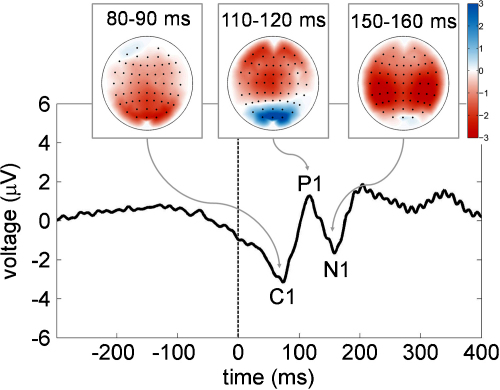
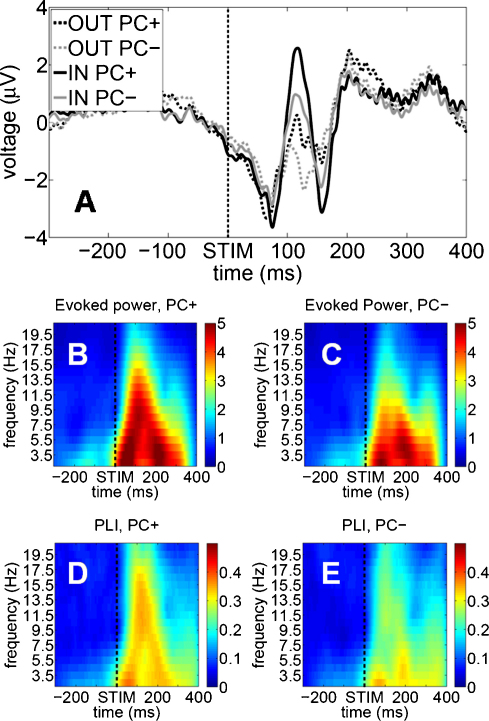
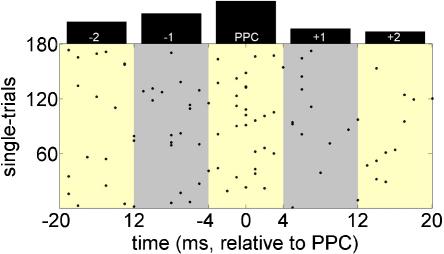
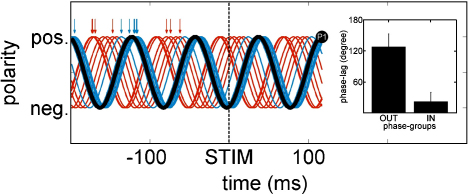
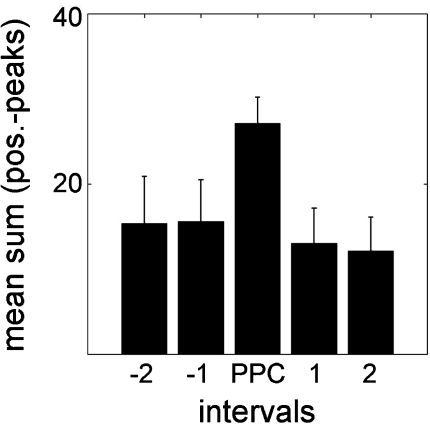
Since years there is a hotly discussed dispute whether event-related potentials are either generated by an evoked component or by resetting of ongoing phase. We argue that phase-reset must not be proven in order to accept the general involvement of phase in ERP-generation as it is only one of several possible mechanisms influencing or generating certain ERP-components. Supporting data are presented showing that positive peaks of ongoing pre-stimulus alpha activity are not randomly distributed in time across trials. Most importantly, we found that a certain kind of pre-stimulus phase concentration that represents a continuous development of an alpha wave up to the time window where the P1 is generated is associated with an enlarged event-related component. We conclude that ongoing oscillations cannot be considered random background noise (even before stimulus onset) and that there are probably more phase-mechanisms that can contribute to the ERP-generation.
多年来,人们一直在激烈争论事件相关电位是由诱发成分产生的,还是由正在进行的相位重置产生的。我们认为,为了接受相位在 ERP 产生中的普遍作用,不必证明相位重置,因为它只是影响或产生某些 ERP 成分的几种可能机制之一。本文提供了支持性数据,表明在试验中,正在进行的刺激前阿尔法活动的正峰并不是随机分布在时间上的。最重要的是,我们发现,在 P1 产生的时间窗口之前,代表阿尔法波连续发展的某种预刺激相位集中与扩大的事件相关成分有关。我们的结论是,正在进行的振荡不能被视为随机背景噪声(甚至在刺激开始之前),可能还有更多的相位机制可以有助于 ERP 的产生。