Department of Medical Physics, University of Wisconsin-Madison, 1111 Highland Avenue, Madison, WI 53705, USA.
Ultrasonics. 2011 Aug;51(6):758-67. doi: 10.1016/j.ultras.2011.03.004. Epub 2011 Mar 23.
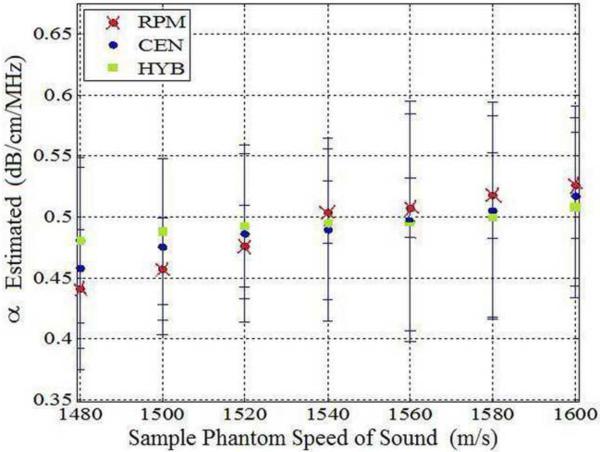
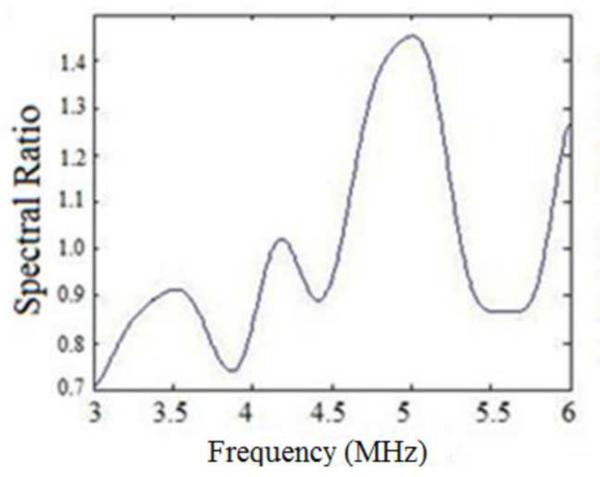
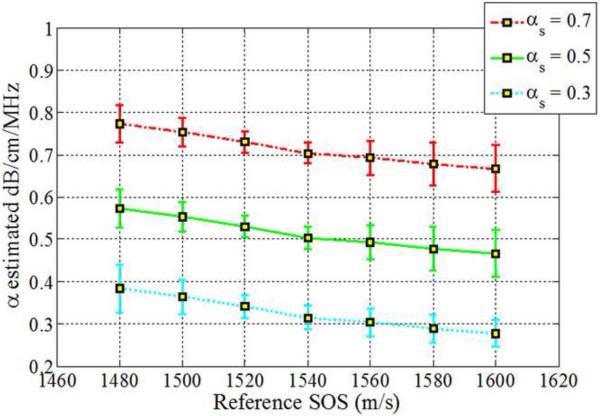
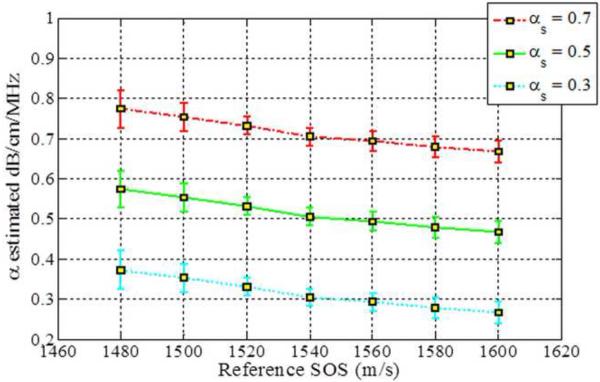
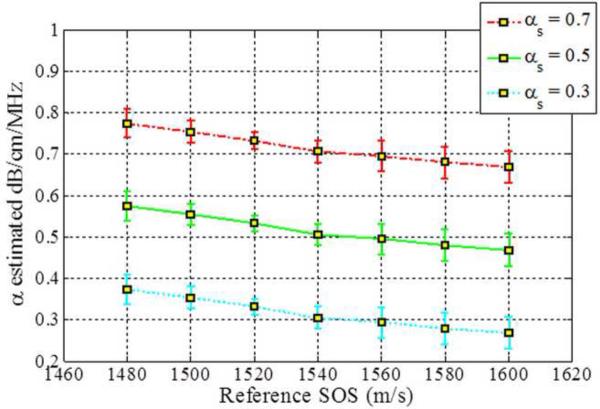
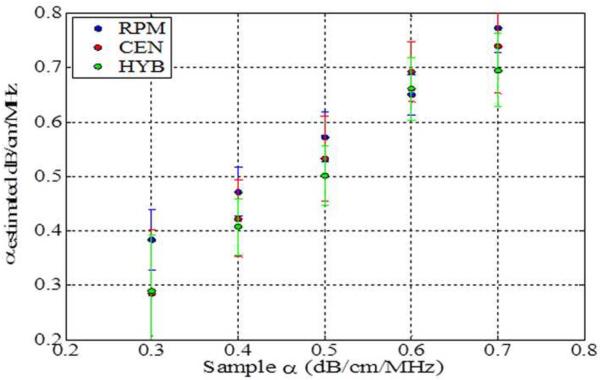
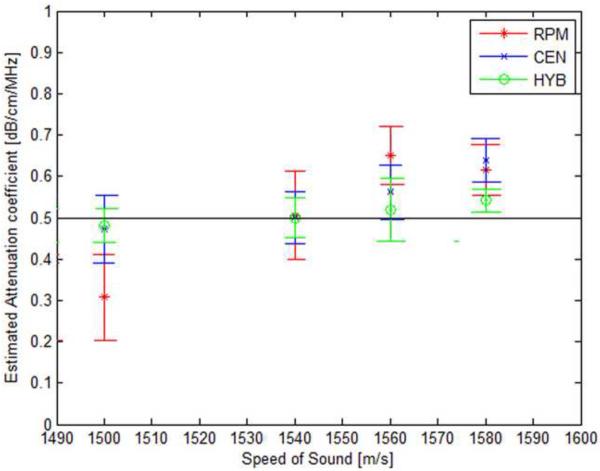
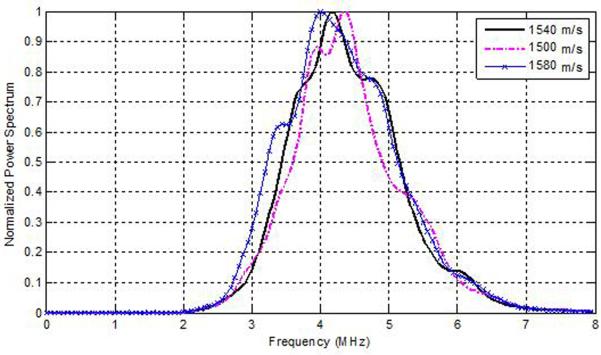
Quantitative ultrasound features such as the attenuation slope, sound speed and scatterer size, have been utilized to evaluate pathological variations in soft tissues such as the liver and breast. However, the impact of variations in the sound speed and backscatter due to underlying fat content or fibrotic changes, on the attenuation slope has not been addressed. Both numerical and acoustically uniform tissue-mimicking experimental phantoms are used to demonstrate the impact of sound speed variations on attenuation slope using clinical real-time ultrasound scanners equipped with linear array transducers. Radiofrequency data at center frequencies of 4 and 5 MHz are acquired for the experimental and numerical phantoms respectively. Numerical phantom sound speeds between 1480 and 1600 m/s in increments of 20 m/s for attenuation coefficients of 0.3, 0.4, 0.5, 0.6, and 0.7 dB/cm/MHz are simulated. Variations in the attenuation slope when the backscatter intensity of the sample is equal, 3 dB higher, and 3 dB lower than the reference is also evaluated. The sound speed for the experimental tissue-mimicking phantoms were 1500, 1540, 1560 and 1580 m/s respectively, with an attenuation coefficient of 0.5 dB/cm/MHz. Radiofrequency data is processed using three different attenuation estimation algorithms, i.e. the reference phantom, centroid downshift, and a hybrid method. In both numerical and experimental phantoms our results indicate a bias in attenuation slope estimates when the reference phantom sound speed is higher (overestimation) or lower (underestimation) than that of the sample. This bias is introduced via a small spectral shift in the normalized power spectra of the reference and sample with different sound speeds. The hybrid method provides the best estimation performance, especially for sample attenuation coefficient values lower than that of the reference phantom. The performance of all the methods deteriorates when the attenuation coefficient of the reference phantom is lower than that of the sample. In addition, the hybrid method is the least sensitive to sample backscatter intensity variations.
定量超声特征,如衰减斜率、声速和散射体大小,已被用于评估肝脏和乳房等软组织的病理变化。然而,由于基础脂肪含量或纤维化变化导致的声速和背散射的变化对衰减斜率的影响尚未得到解决。本研究使用数值和声学均匀的组织模拟实验体模,使用配备线性阵列换能器的临床实时超声扫描仪来演示声速变化对衰减斜率的影响。分别采集实验体模和数值体模的中心频率为 4 和 5 MHz 的射频数据。数值体模的声速在 1480 到 1600 m/s 之间,步长为 20 m/s,衰减系数分别为 0.3、0.4、0.5、0.6 和 0.7 dB/cm/MHz。还评估了当样品的背散射强度相等、高 3dB 和低 3dB 时,衰减斜率的变化。实验组织模拟体模的声速分别为 1500、1540、1560 和 1580 m/s,衰减系数为 0.5 dB/cm/MHz。使用三种不同的衰减估计算法(参考体模、质心下移和混合方法)对射频数据进行处理。在数值体模和实验体模中,我们的结果表明,当参考体模声速高于(高估)或低于(低估)样品声速时,衰减斜率估计会出现偏差。这种偏差是通过具有不同声速的参考和样品的归一化功率谱的小谱移引入的。混合方法提供了最佳的估计性能,特别是对于样品衰减系数值低于参考体模的情况。当参考体模的衰减系数低于样品时,所有方法的性能都会恶化。此外,混合方法对样品背散射强度变化的敏感性最低。