Primary Care Research Unit of Bizkaia, Basque Healthcare Service, Bilbao, Spain.
PLoS One. 2011 Mar 29;6(3):e18363. doi: 10.1371/journal.pone.0018363.
We evaluate the effectiveness of a physical activity promotion programme carried out by general practitioners with inactive patients in routine care.
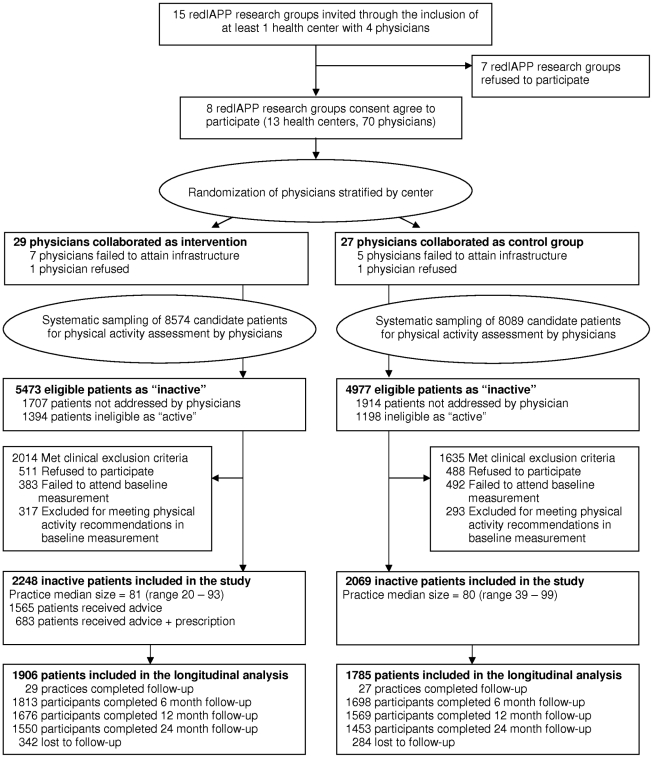
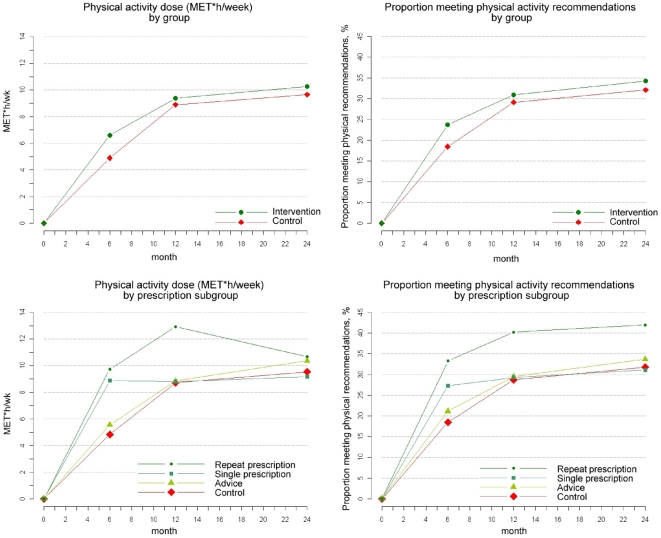
Pragmatic, cluster randomised clinical trial conducted in eleven public primary care centres in Spain. Fifty-six general practitioners (GPs) were randomly assigned to intervention (29) or standard care (27) groups. They assessed the physical activity level of a systematic sample of patients in routine practice and recruited 4317 individuals (2248 intervention and 2069 control) who did not meet minimum physical activity recommendations. Intervention GPs provided advice to all patients and a physical activity prescription to the subgroup attending an additional appointment (30%). A third of these prescriptions were opportunistically repeated. Control GPs provided standard care. Primary outcome measure was the change in self-reported physical activity from baseline to six, 12 and 24 months. Secondary outcomes included cardiorespiratory fitness and health-related quality of life. A total of 3691 patients (85%) were included in the longitudinal analysis and overall trends over the whole 24 month follow-up were significantly better in the intervention group (p<0.01). The greatest differences with the control group were observed at six months (adjusted difference 1.7 MET*hr/wk [95% CI, 0.8 to 2.6], 25 min/wk [95% CI, 11.3 to 38.4], and a 5.3% higher percentage of patients meeting minimum recommendations [95% CI: 2.1% to 8.8%] NNT = 19). These differences were not statistically significant at 12 and 24 months. No differences were found in secondary outcomes. A significant difference was maintained until 24 months in the proportion of patients achieving minimum recommendation in the subgroup that received a repeat prescription (adjusted difference 10.2%, 95% CI 1.5% to 19.4%).
General practitioners are effective at increasing the level of physical activity among their inactive patients during the initial six-months of an intervention but this effect wears off at 12 and 24 months. Only in the subgroup of patients receiving repeat prescriptions of physical activity is the effect maintained in long-term.
clinicaltrials.gov NCT00131079.
我们评估了在常规护理中由全科医生对不活跃患者进行的身体活动促进计划的有效性。
这是一项在西班牙 11 个公共初级保健中心进行的实用、集群随机临床试验。56 名全科医生(GP)被随机分配到干预组(29 名)或标准护理组(27 名)。他们在常规实践中评估了系统抽样患者的身体活动水平,并招募了 4317 名不符合最低身体活动建议的个体(干预组 2248 名,对照组 2069 名)。干预组的 GP 为所有患者提供建议,并为参加额外预约(30%)的亚组开出身体活动处方。这些处方中有三分之一是偶然重复的。对照组的 GP 提供标准护理。主要结局测量是从基线到 6、12 和 24 个月时自我报告的身体活动的变化。次要结局包括心肺健康和健康相关生活质量。共有 3691 名患者(85%)纳入纵向分析,整个 24 个月的随访总体趋势在干预组明显更好(p<0.01)。与对照组相比,最大的差异出现在 6 个月时(调整差异 1.7 MET*hr/wk [95% CI,0.8 至 2.6],25 min/wk [95% CI,11.3 至 38.4],以及满足最低建议的患者百分比提高 5.3%[95% CI:2.1%至 8.8%],NNT = 19)。在 12 个月和 24 个月时,这些差异无统计学意义。次要结局无差异。在接受重复处方的亚组中,达到最低推荐标准的患者比例在 24 个月时仍保持显著差异(调整差异 10.2%,95% CI 1.5%至 19.4%)。
全科医生在干预的最初 6 个月内有效地提高了不活跃患者的身体活动水平,但这种效果在 12 个月和 24 个月时会减弱。只有在接受身体活动重复处方的亚组中,这种效果才能在长期内保持。
clinicaltrials.gov NCT00131079。