Institute of Biology/Geobotany and Botanical Garden, Martin Luther University Halle-Wittenberg, Halle, Germany.
PLoS One. 2011 Mar 29;6(3):e17580. doi: 10.1371/journal.pone.0017580.
Soil biota effects are increasingly accepted as an important driver of the abundance and distribution of plants. While biogeographical studies on alien invasive plant species have indicated coevolution with soil biota in their native distribution range, it is unknown whether adaptation to soil biota varies among populations within the native distribution range. The question of local adaptation between plants and their soil biota has important implications for conservation of biodiversity and may justify the use of seed material from local provenances in restoration campaigns.
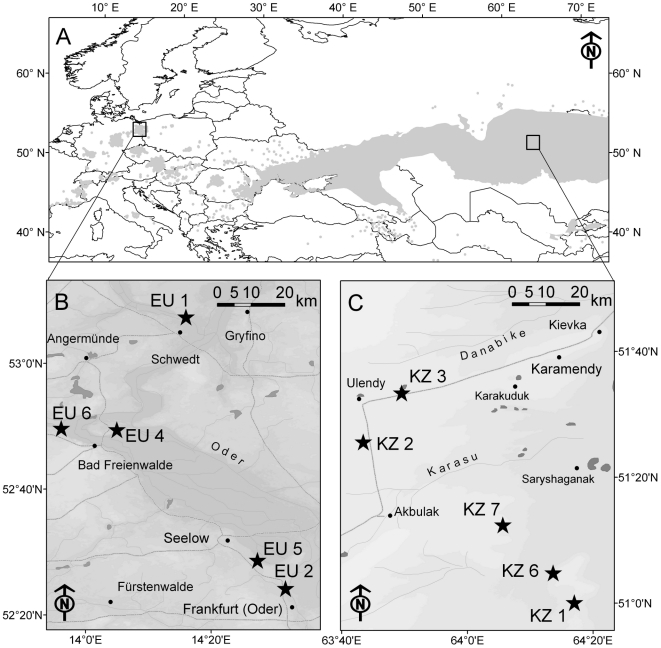
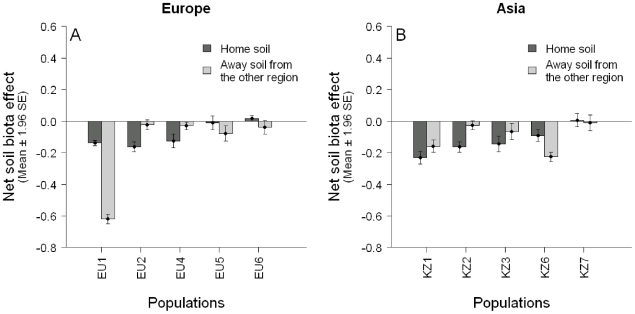
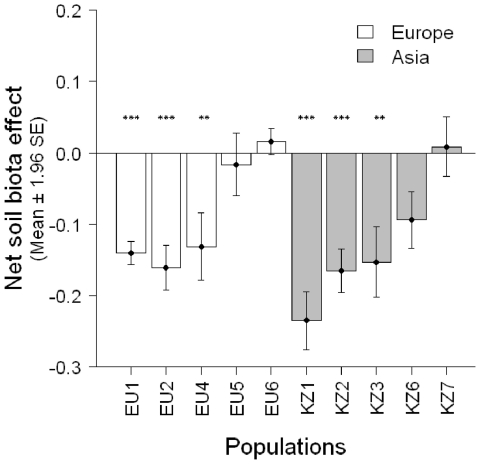
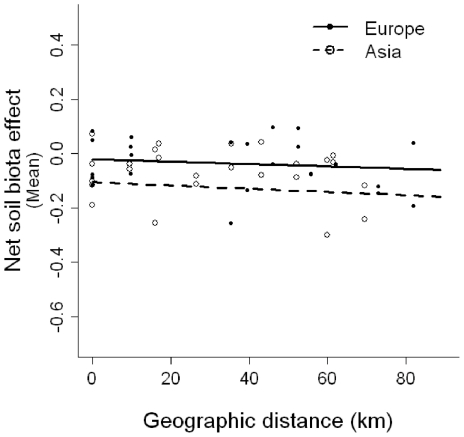
METHODOLOGY/PRINCIPAL FINDINGS: We studied soil biota effects in ten populations of the steppe grass Stipa capillata from two distinct regions, Europe and Asia. We tested for local adaptation at two different scales, both within (ca. 10-80 km) and between (ca. 3300 km) regions, using a reciprocal inoculation experiment in the greenhouse for nine months. Generally, negative soil biota effects were consistent. However, we did not find evidence for local adaptation: both within and between regions, growth of plants in their 'home soil' was not significantly larger relative to that in soil from other, more distant, populations.
CONCLUSIONS/SIGNIFICANCE: Our study suggests that negative soil biota effects can prevail in different parts of a plant species' range. Absence of local adaptation points to the possibility of similar rhizosphere biota composition across populations and regions, sufficient gene flow to prevent coevolution, selection in favor of plasticity, or functional redundancy among different soil biota. From the point of view of plant--soil biota interactions, our findings indicate that the current practice of using seeds exclusively from local provenances in ecosystem restoration campaigns may not be justified.
土壤生物群系的影响正逐渐被认为是植物丰度和分布的重要驱动因素。虽然关于外来入侵植物物种的生物地理学研究表明,它们在原生分布范围内与土壤生物群系共同进化,但在原生分布范围内,种群对土壤生物群系的适应是否存在差异尚不清楚。植物与其土壤生物群之间的局部适应问题对生物多样性的保护具有重要意义,并且可能证明在恢复活动中使用来自当地起源的种子材料是合理的。
方法/主要发现:我们研究了来自欧洲和亚洲两个不同地区的 10 个草原草种 Stipa capillata 种群的土壤生物群系效应。我们使用温室中的互惠接种实验进行了为期九个月的研究,在两个不同尺度上测试了局部适应,一个是在内部(约 10-80 公里),另一个是在外部(约 3300 公里)。一般来说,土壤生物群系的负面影响是一致的。然而,我们没有发现局部适应的证据:无论是在内部还是在外部地区,植物在“本土土壤”中的生长相对于来自其他更遥远种群的土壤并没有显著增加。
结论/意义:我们的研究表明,负向的土壤生物群系效应可能在植物物种分布范围的不同部分占主导地位。缺乏局部适应表明,在不同的种群和地区,根际生物群系的组成可能相似,基因流充足以防止共同进化,选择有利于可塑性,或者不同的土壤生物群系之间存在功能冗余。从植物-土壤生物群系相互作用的角度来看,我们的研究结果表明,在生态系统恢复活动中仅使用来自当地起源的种子的当前做法可能没有道理。