Orthopedic Research Center Amsterdam, Department of Orthopedic Surgery, Academic Medical Center, Meibergdreef 9, 1105 AZ Amsterdam, The Netherlands.
Knee Surg Sports Traumatol Arthrosc. 2011 Nov;19(11):1948-54. doi: 10.1007/s00167-011-1495-z. Epub 2011 Apr 9.
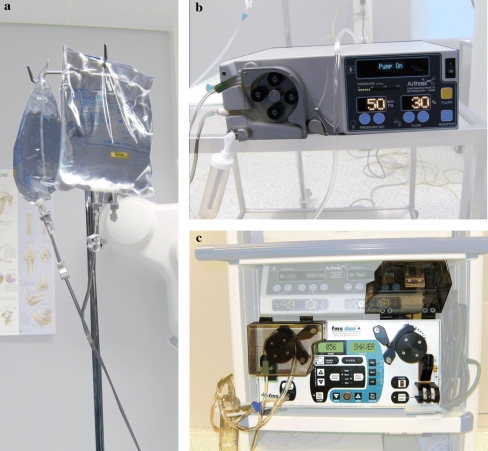
During arthroscopies, bleeding episodes occur as a result of tissue damage. Irrigation systems assist in minimizing these disturbances. The performance of three arthroscopic irrigation systems in clearing bleeding episodes was evaluated objectively.
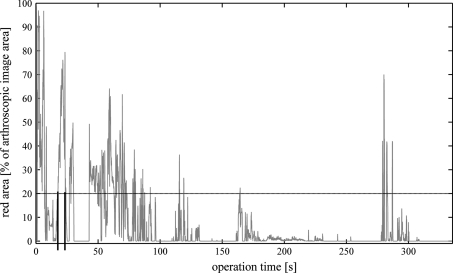
One surgeon performed 99 shoulder arthroscopies using three irrigation systems: gravity infusion, single roller, and double roller pump. The three irrigation systems groups were matched postoperatively for type of surgery-acromioplasty, SLAP, release, rotator cuff repair and capsule repair, and operation duration. The recorded arthroscopies were analyzed for the presence of bleeding episodes with a special computer program that automatically detects the tinctures of red-colored blood. A least 20% of an arthroscopic image had to be covered with blood to qualify as bleeding episode.
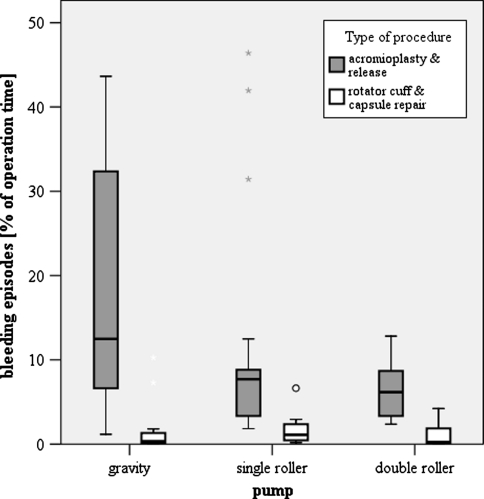
The median (min-max) presence of bleeding episodes as a percentage of the operation time was 6.6% (0.0-43.6%) for gravity infusion, 3.7% (0.2-46.4%) for the single roller, and 3.3% (0.0-19.3%) for the double roller pump, respectively. The large variation could be attributed to the occurrence of arterial bleeding episodes during some procedures. No significant differences were found between the irrigation systems. For a subgroup including acromioplasties and releases, significant differences were found in favor of both roller pumps (P < 0.05).
Overall, the roller pumps did not outperform gravity infusion. However, from the results, high-risk procedures for bleeding episodes were identified (acromioplasty and release of a frozen shoulder) that can benefit from the use of roller pumps. A clear view is essential to perform an arthroscopic procedure safely and efficiently.
在关节镜检查过程中,由于组织损伤会发生出血事件。冲洗系统有助于最大限度地减少这些干扰。客观评估了三种关节镜冲洗系统清除出血事件的性能。
一名外科医生使用三种冲洗系统(重力输注、单滚和双滚泵)进行了 99 例肩部关节镜检查。术后根据手术类型(肩峰成形术、SLAP、松解术、肩袖修复和囊修复术)和手术持续时间对三组冲洗系统进行匹配。使用专门的计算机程序分析记录的关节镜检查是否存在出血事件,该程序自动检测红色血液的色调。只有当至少 20%的关节镜图像被血液覆盖时,才能将其视为出血事件。
重力输注、单滚和双滚泵的中位(最小-最大)出血事件发生率分别为手术时间的 6.6%(0.0-43.6%)、3.7%(0.2-46.4%)和 3.3%(0.0-19.3%)。这种大的差异可以归因于在某些手术中发生的动脉出血事件。三种冲洗系统之间没有发现显著差异。对于包括肩峰成形术和松解术的亚组,发现两种滚泵均有显著优势(P < 0.05)。
总体而言,滚泵并没有优于重力输注。然而,从结果中可以确定,对于容易发生出血事件的高风险手术(肩峰成形术和冻结肩松解术),使用滚泵可能会受益。清晰的视野对于安全有效地进行关节镜手术至关重要。