Tuijthof G J M, van den Boomen H, van Heerwaarden R J, van Dijk C N
Department of Orthopedic Surgery, Academic Medical Centre, Meibergdreef 9, 1105 AZ, Amsterdam, The Netherlands.
Knee Surg Sports Traumatol Arthrosc. 2008 Jun;16(6):590-4. doi: 10.1007/s00167-008-0513-2. Epub 2008 Mar 6.
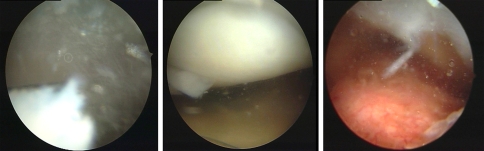
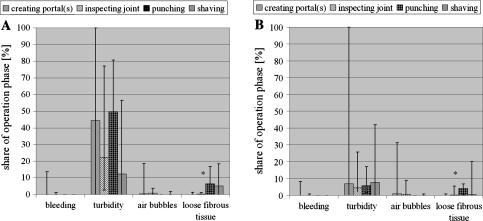
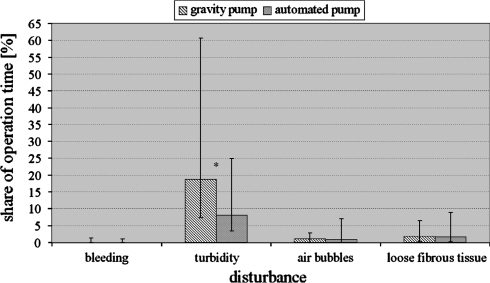
The effectiveness of arthroscopic pump systems has been investigated with either subjective measures or measures that were unrelated to the image quality. The goal of this study is to determine the performance of an automated pump in comparison to a gravity pump based on objective assessment of the quality of the arthroscopic view. Ten arthroscopic operations performed with a gravity pump and ten performed with an automated pump (FMS Duo system) were matched on duration of the surgery and shaver usage, type of operation, and surgical experience. Quality of the view was defined by means of the presence or absence of previously described definitions of disturbances (bleeding, turbidity, air bubbles, and loose fibrous tissue). The percentage of disturbances for all operations was assessed with a time-disturbance analysis of the recorded operations. The Mann-Whitney U test shows a significant difference in favor of the automated pump for the presence of turbidity only (Exact Sig. [2*(1-tailed Sig.)] = 0.015). Otherwise, no differences were determined (Exact Sig. [2*(1-tailed Sig.)] > 0.436). A new objective method is successfully applied to assess efficiency of pump systems based on the quality of the arthroscopic view. Important disturbances (bleeding, air bubbles, and loose fibrous tissue) are not reduced by an automated pump used in combination with a tourniquet. The most frequent disturbance turbidity is reduced by around 50%. It is questionable if this result justifies the use of an automated pump for straightforward arthroscopic knee surgeries using a tourniquet.
关节镜泵系统的有效性已经通过主观测量方法或与图像质量无关的测量方法进行了研究。本研究的目的是基于对关节镜视野质量的客观评估,确定自动泵与重力泵相比的性能。对10例使用重力泵进行的关节镜手术和10例使用自动泵(FMS Duo系统)进行的关节镜手术,在手术持续时间、刨削器使用情况、手术类型和手术经验方面进行了匹配。视野质量通过是否存在先前描述的干扰定义(出血、浑浊、气泡和疏松纤维组织)来定义。通过对记录的手术进行时间干扰分析,评估所有手术中干扰的百分比。曼-惠特尼U检验显示,仅在浑浊情况方面,自动泵具有显著优势(精确显著性[2×(单尾显著性)] = 0.015)。否则,未发现差异(精确显著性[2×(单尾显著性)] > 0.436)。一种基于关节镜视野质量评估泵系统效率的新的客观方法被成功应用。与止血带联合使用的自动泵并不能减少重要干扰(出血、气泡和疏松纤维组织)。最常见的干扰——浑浊减少了约50%。对于在使用止血带的简单关节镜膝关节手术中使用自动泵,这一结果是否合理仍值得怀疑。