Vetterli Laurène, Maechler Pierre
Department of Cell Physiology and Metabolism, University of Geneva Medical Center, Geneva, Switzerland.
Aging (Albany NY). 2011 Apr;3(4):444-9. doi: 10.18632/aging.100304.
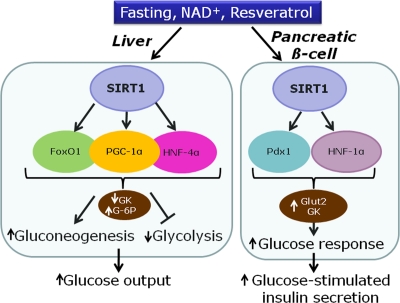
Sirtuins are energy sensors which mediate effects of calorie restriction-induced lifespan extension. The mammalian sirtuin homolog SIRT1 is a protein deacetylase playing a central role in metabolic homeostasis. SIRT1 is one of the targets of resveratrol, a polyphenol that has been shown to increase lifespan and to protect animal models against high-calorie diet induced obesity and insulin resistance. The beneficial effects of resveratrol mediated by SIRT1 activation can be contributed by different organs. Among them, the liver and pancreatic β-cells have been shown to be responsive to resveratrol in a SIRT1-dependent manner. Downstream of SIRT1, transcription factors being activated are tissue-specific, in turn inducing expression of metabolic genes in an apparent paradoxical way. In this review, we discuss specificities of SIRT1 effects in the liver versus pancreatic β-cells, ultimately converging towards metabolic homeostasis at the organism level.
沉默调节蛋白是能量传感器,可介导热量限制诱导的寿命延长效应。哺乳动物沉默调节蛋白同源物SIRT1是一种蛋白质脱乙酰酶,在代谢稳态中起核心作用。SIRT1是白藜芦醇的靶点之一,白藜芦醇是一种多酚,已被证明可延长寿命,并保护动物模型免受高热量饮食诱导的肥胖和胰岛素抵抗。SIRT1激活介导的白藜芦醇的有益作用可由不同器官促成。其中,肝脏和胰腺β细胞已被证明以SIRT1依赖的方式对白藜芦醇有反应。在SIRT1的下游,被激活的转录因子具有组织特异性,进而以一种明显矛盾的方式诱导代谢基因的表达。在这篇综述中,我们讨论了SIRT1在肝脏和胰腺β细胞中的作用特异性,最终在机体水平上趋向于代谢稳态。