Infection, Immunity and Innovation (i3) Institute, University of Technology Sydney, Sydney, New South Wales, Australia.
PLoS Negl Trop Dis. 2011 Apr 5;5(4):e1012. doi: 10.1371/journal.pntd.0001012.
The temporal expression and secretion of distinct members of a family of virulence-associated cathepsin L cysteine peptidases (FhCL) correlates with the entry and migration of the helminth pathogen Fasciola hepatica in the host. Thus, infective larvae traversing the gut wall secrete cathepsin L3 (FhCL3), liver migrating juvenile parasites secrete both FhCL1 and FhCL2 while the mature bile duct parasites, which are obligate blood feeders, secrete predominantly FhCL1 but also FhCL2.
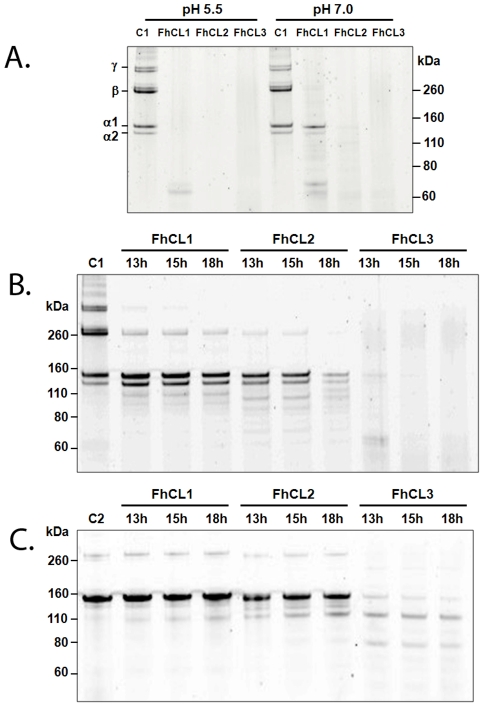
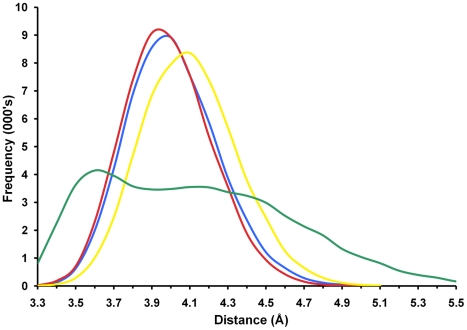
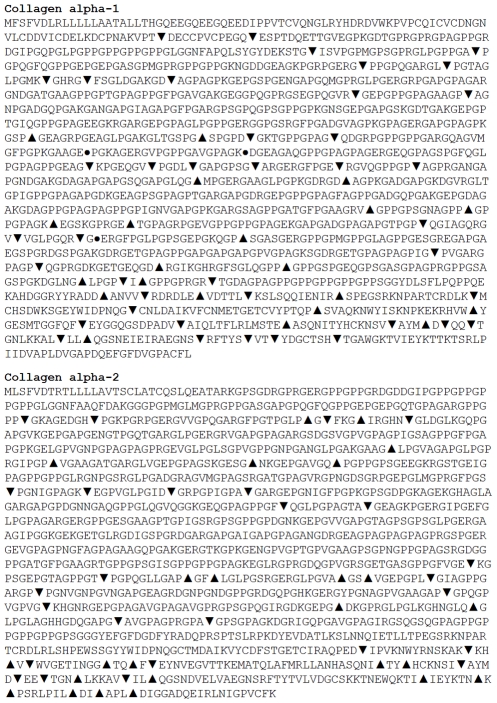
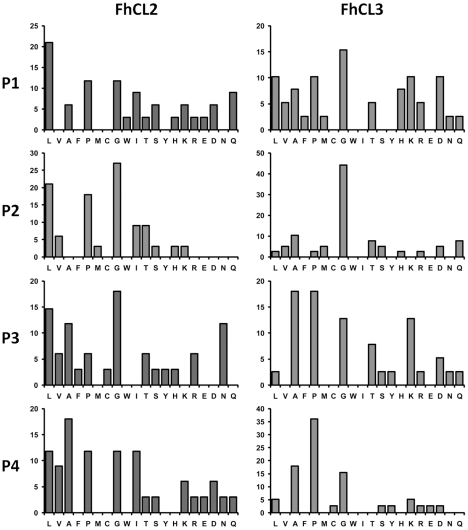
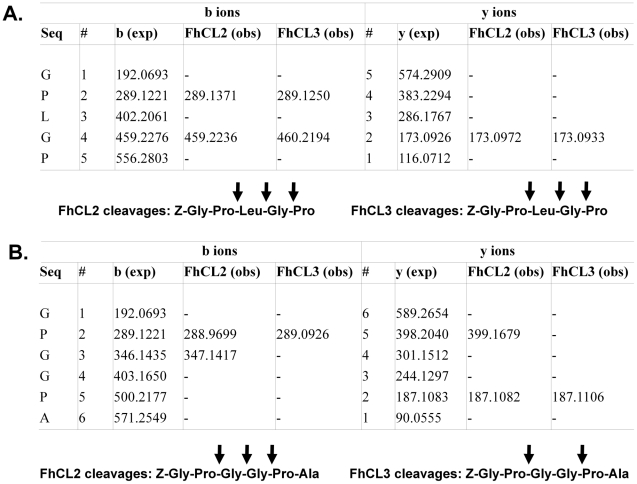
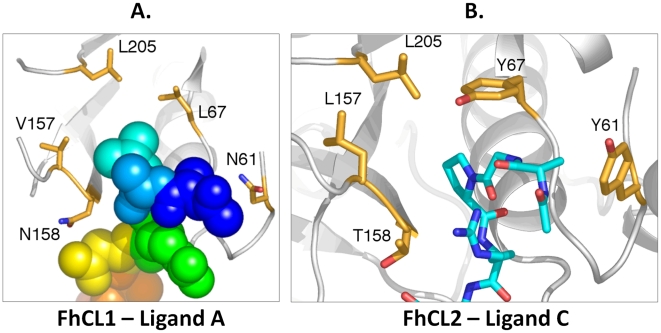
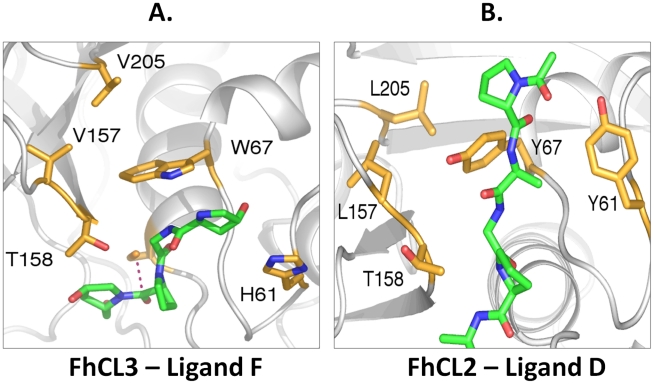
METHODOLOGY/PRINCIPAL FINDINGS: Here we show that FhCL1, FhCL2 and FhCL3 exhibit differences in their kinetic parameters towards a range of peptide substrates. Uniquely, FhCL2 and FhCL3 readily cleave substrates with Pro in the P2 position and peptide substrates mimicking the repeating Gly-Pro-Xaa motifs that occur within the primary sequence of collagen. FhCL1, FhCL2 and FhCL3 hydrolysed native type I and II collagen at neutral pH but while FhCL1 cleaved only non-collagenous (NC, non-Gly-X-Y) domains FhCL2 and FhCL3 exhibited collagenase activity by cleaving at multiple sites within the α1 and α2 triple helix regions (Col domains). Molecular simulations created for FhCL1, FhCL2 and FhCL3 complexed to various seven-residue peptides supports the idea that Trp67 and Tyr67 in the S2 subsite of the active sites of FhCL3 and FhCL2, respectively, are critical to conferring the unique collagenase-like activity to these enzymes by accommodating either Gly or Pro residues at P2 in the substrate. The data also suggests that FhCL3 accommodates hydroxyproline (Hyp)-Gly at P3-P2 better than FhCL2 explaining the observed greater ability of FhCL3 to digest type I and II collagens compared to FhCL2 and why these enzymes cleave at different positions within the Col domains.
CONCLUSIONS/SIGNIFICANCE: These studies further our understanding of how this helminth parasite regulates peptidase expression to ensure infection, migration and establishment in host tissues.
与寄生虫 FhCL 相关的组织蛋白酶 L 半胱氨酸肽酶家族(FhCL)成员的时空表达和分泌与扁形动物病原体 Fasciola hepatica 在宿主中的进入和迁移有关。因此,穿过肠壁的感染性幼虫分泌组织蛋白酶 L3(FhCL3),在肝脏中迁移的幼年寄生虫既分泌 FhCL1 又分泌 FhCL2,而成熟的胆管寄生虫是专性血液寄生虫,主要分泌 FhCL1,但也分泌 FhCL2。
方法/主要发现:在这里,我们表明 FhCL1、FhCL2 和 FhCL3 在其对一系列肽底物的动力学参数方面存在差异。独特的是,FhCL2 和 FhCL3 很容易切割 P2 位置具有 Pro 的底物和模仿胶原蛋白一级序列中出现的重复 Gly-Pro-Xaa 基序的肽底物。FhCL1、FhCL2 和 FhCL3 在中性 pH 下水解天然 I 型和 II 型胶原蛋白,但 FhCL1 仅切割非胶原(NC,非 Gly-X-Y)结构域,而 FhCL2 和 FhCL3 则通过在 α1 和 α2 三螺旋区域(Col 结构域)内的多个位点切割表现出胶原酶活性。为 FhCL1、FhCL2 和 FhCL3 与各种七残基肽形成的复合物创建的分子模拟支持了这样的想法,即 FhCL3 和 FhCL2 的活性位点的 S2 亚位点中的色氨酸 67(Trp67)和酪氨酸 67(Tyr67)分别对赋予这些酶独特的胶原酶样活性至关重要,因为在底物的 P2 位置容纳 Gly 或 Pro 残基。该数据还表明,FhCL3 比 FhCL2 更好地容纳羟脯氨酸(Hyp)-Gly 在 P3-P2 处,解释了 FhCL3 比 FhCL2 更能消化 I 型和 II 型胶原蛋白的原因,以及为什么这些酶在 Col 结构域内的不同位置切割。
结论/意义:这些研究进一步了解了这种寄生虫如何调节肽酶的表达以确保在宿主组织中的感染、迁移和定植。